- A brand that leads in Egypt starts as an unknown in Saudi Arabia; rebuild the positioning against the Saudi shortlist, not the Egyptian one.
- Clear the name three ways before design: SAIP trademark search, the trade name rules and the digital handles.
- Arabic-first means Arabic written for Saudi buyers, not Egyptian copy or a translation of the English.
- Brand name, legal entity, profile and website should tell one consistent story, especially if a regional headquarters is involved.
The decision has been made in Cairo: the company is opening in Saudi Arabia. The board has a budget, someone is reading about investment registration, and a general manager for Riyadh or Jeddah is being interviewed. What nobody has looked at yet is whether the brand that works at home will make sense to a Saudi buyer who has never heard of it.
Egyptian companies are taking this step across sectors. In February 2026 the IT and cybersecurity firm Veibex said it planned to open a regional headquarters in the Kingdom (Sharikat Mubasher). In June, Egyptian Cosmetics Company said it planned to open its first Saudi factory that August (BridgeMena). And Egypt’s chemical and fertiliser exports to Saudi Arabia rose 98% year on year to about $356m in January to August 2026, according to figures from the Export Council for Chemical Industries and Fertilisers reported by Daily News Egypt. The opportunity is real. So is the risk of arriving with a brand built for a different market.
This diagnosis is for the stage before the licence and the first hire. It covers brand readiness only; for the commercial plan after the licence, see our Saudi go-to-market guide. It follows the same order as every RX Diagnosis: the symptoms, the likely causes, how to check each one, and what to fix first.
The symptoms: signs your brand is not ready to travel
Most of these show up in conversations, not in reports. If several sound familiar, the brand work belongs on the expansion plan, not after it.
- Your team cannot say in one sentence why a Saudi buyer should choose you over a local supplier. The answer at home (“we are the established name”) does not travel, because in the new market you are not.
- The company profile is written for Egyptian clients. Its project list, references and certifications all point to Egypt, and the Arabic is the Arabic your Cairo office speaks.
- Nobody has checked whether your name is free in Saudi Arabia. Not as a trademark, not as a trade name, not as a domain or social handle.
- The website has a Cairo phone number, prices in Egyptian pounds or none at all, and no Saudi page. A Saudi visitor has no way of knowing you intend to serve them.
- The Arabic and English materials say different things. One was written, the other translated, and they were updated at different times.
- Your first Saudi meetings end with “send us your profile” and then silence. The material you send is doing less work than the person who sent it.
The likely causes underneath
When a brand fails to cross the border, the cause is usually one of five problems. Each has a different check and a different fix.
| Underlying cause | What it looks like | Where to look first |
|---|---|---|
| Positioning was never rebuilt for the new competitive set | You compete on the strengths that mattered at home against Saudi and international suppliers who already own them | The five companies a Saudi buyer would shortlist instead of you |
| The name and identity are not cleared for the Kingdom | A similar trademark, trade name or handle already exists, or the name reads badly in the local context | The SAIP search engine and the trade name rules |
| Arabic is a translation, not a first language of the brand | Egyptian wording, Cairo-centric examples, English-first layouts with Arabic squeezed in | Your profile and website read aloud by a Saudi colleague |
| Proof is local to Egypt | Every case, client logo and approval refers to the Egyptian market | The evidence section of the profile and website |
| The corporate story does not match the registration | The brand name, legal name and documents tell slightly different stories to buyers and to government portals | Your commercial registration, profile and website “About” page side by side |
In our view, the first and third causes are the hardest to see from inside the company, and the second is the most expensive to discover late.
How to check each one
1. Rebuild the competitive set from a Saudi buyer’s chair
List the companies a procurement manager in Riyadh, Jeddah or Dammam would call if you did not exist. Include Saudi firms, international brands with local agents, and other regional entrants. For each, note what they claim, what proof they show and whether they are visibly present in the Kingdom (address, Saudi phone number, local projects, Arabic content). Then write the sentence a buyer would use to explain why they chose you. If that sentence is “they were cheaper”, the positioning work has not been done.
Being Egyptian is not, by itself, an advantage or a disadvantage. It becomes one depending on how you use it: depth of engineering talent, years of delivery, manufacturing scale and cost structure can all be strengths if they are framed around what the Saudi buyer needs, rather than around where you come from.
2. Clear the name before anything is designed
Three separate checks are needed, and passing one does not mean passing the others.
- Trademark. Trademark rights are territorial, so a registration in Egypt does not by itself protect the name in Saudi Arabia. The Saudi Authority for Intellectual Property (SAIP) offers an IP search engine that covers trademark records, and its trademark pages publish details of applications filed since December 2023. SAIP’s site also links to a list of IP agents who can file on your behalf. Search your name, your logo’s key words and close spellings in both Arabic and English.
- Trade name. Saudi Arabia enacted a new Trade Names Law in January 2025 alongside a new Commercial Registration Law, with implementing regulations issued in March 2025. According to a September 2025 summary by Clyde & Co, trade names may now be reserved or registered in Arabic or English, an English name must carry an Arabic transliteration, and a reservation is valid for 60 days, extendable in justified cases. The similarity criteria it describes go beyond identical spelling, covering for example letters in a different order and numbers or letters pronounced like words. This is a summary, not legal advice: check the current rules with the Ministry of Commerce or a Saudi lawyer before you rely on any of it.
- Digital. Check the .sa domain, the handles you would want on LinkedIn, X, Instagram, Snapchat and TikTok, and the Arabic version of your name in search results. A Saudi company using a near-identical name online is a problem even if your trademark is clear.
Then check meaning. Read the name and tagline aloud with Saudi colleagues or partners. Egyptian colloquial wordplay, abbreviations that only make sense in Cairo, and English names whose Arabic transliteration reads awkwardly are all worth catching now.
3. Read your Arabic as a Saudi buyer would
Ask a Saudi colleague, partner or adviser to read your company profile and homepage aloud and mark every phrase that sounds Egyptian, informal or translated. For most B2B material we would aim for clear Modern Standard Arabic with no dialect at all; for social content and advertising the question of tone is a positioning decision, not a translation one. Check the details too: prices in Saudi riyals, Saudi city names and project locations, and the Saudi riyal symbol, approved on 20 February 2025, which SAMA’s guidance says goes to the left of the numeral with a space between.
Arabic-first does not mean Arabic only. Decision-makers, consultants and procurement teams in the Kingdom often work in both languages, so the English must be equally finished. Our guide to Arabic and English company profile formats covers how to keep the two versions equal.
4. Audit your proof for Saudi relevance
Go through every case study, client logo, certificate and approval in your profile and on your website. Mark each one: relevant to a Saudi buyer, relevant with explanation, or irrelevant. Projects for multinational clients, work to international standards, and any regional or Gulf work usually carry across. Local Egyptian approvals may need a sentence explaining what they prove. If almost nothing survives, the first Saudi projects need to be documented properly as soon as they are delivered, because they will become your strongest sales material.
5. Line up the brand with the legal entity
The Ministry of Investment’s Service Guide (13th edition, March 2026) lists, among the documents for a regular investment registration with a foreign partner, a copy of the foreign partner’s commercial registration and the last fiscal year’s financial statements, both certified by the Saudi Embassy. The same guide lists a Regional Headquarters among its registration categories and says an RHQ may be set up as a company or as a registered branch of a foreign company. These are legal steps for your advisers, but they have a brand consequence: the names on those documents, on your Saudi commercial registration, in your profile and on your website should tell one consistent story about who the company is and how the Saudi entity relates to the Egyptian parent.
If you plan to bid for Saudi government work, this matters more. Under regulations approved in December 2022, Saudi government agencies have since 1 January 2024 been barred from contracting with foreign companies that have no regional headquarters in the Kingdom, with stated exceptions and with works below SAR 1 million excluded, according to Clyde & Co’s analysis of the rules (last updated November 2023; the threshold and exceptions can change). Whether this applies to you is a legal question. Whether your brand architecture can explain a Saudi RHQ, an Egyptian operating company and any sister brands clearly is a marketing one. Confirm the current rules with MISA and your legal advisers.
What to fix first
Not everything has to be finished before the licence. The order matters more than the speed.
- Clear the name. Trademark search, trade name check, domain and handles. If there is a conflict, you want to know before anything else is designed. Of all the steps, this is the one we would least want to see left until later.
- Write the Saudi positioning. One page: who you serve in the Kingdom, who you replace, the reason to choose you, and the proof behind it. Everything else is built from this page. This is the core of our marketing strategy and research work.
- Decide the brand architecture. Same brand as Egypt, an endorsed Saudi version (“X Saudi Arabia”), or a separate name. Then adapt the identity system for Arabic-first use, with a properly drawn Arabic logotype if you do not have one. See our brand identity and positioning service.
- Rebuild the company profile for Saudi buyers. Saudi positioning, Arabic-first, proof selected for relevance, a Saudi contact point, and a clear explanation of the group structure.
- Give the website a Saudi presence. A dedicated section or country version with Saudi contact details, riyal pricing where you publish prices, and Arabic written natively rather than translated. Our article on Arabic and English website structure covers the technical decisions.
- Set up local channels last, but before launch. LinkedIn company page, Saudi-relevant social channels and Google Business Profile for the Saudi address, ready to go live with the announcement.
Same brand, endorsed brand or a new name?
Professional recommendation: answer the rows below in order. The first two are pass-or-fail; the rest decide between the options that survive.
| Question | Same brand as Egypt | Endorsed (“X Saudi Arabia”) | Separate Saudi name |
|---|---|---|---|
| Is the name cleared in the Kingdom (trademark, trade name, handles)? | Required. If the Egyptian name is blocked, this option is gone. | Required for the core name; the country suffix does not cure a conflict. | Only the new name needs clearing, which is why this option often appears after a failed check. |
| Does the name read well aloud in Saudi Arabic? | Must, without explanation. | Must; the suffix can carry the local signal. | Chosen so that it does. |
| Is the Egyptian reputation useful to Saudi buyers? | Best fit when buyers already know the name or the parent’s track record is part of the sale. | Fits when the parent’s experience helps but buyers need to see a committed local company. | Fits when the Egyptian name means nothing in the Kingdom, or carries associations you do not want there. |
| Does it fit the legal structure (Saudi entity, any RHQ, government bidding)? | Works when the Saudi entity carries the same name; check the documents tell one story. | Often maps cleanly onto a Saudi entity that is visibly part of the group. | Needs the clearest explanation of how the Saudi company relates to the Egyptian parent. |
| Can you fund building a second brand? | Lowest extra effort: adapt, do not rebuild. | Moderate: one system, two lock-ups, Saudi-specific materials. | Highest: a full identity, profile, website and launch for a name nobody knows yet. |
Market sizing, partner selection and the regulatory route belong in your wider market-entry plan; our guide to researching a new market covers that side. This list is only the brand work that should sit inside it.
When outside help is worth it
Many companies can run the checks above with their own team and a Saudi partner. An outside view tends to help when the Egyptian brand is strong at home and nobody internally wants to question it, when the group has several brands and the Saudi structure makes the story harder to tell, or when the launch date is fixed and the name, identity, profile and website all have to be ready together.
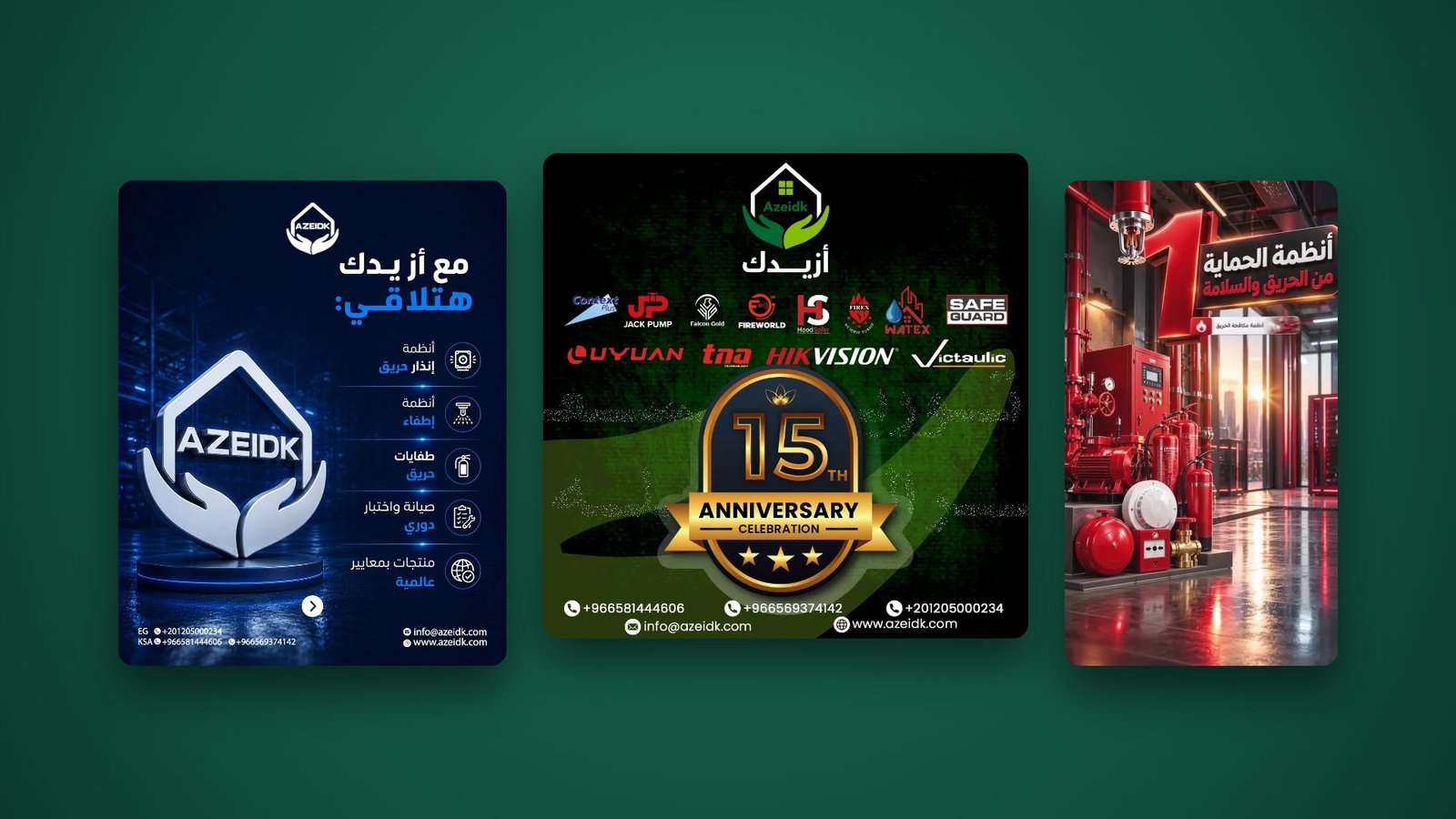
RX Designer works across Saudi Arabia and Egypt as one team for strategy, identity, content and websites. For Azeidk, a contracting and electromechanical company working across Saudi Arabia and Egypt, RX acts as one marketing control centre: one visual and verbal system across social, brand applications, events and sales documents in both markets. Our GCS case study shows a new fire-safety brand’s market entry in the Kingdom, from identity to sales tools.
Run the self-test above first. Bring the answers and your name-check results to a business diagnosis session, and we will turn them into a fix-first list for your launch date.
Frequently asked questions
Does my Egyptian trademark protect my brand name in Saudi Arabia?
Not by itself. Trademark rights are territorial, so search the Saudi register through SAIP's IP search engine and, if the name is clear, file in Saudi Arabia; SAIP's site links to a list of IP agents who can file on your behalf.
Can my Saudi company use an English trade name?
According to a September 2025 Clyde & Co summary of Saudi Arabia's new Trade Names Law and its regulations, trade names may be reserved or registered in Arabic or English, and English names must include an Arabic transliteration. Confirm the current rules with the Ministry of Commerce or a Saudi lawyer.
Should we use the same brand in Saudi Arabia as in Egypt?
Often yes, if the name is legally clear and reads well in Saudi Arabia, but the positioning, proof and Arabic copy usually need rebuilding. An endorsed version or a separate brand makes sense when the name is taken, reads badly, or carries associations that do not help in the new market.
Do we need a regional headquarters in Saudi Arabia?
It depends on your plans. According to Clyde & Co's analysis (last updated November 2023), since 1 January 2024 Saudi government agencies have been restricted, with exceptions and a value threshold, from contracting with foreign companies that have no regional headquarters in the Kingdom. If you plan to bid for government work, take legal advice and check MISA's current rules.
What should a company profile for Saudi buyers include?
Saudi-specific positioning, Arabic written natively alongside equally finished English, proof selected for relevance to Saudi buyers, a Saudi contact point, and a clear explanation of how the Saudi entity relates to the Egyptian parent.
- Sharikat Mubasher, Egypt's Veibex to open regional headquarters in Saudi Arabia (2026-02-11).
- BridgeMena, Egyptian Cosmetics Company to Invest $40 Million and Launch First Saudi Factory (2026-06-19).
- Daily News Egypt, Egypt's chemical exports to Saudi Arabia surge 98% to $356m in 8M 2026 (2026-10-11).
- Saudi Authority for Intellectual Property (SAIP), IP search engine.
- Saudi Authority for Intellectual Property (SAIP), Trademarks.
- Clyde & Co, Saudi Arabia's recently issued Regulations of the Commercial Registration Law and Trade Name Law (2025-09-17).
- Clyde & Co, Saudi Arabia Regional Headquarters Programme: Contracting with government entities (2023-11-23).
- Ministry of Investment, Saudi Arabia, Ministry of Investment Service Guide, 13th edition (2026-03).
- Ministry of Investment, Saudi Arabia, Frequently Asked Questions.
- Saudi Central Bank (SAMA), Saudi Riyal Symbol FAQs.
- Saudi Central Bank (SAMA), Custodian of Two Holy Mosques Approves Saudi Riyal Symbol (2025-02-20).