- A logo, a visual identity and brand strategy are three different purchases; research, naming, a drawn Arabic logotype and the number of applications move a quote most.
- Name every deliverable in writing, including Arabic and English lockups, guidelines, templates and source files.
- Paying for a design does not settle ownership: get a written rights assignment and font licence details in the agreement.
- Trademark protection runs in 10-year terms in Saudi Arabia, the UAE and Egypt; design a mark that is distinctive enough to register.
Ask five suppliers to quote for “a logo” and you can get five answers that are hard to believe describe the same job. The gap is rarely about talent alone. It is about scope: one quote covers a single mark delivered as a PNG, another covers the thinking that decides what the company should stand for, plus a full system the team can use for years. Until you compare the two line by line, the cheaper quote looks like the obvious choice.
What moves a brand identity quote up or down
We do not publish prices: rates move, and a number without a scope means little. What we can show is which parts of the scope carry the most effort. These are the items that usually explain why one quote is several times another, whether you are buying in Saudi Arabia, the UAE or Egypt. The relative effort below is our professional judgement, not a market survey.
| Scope item | Relative effort | Why it moves the quote | Ask the supplier |
|---|---|---|---|
| Research and positioning (interviews, competitor review, positioning statement) | High | Senior strategy time before any design starts | “Who do you interview, and what document do we receive?” |
| Naming or name direction | High | Language checks in Arabic and English, plus trade-name and trademark screening | “Is naming in scope, and who runs the first clearance search?” |
| Custom Arabic logotype (drawn, not typeset) | Medium to high | Needs specialist Arabic type skill, and the work is paired with the Latin version | “Is the Arabic drawn for us, or set in an existing font?” |
| Number of concept routes and revision rounds | Medium | Each route is designed and presented separately | “How many routes, how many rounds, and what counts as a round?” |
| Guidelines depth (one-page sheet or full manual) | Medium | Rules for clear space, misuse, imagery, tone and Arabic layout all have to be written | “Can we see a guideline you wrote that a client team uses?” |
| Number of applications (profile, deck, stationery, social templates, signage artwork) | Medium per item | Each application is a design job in its own right | “List every application included, by name.” |
| Production-ready files and supervision | Low to medium | File preparation, plus checks with fabrication partners | “Do you check proofs with our sign or fleet supplier?” |
Two quotes become comparable only when both answer every row. The rest of this guide shows what each scope level usually hands over, deliverable by deliverable.
Logo, visual identity and brand strategy are three different purchases
Most confusion comes from using one word for three things.
- A logo is the mark itself: a symbol, a wordmark or both. It answers “what do we put on the door?”
- A visual identity is the system around the mark: colour palette, typefaces, layout rules, imagery style and the templates that make every document, post and sign look like it came from the same company.
- Brand strategy is the decision work that comes first: who the company serves, who decides the purchase, who it competes with, what it should be known for, and how it should sound. It shapes the name direction, the messaging and every visual choice.
A logo without an identity tends to drift: each new brochure or post is designed from scratch and the brand looks slightly different every time. An identity without strategy can be attractive and still say nothing that helps a buyer choose you. Knowing which of the three you are buying is the first step to judging any quote.
What each scope level typically delivers
The table below describes common patterns, not rules. A strong freelancer can deliver more than the column suggests, and a weak studio can deliver less. Where the answer depends on the supplier, the cell gives you the question that settles it.
| Deliverable | Marketplace logo gig | Independent freelancer | Studio engagement |
|---|---|---|---|
| Discovery of the business, buyers and competitors | Usually a short form | Ask: will you speak to anyone besides us, or work only from our brief? | Structured research and workshops |
| Positioning and messaging | Not included | Ask: will we receive a written positioning statement? | Usually a defined deliverable |
| Logo concepts and revisions | Fixed number of concepts and rounds | Ask: how many concepts, and what counts as a revision round? | Concepts tied back to the positioning |
| Arabic and English lockups designed together | Often one script, the other added later | Ask: is the Arabic logotype drawn or typeset? | Ask: who draws the Arabic, and is it shown beside the Latin in round one? |
| Colour and typography system | Colour codes at most | Often included | Full system with usage rules |
| Brand guidelines document | Rarely | Ask: a one-page sheet or a full manual? | Usually included |
| Applications (stationery, profile, presentation, social templates) | Extra gigs | Ask: which applications are in the fee, listed by name? | Often part of the package |
| Editable source files and font licence guidance | Ask: are vector and editable files in the gig, or an extra? | Ask: will you hand over working files and list every font used? | Ask: are the rights assignment and a font licence list in the contract? |
| Support after launch | None | Ask: what help is there when our team makes its first files? | Defined, or ongoing retainer |
Notice the bottom rows. The parts that cost least to leave out at the start are the ones that cost most to fix later: guidelines nobody wrote, an Arabic version improvised by whoever designs the first signboard, and source files no one can find.
The deliverables worth naming in writing
Whatever level you choose, ask for a written scope that lists each item below as included, excluded or optional. If a supplier cannot tell you, that is useful information too.
- Positioning statement. One page that says who you serve, what you offer and why you are the better choice. Every later design decision should be checkable against it.
- Primary logo and variations. Horizontal and stacked versions, a compact mark for small sizes and app icons, and one-colour and reversed versions for dark backgrounds, embroidery and engraving.
- Arabic and English lockups. Designed as a pair, with agreed rules for when each appears alone and how they combine. In Gulf and Egyptian markets this is not an add-on; your name will appear in Arabic on documents and signage. Our guide to bilingual Arabic and English logos covers lockups and font licensing in detail.
- Colour system. Values for screen and for physical production, plus rules for which colours lead and which support.
- Typography. Named Arabic and Latin typefaces, the weights to use, and confirmation that the licences cover how you will use them (desktop, website, app, signage).
- Brand guidelines. A usable document, not a moodboard: clear space, minimum sizes, incorrect uses, photography and icon style, tone of voice. See what brand guidelines should include for a section-by-section list.
- Core templates. Letterhead, business cards, email signature, presentation deck, company profile and social post templates. For B2B companies the company profile and presentation often matter more than the website in the first year.
- File package. Vector masters, editable working files and export sets, organised and named.
Ownership and trademark readiness in Saudi Arabia, the UAE and Egypt
Paying for a design does not by itself settle who owns it, so check three things in the agreement:
- A clause that assigns the rights in the final approved identity to your company on payment, with the editable source files delivered.
- A list of fonts and other third-party elements, because typefaces are licensed separately from the logo built with them.
- No reliance on the Saudi default: law firms read the new Copyright Law differently on who owns commissioned work, so put the assignment in writing.
The logo copyright and file handover guide covers the law and the handover checklist in full. The rest of this section deals with the mark itself.
A designer does not register your trademark, but the identity work decides whether the mark is easy to protect. A logo built from a generic icon and a descriptive word is harder to defend than a distinctive mark. If you plan to register, tell the designer at the start and run a search before you approve the final concept, not after the signboard is installed.
| Market | Where you file | Key facts to know |
|---|---|---|
| Saudi Arabia | Saudi Authority for Intellectual Property (SAIP) | Protection lasts 10 years and is renewable in further 10-year periods (UK IPO guidance). SAIP publishes applications filed from 19 December 2023 onwards in its IP Gazette. |
| UAE | Ministry of Economy and Tourism, online | Governed by Federal Decree Law No. 36 of 2021 on Trademarks. Applications need the logo, a commercial licence and supporting documents; renewal extends protection for another ten years. |
| Egypt | Egyptian Intellectual Property Authority (EGIPA) | Protection runs 10 years from filing and is renewable (INPI, June 2025). Third parties can oppose an application within a short window after publication (sources give different periods, so confirm it with your IP agent), and a mark unused for five consecutive years can be cancelled by court decision (EC IP Helpdesk). |
Filing is classified by goods and services, so the strategy work also helps here: knowing exactly what you sell, and what you plan to sell next, tells your trademark adviser which classes to cover. For filing itself, use a qualified IP agent or lawyer in each country.
Matching scope to your stage
There is no single right level. There is a right level for where the business is now and where it needs to be in the next two to three years. The clearest way to see the difference is to put three proposals for the same company side by side.
Hypothetical example. A Saudi building-materials trading company has three branches, a sales team sending quotations every day, a fleet of delivery vans and a plan to bid for larger contractor accounts. It receives three proposals.
| Area | Level 1: Mark | Level 2: Identity system | Level 3: Strategy, identity and rollout |
|---|---|---|---|
| Positioning | None | A short brief | Interviews with the sales team and two customers; a written positioning statement |
| Logo | English mark; Arabic added later | Arabic and English designed together | The same, tested against the positioning |
| System | Colour codes | Colour, type and layout rules, with guidelines | Full guidelines, including tone of voice |
| Applications | None | Stationery, email signature, quotation template | All of Level 2, plus company profile, sales deck, van livery and branch sign artwork |
| Files and rights | PNG and PDF | Vector masters and editable files | The same, plus the assignment clause and a font licence list |
| What stays unsolved | Every document is still designed ad hoc | The pitch to contractors still says nothing distinctive | The least, but it needs the most input from management |
The company’s real problem is winning contractor accounts, so Level 2 fixes its appearance but not its argument. That points to Level 3, possibly phased: the system first, then the profile and the fleet.
The same logic applies at other stages:
- Testing an idea. If the offer or the name may change within months, a clean mark with vector files is enough; do not put it on signage or vehicles yet. The startup launch kit guide lists what a first package needs.
- Launching. A new business opening its first shop needs a mark plus the few applications customers see on day one. Future Creator, a Saudi car-accessories startup, is an example of that scope: a brand identity and a shop sign.
- Entering a market or bidding for tenders. When buyers judge you from a company profile, positioning matters as much as appearance. The GCS case study shows identity, launch and sales tools delivered together for a new fire-safety brand in Saudi Arabia.
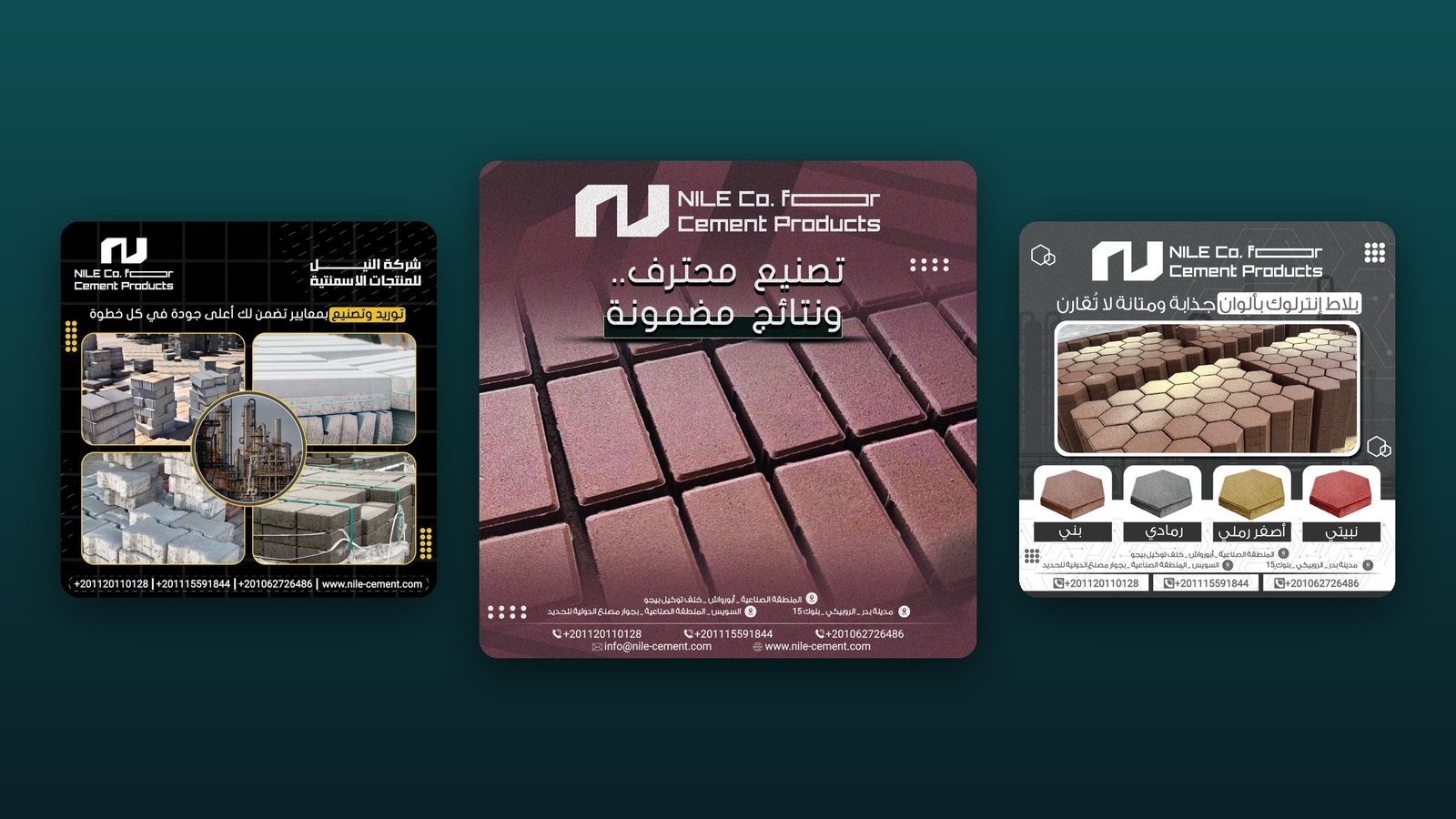
- Rebranding an established company. Recognition, signage and documents already in circulation make this a rollout as much as a design job. For the scale of work at this level, see the Nile Cement brand system built for an industrial manufacturer: identity, stationery and a large volume of social designs.
Five questions to ask before you sign
- What exactly will I receive? Ask for the list of files and documents, not a description of the process.
- How will the Arabic version be designed? Who draws it, at what stage, and will it be presented alongside the English concept?
- Which fonts are you using, and what licence do I need? Get the names and the licence type in writing.
- Who owns the final work and the source files? Look for an assignment clause, not an assumption.
- What happens after delivery? If your team will produce materials in-house, ask what guidance or support comes with the handover.
A short, clear scope protects both sides. If you are comparing agencies rather than scopes, the branding agency scoring sheet gives you a weighted way to choose. If you want a second opinion on a quote you have received, or on which level fits your stage, our brand identity and positioning team can review it with you.
Frequently asked questions
What is the difference between a logo and a brand identity?
A logo is the mark itself. A brand identity is the full system around it: colours, typefaces, layout rules, imagery style, guidelines and templates, so every document, post and sign looks consistent.
Do I own my logo once I pay the designer?
Not automatically. Copyright arises when the work is created, and law-firm readings of Saudi Arabia's new Copyright Law differ on who owns commissioned work by default, so your agreement should state that rights in the final approved design transfer to your company and that you receive the editable source files.
Does owning my logo mean I own the font used in it?
No. Typefaces are licensed separately. A logo can be registered as a trademark, but the typeface it uses cannot, and your team needs valid licences to use the brand fonts on its own devices and website.
How long does trademark protection last in Saudi Arabia, the UAE and Egypt?
In all three markets registration is granted for 10-year terms that can be renewed. Saudi filings go to SAIP, UAE filings to the Ministry of Economy and Tourism, and Egyptian filings to the Egyptian Intellectual Property Authority.
When is brand strategy worth paying for?
When buyers judge you before they meet you: entering a new market, bidding for tenders, launching a brand you distribute, or rebranding an established company. For a business still testing an idea, a simple mark is often enough for now.
- UK Intellectual Property Office (GOV.UK), IP in Saudi Arabia (2023-03-02).
- Saudi Authority for Intellectual Property (SAIP), Trademarks.
- The UAE Government portal (u.ae), Intellectual property.
- UAE Ministry of Economy and Tourism, Trademark renewal.
- European Commission IP Helpdesk, IP Country Fiche: Egypt (2022-01).
- INPI France, La propriété intellectuelle en Égypte (2025-06).
- Adobe Help Center, Font licensing.
- Baker McKenzie, Saudi Arabia: New Copyright Law modernises KSA IP framework (2026-07-20).