- Each guidelines section should give a decision someone can act on without calling the designer.
- Arabic needs its own lockup rules, mirrored grids, type hierarchy and a fixed numeral choice per use.
- Signage and fleet pages need dimensions and local rules; Dubai, for example, was reported in 2026 to require Arabic above English on shopfront signs.
- Governance, meaning file naming, version control and named approvers by role, keeps the document in use.
Most brand guidelines are written for the day of handover and abandoned within a year. The logo pages are fine. Then a supplier needs the Arabic lockup for a van door, a new hire builds a sales deck in a default font, and an exhibition contractor asks which red is the real one. Nobody knows where the files are or who is allowed to say yes.
The global templates that dominate this topic list the right headings: logo, colour, typography, voice, applications. What they leave out is most of what goes wrong for companies in Saudi Arabia, the UAE, Egypt and Qatar: rules for two scripts, two reading directions and two numeral systems, specifications for signage and fleets that local authorities regulate, and a named person who approves each kind of output. This guide is a contents checklist for a guidelines document that a marketing team, a sales team and outside suppliers can actually work from.
The core contents, and what each section must actually specify
A heading in the table of contents is not the same as a rule. Use this table to check whether each section gives someone a decision they can act on without calling the designer.
| Section | What it must specify | Common gap |
|---|---|---|
| Brand foundation | Positioning in two or three sentences, the audiences, and the claims the company can and cannot make | Long mission essays with no practical use |
| Logo system | Every approved lockup, clear space, minimum size, colour versions, and incorrect uses shown visually | No rule for which lockup to use where |
| Colour | HEX and RGB for screens, CMYK and spot references for production, ratios of primary to accent colours, and text-on-colour pairs that meet contrast targets | Values for screen only, so every supplier matches by eye |
| Typography | Arabic and Latin families, weights, a size hierarchy for both scripts, fallback fonts, and who holds the licences | A Latin hierarchy with “Arabic: same” written underneath |
| Layout and grids | Margins, columns and logo positions for the main formats, in both directions | English layouts only |
| Imagery and icons | Photography direction, icon construction and formats | Mood boards with no rules |
| Voice and copy | Tone in Arabic and in English separately, approved terms, the company name and descriptors in both languages | English tone rules translated literally |
| Applications | Templates and specifications for stationery, documents, social, signage, vehicles, uniforms and exhibitions | Pretty mock-ups with no dimensions |
| Files and governance | Where the master files live, how they are named, who approves what, and how the document is updated | Missing entirely |
On colour accessibility, a useful benchmark is the W3C’s WCAG 2.2 contrast criterion: at least 4.5:1 for normal text and 3:1 for large text, defined as 18 point, or 14 point bold. Publish the approved text-and-background pairs in the guidelines rather than leaving each designer to test them.
The Arabic rules global templates skip
For a bilingual brand, every core section above needs an Arabic counterpart. The design of the bilingual logo itself is a separate job, covered in our guide to what a proper Arabic-English identity system includes. The guidelines document is where those decisions become rules for everyone else. One published example is the March 2026 brand guidelines of MBZUAI, the Abu Dhabi university, cited here only to show how a few of these rules can be written.
Lockup selection rules
List the Arabic-only, English-only and combined lockups, then state which to use for each situation. The MBZUAI document, for example, left-aligns its English logo and right-aligns its Arabic one, tells users to pick the logo that matches the language of the asset, and reserves a centred bilingual version for balanced bilingual layouts. A rule as plain as “Arabic-only on government submissions, combined on signage, English-only on international partner decks” saves dozens of questions a year.
Right-to-left grids
The W3C’s Arabic and Persian Layout Requirements, a Group Draft Note from the Internationalization Working Group rather than a formal standard, states that when the main script is Arabic, the layout and structure of pages are also set right to left. The guidelines should show each main grid in both directions and say what mirrors (column order, logo corner, alignment, arrows) and what does not (photography, product shots, charts on a timeline). MBZUAI’s version is a single instruction: for Arabic, flip the grid horizontally, and lock the logo to the right-hand corner.
Arabic type hierarchy
Give Arabic its own size table for headings, body, captions and data, because Arabic letterforms at the same nominal point size usually read differently from Latin. Specify line spacing separately. Add one rule that Latin habits break: do not add tracking to Arabic text. The W3C document explains that stretching Arabic is done by extending the connections between joined letters (kashida) and warns that excessive kashida produces uneven text; MBZUAI’s guidelines keep Arabic tracking at “normal” in all cases.
Numerals
Decide whether Arabic materials use Western digits (0–9) or Arabic-Indic digits (٠–٩), and for what. Both sets appear across the region: the W3C note says there is no clear dividing line between countries, and default device settings differ by country too. In the current Unicode CLDR locale data that many systems draw on, the Saudi (ar_SA), Egyptian (ar_EG) and Qatari (ar_QA) locales default to Arabic-Indic digits, while the UAE locale (ar_AE) defaults to Western digits. So the guidelines should fix one choice per use: prices, phone numbers, dates, model numbers and technical specifications. Model numbers and phone numbers are usually safest kept identical to the source documents. How these script and direction choices carry into a bilingual website is covered in our guide to Arabic and English website structure.
Mixed strings and names
Include worked examples of the company’s real mixed text: a product code inside an Arabic headline, an email address in an Arabic signature, a bracketed English term in an Arabic sentence. Also record the official company name and descriptor in both languages, spelled exactly as on the commercial registration, so no one invents a new translation.
Physical specifications: signage, fleet and uniforms
This is the section most often reduced to mock-ups, and the one where mistakes cost the most to correct. Local rules matter here. Dubai’s shopfront rules, as reported in May 2026, allow one trade name with the Arabic above the English, so a brand whose only combined lockup is side by side is likely to need a stacked version; our guide to shopfront signage permits in Dubai covers the rules and permit route. In Saudi Arabia, the national Arabic language policy promotes Arabic in signage, advertisements, invoices and contracts, according to a March 2026 note by the law firm CMS, a clear signal that the Arabic side of the identity must be fully specified, although the note describes it as guiding principles rather than detailed rules. Confirm current requirements with the licensing authority before fabrication.
For each physical application, the guidelines should give:
- Signage: approved lockup per sign type, Arabic and English order, minimum letter heights for reading distance, illumination type, colour references for the fabrication material, and a note on local permit requirements.
- Vehicles and fleet: a drawing per vehicle model and side, including the rear doors; which lockup goes on each panel; the position of phone numbers, licence or registration details and website; and the mirroring rule for the two sides of the vehicle, so the Arabic never reads backwards on one side.
- Uniforms and merchandise: logo placement and size per garment, embroidery versions with simplified detail, and the colours approved for fabric.
- Production checks: what a supplier must submit before going ahead (artwork proof, material sample, a photo of a test piece) and who signs it off (our guide to production supervision and colour quality covers that stage).
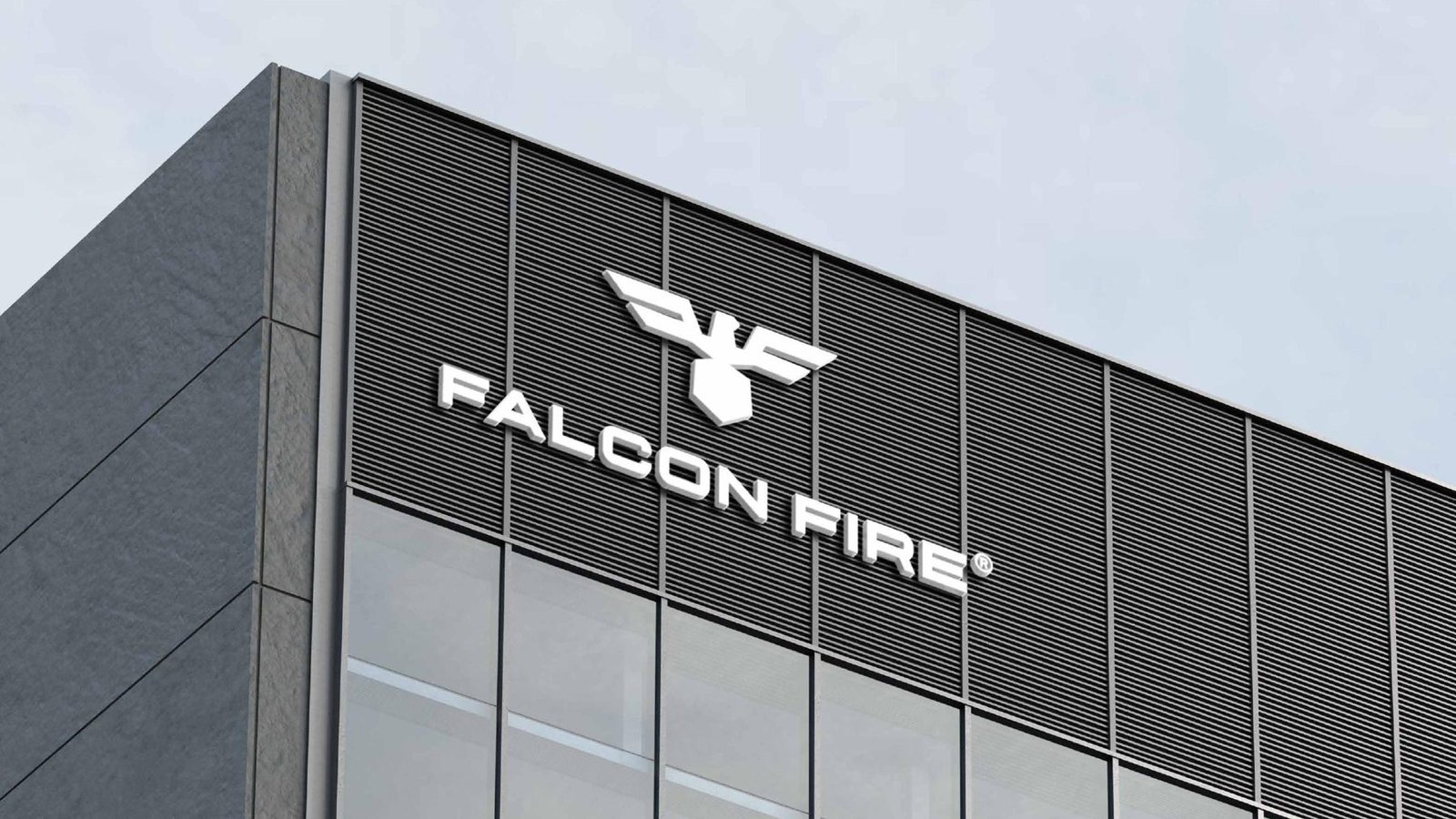
Our brand applications work follows that last point: production-ready files, agreed materials, proofs reviewed and the result checked against what was approved. A bold identity applied from business cards to trucks, as in our work for Falcon Fire in Dubai, only stays consistent if each of those surfaces has its own specification.
Files, naming and the asset library
A guidelines PDF with no file library behind it creates its own failures: screenshots of logos, outdated versions on suppliers’ laptops, Arabic fonts substituted on another computer. The document should state where the master files live, who has access and which formats exist for which use.
A simple naming convention removes most version confusion. For example, a company could adopt this pattern:
company_asset_variant_language_colour_format, for example acme_logo_stacked_ar-en_fullcolour_rgb.svg or acme_logo_horizontal_ar_mono-white_cmyk.pdf
Whatever pattern you choose, write it into the guidelines and apply it to every file in the library. Then add three supporting rules:
- Formats by use: vector files (SVG, AI or PDF) for production, PNG for office documents and presentations, and a separate favicon and social avatar set.
- Language and direction in the file name, so no one picks an English-first lockup for an Arabic layout by accident.
- A version line on the guidelines cover and in the library (for example, “Version 2.1, approved March 2027”), with a short changelog page at the back.
Fonts belong on this page too. List each typeface and the exact version to use, its licence type, who holds the licence and how staff and suppliers obtain it, so no one installs a near-identical version from a subscription service and gets different spacing.
Governance: owners and an approval workflow
In practice, governance is the section that keeps the others alive. Without it, the guidelines describe the brand but nobody enforces them. An email address for requests is a start, not a sign-off process.
Name owners by role, with a backup, rather than by person, so the document survives staff changes. A practical structure:
| Output | Prepared by | Approved by | Checked against |
|---|---|---|---|
| Social posts and campaigns | Marketing team or agency | Marketing manager | Content plan, tone rules, templates |
| Arabic copy | Arabic writer | A named Arabic reviewer | Terminology list, numeral rules |
| Sales decks, proposals, profiles | Sales or marketing | Marketing manager | Master templates |
| Signage, fleet, uniforms | Designer with fabrication partner | Marketing director, plus facilities for site matters | Specification drawings, approved proof |
| New lockups, sub-brands, co-branding | Brand designer | CEO or brand owner | Logo architecture rules |
| Changes to the guidelines | Brand owner | CEO | Changelog and version number |
Then write the workflow itself in a few steps: brief, draft, review against the guidelines, approval in writing, release from the library, and archive of the approved version. For distributors, add a step for checking materials against the partner brand’s own guidelines before release. State a review date for the whole document, typically once a year or whenever the company adds a branch, a product line or a market.
Before you approve the document: a checklist
Run through these points with the designer before the guidelines are signed off. If you are commissioning a new identity, put them in the brief from the start; our brand identity service treats guidelines as a working tool for the team, not a closing presentation.
- Every lockup has a written rule for where it is used, including a stacked Arabic-over-English version.
- Colour values exist for screen and for production, and approved text-and-background pairs meet the WCAG contrast targets.
- Arabic has its own type hierarchy, line spacing and a no-tracking rule.
- Numeral choices are fixed for prices, dates, phone numbers and specifications.
- Main grids are shown in both directions, with mirroring rules.
- The official company name and descriptor are recorded in both languages, matching the registration.
- Signage, vehicle and uniform pages include dimensions, positions and material colour references, with a note to confirm local permit rules.
- File library location, naming convention, formats and font licences are documented.
- Each type of output has a named approver by role, and the document has a version number, a changelog and a review date.
- Templates exist for the materials the team produces most: presentations, letters, proposals and social posts, in both languages.
If several of these are missing from the guidelines you already have, you do not necessarily need a new identity. Often the fastest fix is an addendum covering the Arabic rules, the physical specifications and the approval workflow, issued as the next version of the same document.
Frequently asked questions
What should brand guidelines include at minimum?
Brand foundation, the logo system with usage rules, colour values for screen and production, typography for every script you use, layout grids, imagery, voice and copy rules, application specifications and a governance section covering files, naming and approvals.
Should Arabic materials use Western or Arabic-Indic numerals?
Both are in use across the region, and default device settings differ by country. Choose one set per use (prices, dates, phone numbers, specifications), write it into the guidelines and make sure the Arabic typeface has well-drawn glyphs for it.
Who should approve materials under the brand guidelines?
Name approvers by role for each type of output: for example the marketing manager for social and sales materials, a named Arabic reviewer for Arabic copy, the marketing director for signage and fleet, and the CEO or brand owner for new lockups and changes to the guidelines.
Do I need a new identity if my guidelines are incomplete?
Not necessarily. If the logo and visual system work, an addendum covering the Arabic rules, physical specifications, file library and approval workflow can be issued as the next version of the existing document.
- Mohamed bin Zayed University of Artificial Intelligence, MBZUAI Brand Guidelines, March 2026 (2026-03).
- W3C Internationalization Working Group, Arabic & Persian Layout Requirements (W3C Group Draft Note) (2025-10-02).
- W3C Web Accessibility Initiative, Understanding Success Criterion 1.4.3: Contrast (Minimum).
- Unicode Consortium (GitHub), CLDR locale data: ar_SA.xml.
- Unicode Consortium (GitHub), CLDR locale data: ar_EG.xml.
- Unicode Consortium (GitHub), CLDR locale data: ar_AE.xml.
- Unicode Consortium (GitHub), CLDR locale data: ar_QA.xml.
- Gulf News, One trade name only: Dubai tightens shopfront signage rules (2026-05-12).
- Khaleej Times, Vertical signs, single names: Shop owners in Dubai asked to follow signage rules (2026-05-13).
- CMS, Saudi Arabia's National Arabic language policy: What businesses need to know (2026-03-24).