- Map the unboxing sequence first; the main label and care label are the only items that last as long as the garment.
- Design a logo family with a compact mark tested as a woven sample, and Arabic and English versions as a pair.
- SASO's textile regulation, now in its second edition, asks for Arabic label information covering fibre composition, origin, size and care; check the current text before production.
- Premium comes from restraint: one signature material, one tactile finish, one accent colour, approved from physical samples.
Most new clothing labels start with a logo and only later ask how it will look on a woven label 20 millimetres wide, on a swing tag or on the flap of a mailer box. That order is backwards. A customer meets a small fashion brand through a handful of physical objects: the parcel, the bag, the tag, the label at the neck. If those feel improvised, the website and the Instagram feed cannot rescue the impression.
This guide builds a fashion brand identity from the physical touchpoints outwards. It covers what each item has to do, how to design a system that survives tiny sizes and thread, and the label information that official sources for Saudi Arabia, Egypt, the EU and the US say must appear, so the premium look never comes at the cost of a non-compliant garment.
Start with the unboxing sequence, not the logo
Before any sketching, write down the order in which a customer encounters your brand when an order arrives or when they buy in a store. For an online order it usually runs like this:
- Outer mailer or shipping box: the first thing seen, often on a doorstep or a courier counter.
- Closure: a sticker, tape or seal that signals someone cared how the parcel was closed.
- Inner wrap: tissue, a dust bag or a sleeve.
- Insert card: thank-you note, returns instructions, a code for the next order.
- Hang tag: the brand’s moment of storytelling, plus price, size and barcode.
- Main label: usually woven, at the neck or waistband; it stays with the garment for its whole life.
- Care and composition label: the legally required information, usually in a side seam.
Each item has a different lifespan. The mailer is usually thrown away within minutes and the hang tag within days; the main label lasts as long as the garment. That tells you where to spend design effort and money. A premium feel rarely comes from the most expensive box. It comes from consistency across all seven moments, and from the two permanent items (main label and care label) being clean, legible and well finished. The same boxes, tags and tissue will also appear in product shots, so plan them alongside your e-commerce product photography.
A touchpoint map for a small fashion label
Use a simple map like the one below to brief your designer and your production suppliers at the same time. It forces decisions that are often left to whoever happens to quote first.
| Touchpoint | Its job | What makes it feel premium | Common mistake |
|---|---|---|---|
| Main woven label | Identify the brand for the life of the garment | A simple wordmark or monogram, fine weave, soft edges that do not scratch | Squeezing the full logo with tagline into a label too small to weave it cleanly |
| Care and composition label | Carry mandatory information and washing guidance | Clear hierarchy, correct symbols, soft material, sensible placement | Treating it as an afterthought, so text is cramped, wrong or in the wrong language |
| Hang tag | Tell the brand story at the point of decision; carry price, size, barcode | Good board weight, one tactile finish such as embossing, a considered string or fastener | Five finishes at once, and a barcode area that the retailer’s scanner cannot read |
| Shopping bag | Carry the purchase and the brand through the street or mall | Proportion, handle quality, restraint in graphics | Logo enlarged to fill the whole side |
| Mailer box or bag | Protect the product and announce the brand at delivery | An outside that survives couriers; the brand moment saved for the inside | Delicate outer finishes that arrive scuffed |
| Inner wrap and insert | Create the opening moment and guide the next action | One sticker, one card, a clear message | Too many loose pieces that fall out and look like clutter |
Design an identity that survives thread, small sizes and two scripts
A fashion identity has to work at sizes and in materials that most corporate identities never face. Plan for these constraints from the first concept rather than adapting later.
Build a logo family, not a single logo
- Primary wordmark for bags, boxes, the website and the hang tag front.
- Compact mark or monogram for the woven label, buttons, zip pulls, stickers and social avatars.
- Minimum sizes defined separately for paper, board and woven labels. Weaving builds the mark from threads, so fine serifs, hairlines and small counters can close up. Ask your label supplier for a woven sample of the mark before you approve the identity, not after.
Plan Arabic and English together
If you sell in Saudi Arabia, the UAE or Egypt, decide early whether the brand has an Arabic name or an Arabic rendering of the Latin name, and design both versions as a pair with matched weight and height (what a full bilingual Arabic-English identity system includes is covered separately). Mandatory information may have to appear in Arabic (see the next section), so test the care-label layout early at its real size, with both languages set and neither shrunk to an unreadable size.
Specify colour for each material
Thread is the material that most often breaks a fashion palette. Many label suppliers weave from a fixed range of yarn colours, so the woven label may never match the box or the tag exactly. Ask for the closest available yarn, approve it from a woven sample, and decide early which item is the colour master and where a near match is acceptable.
Choose typography that works at 6 points
Care labels and hang-tag backs carry small text. Choose a secondary typeface with open letterforms and a matching Arabic companion, and set a minimum size for legal text in the guidelines so it is not quietly reduced to fit.
Mandatory label information: check it before you design the label
The care and composition label is not only a design object. It carries information that regulators require, and getting it wrong can hold up a shipment or a listing. The rules differ by market. The summary below is based on the sources linked, as we read them at the end of October 2026. Rules are revised, so treat it as a starting point for your own checks, not legal advice: confirm the current text with the regulator, your importer or a conformity body before the first production run.
| Market | What the source we checked requires |
|---|---|
| Saudi Arabia | SASO’s Technical Regulation for Textile Products is now in its second edition: approved by SASO’s board on 28 December 2023 and published in the Umm Al-Qura gazette on 12 January 2024. SASO’s guide to the second edition (Arabic, December 2024) says it applied at ports and factories from 10 July 2024 and in the market from 11 January 2025, and lists the label data as fibre types with percentages by mass; weight, size or dimensions; the supplier’s or trader’s name on the outer packaging; country of origin; any finishing or treatment; care and washing instructions and symbols; and recycling and disposal information and symbols. SGS and Adherent report that the second edition requires this information in Arabic, with another language allowed alongside, replacing the earlier “Arabic, or Arabic and English” wording. The 2018 first edition, which is still the English PDF on SASO’s site, also required labels to be sewn in or firmly fixed, the supplier’s commercial registration on the packaging and care symbols to SASO ISO 3758; check whether the current Arabic text keeps those details. |
| Egypt | The US International Trade Administration’s Egypt labelling guide (updated November 2025) states that finished goods imported for sale in Egypt must be labelled in Arabic with the country of origin, the manufacturer’s name and a product description, that labels may not be added to products after import, and that additional requirements apply to textiles. It also cites Ministerial Decree 477/2018, which obliges producers and importers to follow Egyptian Standard ES 7322, the basic health and safety specification for products made of fabric, leather, polymers or blends. The guide does not list the textile label content itself. Confirm textile-specific label content with the Egyptian Organization for Standardization and Quality or GOEIC. |
| European Union | Regulation (EU) No 1007/2011 requires fibre composition labelling that is durable, easily legible, visible and accessible (Article 14), in uniform lettering, and in the official language or languages of the member state where the product is sold (Article 16). It is harmonised only for fibre composition: the regulation does not itself make care or origin labels mandatory, and its recitals only asked the Commission to study possible future rules on both. Check national rules in each member state you sell in. |
| United States | The FTC’s textile labelling guidance requires fibre content by generic name and percentage, country of origin, and the manufacturer’s or dealer’s name or RN number, in English. On garments with a neck, the origin must appear on a label at the inside centre of the neck, and the fibre content must be shown in lettering of equal size and conspicuousness. Care instructions on a permanent label are required under a separate FTC rule (16 CFR Part 423). |
We have not set out UAE or other Gulf rules here. Ask your importer or a conformity assessment body which regulation and label language apply to your product category before you finalise artwork, rather than assuming the Saudi layout will be accepted everywhere.
Lay out the care label like a document, not a decoration
- Group the required items in a fixed order: composition, care symbols, country of origin, size, brand or supplier identification, plus any market-specific items such as the recycling and disposal information in SASO’s second edition.
- Keep composition in a single size and weight; the FTC guidance, the EU regulation and SASO’s 2018 text all ask for uniform lettering.
- Build one master template per market, with space reserved for the longest language version.
- Have someone other than the designer check every number against the fabric supplier’s specification.
Choose materials and finishes with restraint
The quickest way to look like a new brand is to use every finish the supplier offers. Established fashion houses tend to repeat a small number of materials and details everywhere. A practical rule for a small label:
- One signature material. For example, a heavy uncoated board for tags, cards and the inside of the box, so the same texture recurs.
- One tactile finish. Embossing, debossing or foil on the hang tag and box lid, not all three.
- One accent colour beyond the core palette, used for tissue, string or sticker.
- Comfort first on labels. Main labels sit against the skin. Ask for soft-edge or folded options and test them on a real garment before approving.
- Courier-proof outer packaging. Keep the outside simple and durable, and spend on the inside, where the customer opens it.
If sustainability is part of your positioning, only state material claims that your supplier can document. A “recyclable” or “recycled” line on a box needs evidence behind it.
Get every item produced the way it was approved
Labels, tags and packaging usually come from different suppliers, each with its own tolerances, so they can drift apart over a few reorders. For a fashion label, the practical safeguards are:
- One file pack per item with dimensions, materials, finishes and the approved mandatory text, so the care-label wording is never retyped by a supplier.
- Label, tag and box samples approved together, side by side under the same light, rather than one at a time.
- A check of the first bulk batch against the signed samples before stock is labelled and shipped.
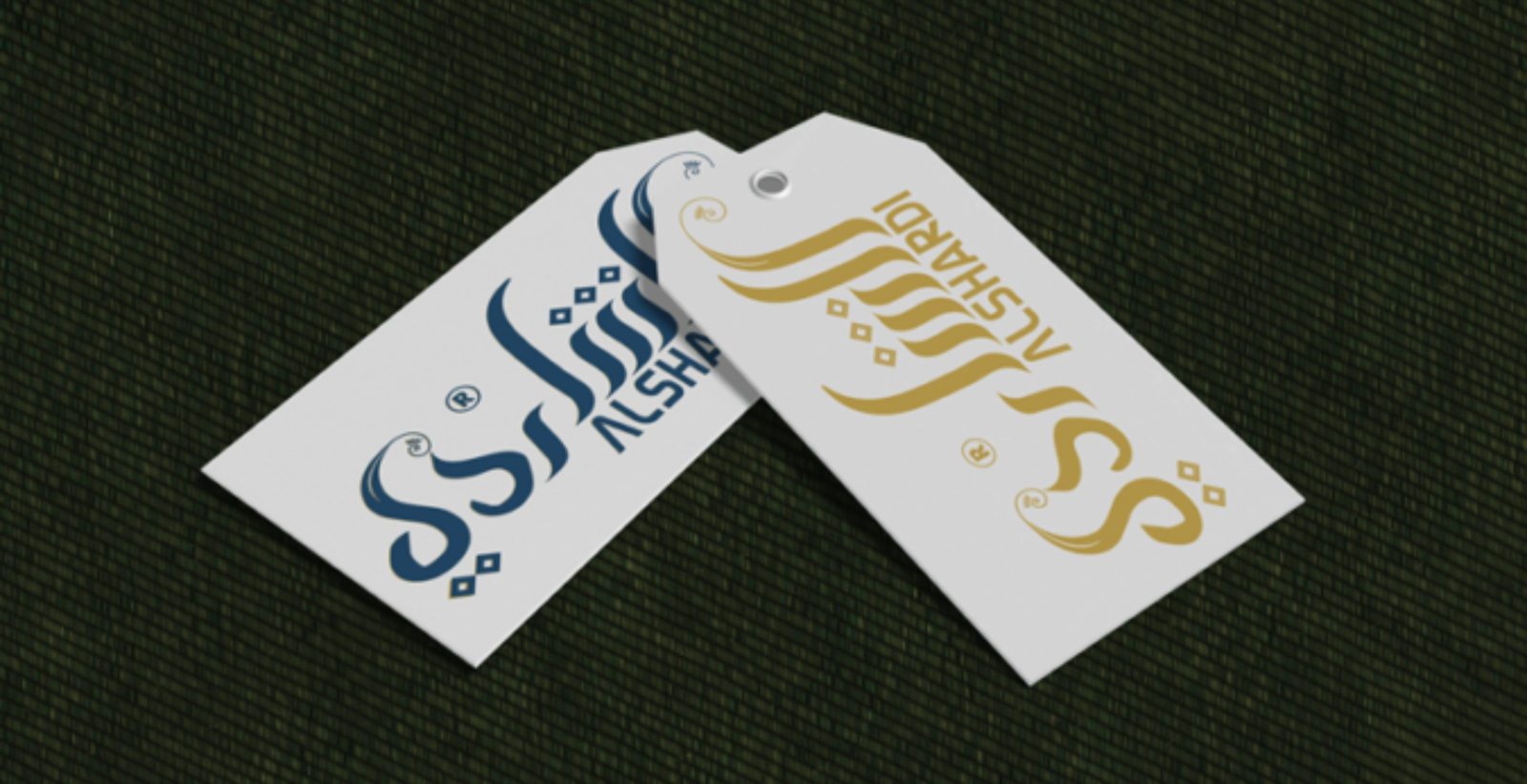
Our article on production supervision and colour quality covers tolerances and proof approval in more depth. At RX Designer, the Brand Applications team prepares production-ready files for packaging and labels and supervises fabrication partners, agreeing materials and reviewing proofs against what the client approved. Our work for Alshardi, an Egyptian fashion brand, shows an identity, campaign visuals and brand applications, from the façade to the swing tag, built as one system.
Checklist before your first production run
- The unboxing sequence is written down and every item has a defined job.
- The logo family includes a compact mark tested as a woven sample.
- Arabic and English versions are designed as a pair if you sell in Arabic-speaking markets.
- Colour references exist for screen, paper, board and thread, with one declared master.
- Mandatory label content is confirmed per market from a current official source or your importer.
- Brand name, tagline and graphics have been checked against local content rules, such as SASO’s restrictions on religious text.
- Care-label templates hold the longest language version at a legible minimum size.
- Materials and finishes are limited to one signature material, one finish and one accent.
- Samples of label, tag and box have been approved together, and the first bulk batch will be checked against them.
If the identity is still being defined, put these physical constraints in the brief for the logo, colour system and guidelines from the start; that is how our brand identity work approaches fashion labels. If the labels, tags and boxes already exist, lay one of each on a table next to the garment and photograph them together: any item that looks as if it came from a different brand is the one to redesign first.
Frequently asked questions
What information must a clothing label show in Saudi Arabia?
SASO's Technical Regulation for Textile Products, second edition (published January 2024 and applied in the market from 11 January 2025, according to SASO's guide), lists fibre composition by mass percentage, weight, size or dimensions, country of origin, care instructions and symbols, recycling and disposal information, and the supplier's name on the outer packaging. Testing bodies report that the information must be in Arabic, with another language allowed alongside. Check the current text with SASO or your conformity body before production.
Do clothing labels in Egypt have to be in Arabic?
According to the US International Trade Administration's Egypt guide, finished goods imported for sale in Egypt must be labelled in Arabic with the country of origin, manufacturer's name and a product description, and textiles carry additional requirements that the guide does not list. Confirm the textile-specific content with Egyptian standards authorities or your importer.
Should the logo on my woven label be the same as on my website?
Usually not exactly. Weaving builds the mark from threads, so fine details can close up at small sizes. Most fashion brands use a compact mark or monogram for labels, buttons and stickers, from the same family as the main wordmark, and approve it from a woven sample.
How many finishes should a hang tag have?
For a small label, one tactile finish such as embossing, debossing or foil is usually enough. Repeating one signature material and one finish across tags, cards and boxes looks more established than combining many effects.
Are care labels mandatory everywhere?
Not in every market. SASO's textile regulation in Saudi Arabia lists care instructions, and in the US they are required under the FTC's Care Labeling Rule (16 CFR Part 423), but EU Regulation 1007/2011 harmonises only fibre composition and does not itself make care labels mandatory. Check the rules in each market you sell in.
- Saudi Standards, Metrology and Quality Organization (SASO), Guide to the Technical Regulation for Textile Products, Second Edition (Arabic) (2024-12-01).
- Saudi Standards, Metrology and Quality Organization (SASO), Technical Regulation for Textile Products (first edition, English) (2018-08-24).
- SGS, Saudi Arabia updates technical regulations for textile products (SafeGuardS 70/24) (2024-05).
- Adherent (formerly Compliance & Risks), What you need to know about the technical regulations for textiles in Saudi Arabia (2024-03-04).
- International Trade Administration, US Department of Commerce, Egypt – Labeling/Marking Requirements (Country Commercial Guide) (2025-11-21).
- EUR-Lex, European Union, Regulation (EU) No 1007/2011 on textile fibre names and related labelling and marking (2011-09-27).
- US Federal Trade Commission, Threading Your Way Through the Labeling Requirements Under the Textile and Wool Acts (2026-04-10).