- Score every candidate asset on fame (do buyers link it to you?) and uniqueness (only to you?).
- Ask buyers, unprompted and without the name; managers tend to overrate fame and underrate uniqueness.
- Place each asset on the distinctive asset grid: use or lose, invest, avoid, test or ignore.
- Write the results into the design brief as keep, evolve and drop lists before design starts.
Most rebrand projects begin with a design question: what should the new logo look like? The better first question is about what you already own. Somewhere in your customers’ memory there are a few colours, shapes, words and layouts that they connect with your company without reading the name. Those are your distinctive brand assets, and a redesign can either build on them or quietly throw them away.
This guide is a working method for finding them before anyone opens a design file. It takes the research framework from the Ehrenberg-Bass Institute for Marketing Science and turns it into an audit a mid-sized company in the Gulf or Egypt can run itself, with its own customers, in a few weeks. If you are still deciding between a refresh and a full rebrand, read our rebrand or refresh decision framework first. This article goes one level deeper: how to measure each asset properly and turn the results into a brief.
What counts as a distinctive brand asset
A distinctive asset is anything other than the brand name that signals the brand: a colour, a logo or symbol, a shape, a typeface, a character, a tagline, a sound. A WARC news summary of a piece Professor Jenni Romaniuk wrote for Admap, republished on the Institute’s site, puts it plainly: assets “can be anything sensory”, although in advertising and media they are mostly visual and audio.
The framework, set out in full in Romaniuk’s book Building Distinctive Brand Assets (Oxford University Press, 2018), judges every asset on two measures. Romaniuk’s article “Brands of Distinction”, first published in unisabusiness magazine and now on the Ehrenberg-Bass site, defines them simply:
- Fame: does everyone who sees the asset think of your brand? A colour that most buyers in your category link to you is famous.
- Uniqueness: does the asset bring only your brand to mind, or competitors too? A red that buyers link to you and to three other contractors is not unique.
The same article states that “of these two, uniqueness is most important”. That matters in categories where many companies share a visual language. Fire and safety brands use red, logistics firms use globes and arrows, contractors use blue and grey. A cue that the whole category uses can be well known and still do almost nothing for you.
This is not only a consumer-brand idea. An article on the 95:5 rule for B2B growth, published by Dreamdata and republished on the Institute’s site, names unaided brand recall, category entry points and distinctive brand assets as brand health metrics that “should be continuously monitored”. The reasoning: only about 5% of your target buyers are actively looking to buy at any given time, and when the rest enter the market, they need to recognise you quickly.
Why the management team cannot do this audit alone
The obvious shortcut is to put the leadership team in a room and agree which assets are strong. The research says that shortcut fails. A Journal of Brand Management study by Ehrenberg-Bass researchers Ruby Brus, Nicole Hartnett, Margaret Faulkner and Carl Driesener compared marketers’ judgements with consumer data on more than 400 brand elements. As Marketing Week reported, the judgements were “rarely accurate”. Marketers overestimated fame and underestimated uniqueness, which the authors put down to marketers projecting their own familiarity with the category onto buyers. Group judgements were more likely to be accurate than individual ones, and the paper recommends them only as the fallback when consumer research is not affordable.
The cost of guessing wrong can be large. “Brands of Distinction” recounts how Tropicana replaced its orange-with-a-straw packaging with a plain glass of juice, leaving the brand “barely recognisable”. The original image was back on the packaging less than a month after launch, and the article cites an estimate, without saying whose, that the change cost US$26.3 million in sales. The same piece points to the Australian department store David Jones, which dropped its long-running slogan in 2011, an asset it describes as “just wasting away”.
Step 1: Inventory every candidate asset
Start with an honest list of everything that has repeated across your touchpoints for at least a few years. Walk the real estate of the brand, not the brand guidelines: vehicles, site hoardings, uniforms, the reception wall, tender covers, exhibition stands, the WhatsApp profile picture, the email signature, the company profile your sales team actually sends.
For each candidate, record four things in a simple sheet:
| Field | What to record | Why it matters |
|---|---|---|
| Asset | A precise description: “dark green on vehicle sides”, not just “green” | Buyers remember executions, not swatches |
| Years in use | When it first appeared and whether it has changed | Older, stable assets have had more time to build memory |
| Consistency | Is it used the same way everywhere, or in five variants? | An asset applied inconsistently rarely becomes famous |
| Category use | Do competitors use something similar? | Flags likely uniqueness problems before you test |
In bilingual markets, list the Arabic and English versions as separate assets. The Arabic wordmark, the English wordmark, an acronym and a nickname customers use on the phone can each carry different levels of recognition with different buyer groups. A procurement officer in Riyadh and a consultant in Dubai may know you by different cues.
Aim for eight to fifteen candidates. More than that tires respondents; fewer usually means something has been missed.
Step 2: Run a recognition test buyers can answer in five minutes
This is a practical, small-scale version of the approach, not a formal research study. It will not give you statistically robust numbers, but it gives you outside evidence instead of internal opinion, which is the point.
Prepare the stimulus
- Show each asset on its own with the brand name, and any other cue, removed. If you test the colour, show a plain swatch or a neutral shape in that colour, not your truck.
- Test the Arabic and English versions of word-based assets separately, and translate the questions properly rather than mixing languages in one question.
- Add two or three competitor assets to the set. They make the test less obvious and tell you how much of the category’s visual language is shared.
Ask the right question, unprompted
Ask an open question for each asset: “Which company, if any, comes to mind when you see this?” Do not show a list of brand names to choose from. Speaking at the Mumbrella360 conference, Romaniuk warned that prompted measurement gives inflated fame scores, “up to about 20 percentage points”. A list tells people the answer could be you.
Choose the right respondents
- Category buyers, not only your customers. Include people who buy from competitors. Your existing customers will overstate fame, for the same reason your managers do.
- The people who actually choose. In B2B that may be procurement staff, consultants, engineers, distributors or dealers, depending on how your sales happen.
- No employees, no agencies, no family.
Our working rule of thumb, not a research standard, is 30 to 50 responses per buyer group you care about. Short interviews at an exhibition stand, a brief online form shared by the sales team, or calls by someone who is not the account manager all work. Record the answers word for word.
Step 3: Score each asset and place it on the grid
For each asset, calculate two simple percentages from the answers. These formulas are our practical approximation for a small in-house sample, not Romaniuk’s published scoring method; her book sets out the full measurement approach.
- Fame = respondents who named your company ÷ all respondents.
- Uniqueness = respondents who named your company ÷ respondents who named any company.
An asset that 18 of 40 buyers link to you has 45% fame. If 30 of the 40 named some company and 18 of those named you, uniqueness is 60%; the other 12 had someone else in mind.
Then plot each asset on the Ehrenberg-Bass distinctive asset grid, with uniqueness on one axis and fame on the other. The quadrant names and profiles below come from “Brands of Distinction”; the right-hand column is our reading of what each means when a redesign is on the table:
| Quadrant | Profile | Our reading before a rebrand |
|---|---|---|
| Use or lose | Famous and unique | Protect it. Redraw or modernise only with care, and keep it recognisable. If it is not used, it erodes. |
| Invest | Unique but not famous | A strong candidate to carry into the new identity and use far more consistently, so it builds fame. |
| Avoid | Famous but not unique | The source warns that competitors are likely to copy it. Do not rely on it alone; pair it with a unique asset or make it more ownable. |
| Test or ignore | Neither | Needs testing, says the source. In a rebrand it is free to change, and new ideas start here too, so test them before launch rather than assuming they will work. |
The study reported by Marketing Week describes the strongest assets as the ones in the top right corner of the grid, high on both measures. It gives no cut-off figures, and you do not need precise thresholds to act. With a small sample, look for clear gaps between assets rather than reading meaning into a few percentage points.
For example, a hypothetical Gulf contracting company might find that its Arabic wordmark sits in “use or lose”, its dark-green fleet colour in “invest” because few buyers outside one region have seen it, its blue-and-grey palette in “avoid” because three competitors share it, and its tagline in “test or ignore”. That company does not need a new everything. It needs to keep the wordmark, push the green across every touchpoint, retire the shared palette and write a new line.
Step 4: Turn the results into a keep, evolve, drop brief
The audit is only useful if it changes the design brief. Before any agency or designer starts, add an asset section to the brief with three lists:
- Keep. Assets in “use or lose” and “invest”. State what may change (line weight, proportions, screen versions, the Arabic and English pairing) and what may not (the shape, the colour, the arrangement buyers recognise).
- Evolve. Assets in “avoid” that still have some fame. Ask for ways to make them more ownable, such as a specific shade, a distinctive application or a pairing with a unique asset.
- Drop or replace. Assets in “test or ignore”. The designer is free here, and new candidates should be tested with the same method before launch.
Two checks belong alongside the brief. First, confirm who legally owns and has registered the assets you are keeping, especially if an earlier agency or a partner created them; check with a lawyer rather than assuming. Second, make sure the kept assets will appear in the first wave of the launch on the touchpoints buyers see most, so recognition carries across. Our rebrand rollout plan covers sequencing.
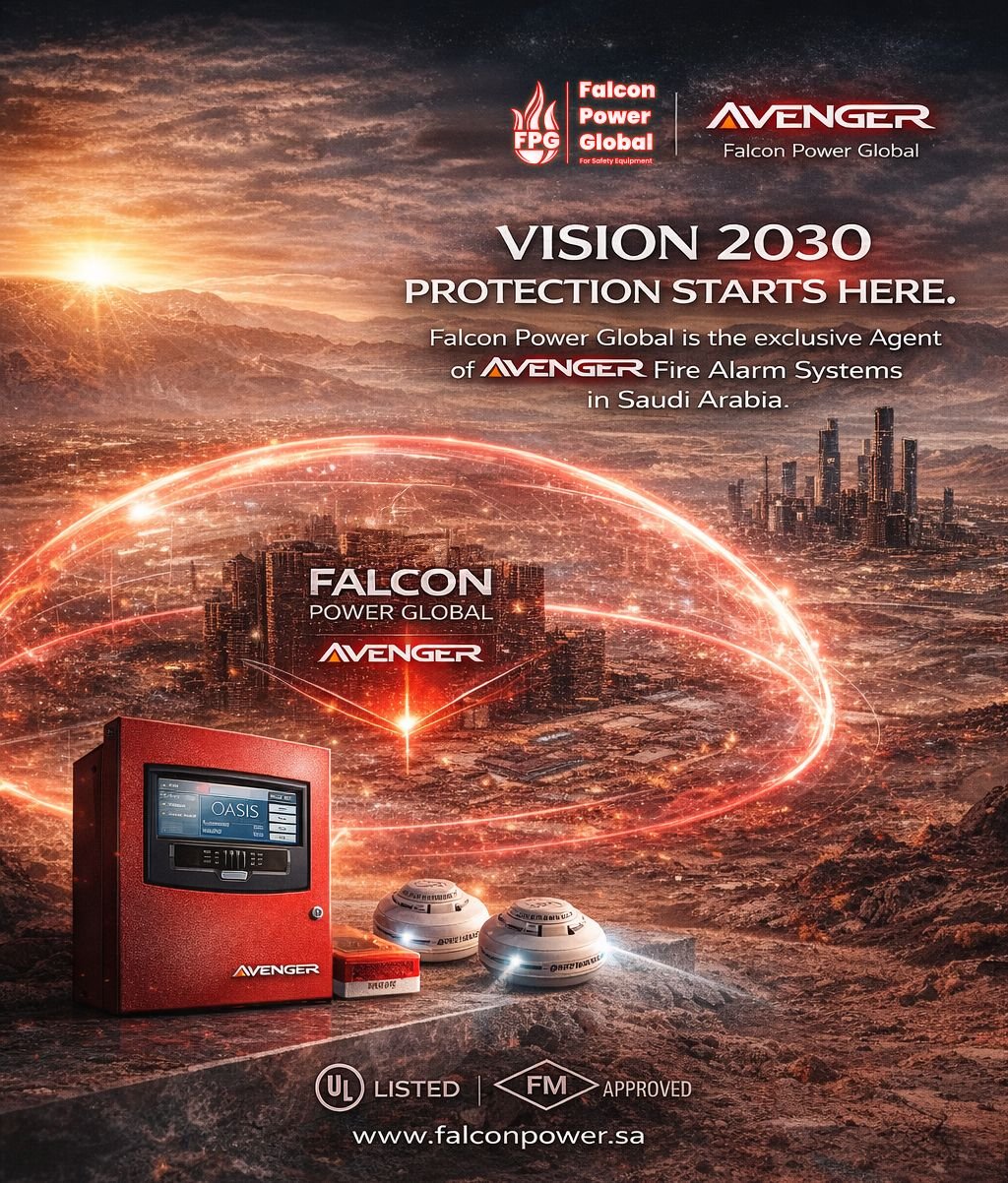
Our Falcon Power Global case shows the kind of evolution this brief supports: as the company became an authorised agent for international brands, its launch identity grew into a stronger, simpler FPG identity, with a clear path from one to the other without losing recognition. An audit like this one is how you decide, before design starts, which cues need to make that journey, and its keep, evolve, drop list becomes the first page of any brand identity brief.
Keep measuring after the launch
Distinctive assets are built over years and can be lost in months. Repeat the same test, with the same questions and buyer groups, about a year after the new identity launches and then at regular intervals. The B2B article on the Institute’s site treats assets as something to monitor continuously, alongside recall. What you are looking for is simple: kept assets holding their scores, “invest” assets moving up in fame, and new assets climbing out of “test or ignore”.
Two habits protect the results. Use the kept assets consistently, in the same form, everywhere, including on the materials your sales team and distributors produce; writing them into your brand guidelines is what makes that hold. And resist the urge to change them because the team has grown tired of them; buyers see your brand far less often than you do.
Frequently asked questions
What are distinctive brand assets?
They are non-name elements that signal your brand to buyers, such as a colour, logo or symbol, shape, typeface, tagline, character or sound. An asset is strong when many category buyers link it to you (fame) and few link it to anyone else (uniqueness).
How many people do we need to survey?
As a practical in-house check, our rule of thumb is 30 to 50 responses per important buyer group. That is not a research standard and will not give statistically robust figures, but it shows clear differences between assets and replaces internal opinion with outside evidence.
Do distinctive assets matter for B2B companies?
Yes. An article on B2B growth republished by the Ehrenberg-Bass Institute lists distinctive brand assets among the brand health metrics to monitor continuously, because only a small share of buyers are in the market at any time and the rest need to recognise you when they enter it.
- Oxford University Press Australia, Building Distinctive Brand Assets (Jenni Romaniuk) (2018-03-16).
- Ehrenberg-Bass Institute for Marketing Science (republished), Brands of Distinction (Jenni Romaniuk; first published in unisabusiness magazine, Issue 03).
- WARC, republished by the Ehrenberg-Bass Institute for Marketing Science, Brands need distinctive assets (WARC news summary of Jenni Romaniuk's Admap article).
- Mumbrella, republished by the Ehrenberg-Bass Institute for Marketing Science, Mumbrella360: Ehrenberg-Bass professor says you're poorly branding if you're focusing on assets over your brand.
- Dreamdata, republished by the Ehrenberg-Bass Institute for Marketing Science, The 95:5 rule: why B2B growth starts long before the purchase.
- Marketing Week, Marketers' judgement of brand asset strength 'rarely accurate', study finds (Journal of Brand Management study by Brus, Hartnett, Faulkner and Driesener).
- RX Designer, Falcon Power Global case study.