- A manufacturer's rebrand is a channel decision: dealers, site teams, specifiers and procurement each recognise you by different cues.
- Keep product names, codes and grade references fixed; refine the name and colour rather than replacing them without a clear reason.
- Plan for months when old and new packs, marks and paperwork coexist, and switch delivery notes and invoices on one stated date.
- Brief dealers and your sales team first, key accounts and consultants second, and the public last.
A factory that has outgrown its identity usually knows it. The products pass the standards, the lines run on time, but the logo was drawn when the company had one site and three trucks, and the brochures look nothing like the business that now bids on large projects. So the board approves a rebrand. A composite of situations manufacturers describe follows: six months later the sales director is fielding calls from dealers asking whether the new bags are genuine, a consultant has queried a submittal because the name on the datasheet does not match the approved list, and a contractor’s site foreman has refused a delivery he did not recognise.
None of that is a design failure. It is what happens when an industrial company treats a rebrand as a logo project instead of a change to how its whole sales channel identifies its products. This article is about changing the identity without making dealers, contractors, consultants or procurement teams hesitate.
Why a manufacturer’s rebrand is a channel decision
A consumer brand mostly has to persuade the end customer. A manufacturer sells through layers, and each layer recognises the company by something different:
- Dealers and distributors know you by the bag, the pallet label, the colour on the yard sign and the name their customers ask for at the counter. Their own reputation is attached to yours.
- Contractors and site teams know you by the delivery note, the truck and the mark on the product itself. They check what arrives against what was ordered.
- Consultants and specifiers know you by the name and product codes in their specifications, approved-materials lists and past submittals.
- Procurement teams know you by the legal name in their vendor master, your certificates and your invoice template.
Change any of these without warning and the buyer’s first thought is not “they look more modern”. It is “is this the same company, the same factory, the same quality?” In product categories where lookalike and counterfeit goods exist, an unexplained packaging change can read as a warning sign rather than an upgrade.
Map what each buyer relies on before you brief the designer
Most rebrand briefs list the touchpoints the company controls. A manufacturer’s brief should start from the other side: what does each buyer use to recognise, order and accept your product? A one-page map is enough. For example, a building-materials factory selling through dealers might fill it in like this:
| Who | What they recognise you by | What goes wrong if it changes silently | Default decision |
|---|---|---|---|
| Dealers | Bag or pack colour, logo on the pack, yard signage | Customers ask if the new stock is genuine; dealer stops pushing it | Keep the colour family; brief dealers first |
| Contractors and site teams | Delivery note, truck livery, marks on the product | Deliveries questioned or refused at the gate | Change the paperwork and trucks together; tell key accounts in writing |
| Consultants and specifiers | Company name, product names and codes, standards cited | Submittals queried; product treated as a new, unapproved source | Keep product codes and grade names; send a formal name-change letter |
| Procurement | Legal name, registration details, certificates | Invoices rejected; vendor record has to be reopened | Update legal records before anything customer-facing |
| Your own sales team and drivers | Everything above | Inconsistent answers to the same question | Brief them before anyone outside the company |
The quickest way to fill in the middle column is to ask: spend a week calling ten dealers, five regular contractors and two or three consultants who specify you, and ask how they describe your product to someone else. A full recognition audit of colours, marks and names is a separate exercise (we cover it in our guide to auditing distinctive brand assets before a rebrand). Here the point is narrower: find the handful of cues the channel uses to place an order and accept a delivery.
Decide what stays fixed: name, product marks and the colour dealers sell by
For most established manufacturers, the answer is that the business does not need a new name. It needs the name to look as solid as the factory behind it. The equity sits in three places, and each should be changed only for a reason you can explain to a dealer in one sentence.
The company name
If buyers order by name, keep it, and modernise how it is drawn: a cleaner Arabic and English lock-up, a consistent short form, a proper hierarchy between the company name and product ranges. A new name is justified when the old one is legally weak, misleading about what you now make, or shared with others in your market. It is never justified because the board is tired of it. If you are still deciding whether to rebrand or refresh, settle that first; the rest of this guide assumes the decision is made.
Product names, codes and grade references
These are the most dangerous things to touch. Specifications, bills of quantities, approved lists and dealer price lists all refer to them. Keep them exactly as they are, including the standards each product is tested against, and redesign only how they are presented on datasheets and packs. If a range genuinely must be renamed, publish a cross-reference table that maps every old code to the new one and keep it available for as long as old specifications are in circulation.
Hypothetical example: a code cross-reference sheet. The layout below is a template, with two invented rows for a precast factory. The rows are illustrative, not real product data. Publish the sheet as a dated PDF on the website, attach it to the formal letter to consultants and procurement, and give it to every dealer.
| Old product name | Old code | New product name | New code | Standard tested against | Datasheet revision | Effective date |
|---|---|---|---|---|---|---|
| Interlock paver, grey, 8 cm | IP-08-G | [Range name] Interlock 80, grey | IP-08-G (unchanged) | [As cited on the current datasheet] | Rev. 4, new identity | [Cut-over date] |
| Hollow block 20 | HB-20 | [Range name] Hollow Block 200 | HB-200 | [As cited on the current datasheet] | Rev. 1, new identity | [Cut-over date] |
| [Old name] | [Old code] | [New name] | [New code, or “unchanged”] | [Standard and clause] | [Revision] | [Date] |
Three rules keep the sheet useful. Mark unchanged codes as unchanged rather than leaving the cell blank, so nobody wonders whether a code was missed. Never change the standard column during a rebrand; if a test standard has also changed, that is a technical revision and needs its own notice. And date the sheet, so a consultant holding an older version can see it has been replaced.
The colour family
Dealers and site teams often identify a supplier by pack or sign colour long before they read the logo. You can refine the shade, add a supporting palette and fix how it is reproduced, but moving from, say, a red pack to a blue one asks the whole channel to relearn you. If the colour has to change, change it with the most visible explanation you can give.
The product itself: packs, marks and the months when old and new coexist
A services company can switch its identity on a single day. A manufacturer cannot, because its brand is physically on the goods, and the goods sit in dealer yards and on construction sites for months.
Plan for the overlap rather than pretending it will not happen:
- Packaging and labels. Agree a cut-over batch or date with production and with your packaging suppliers, and use up or retire old stock deliberately. Put a small, consistent line on new packs during the first months (for example “same factory, same standard, new look”) so dealers have something to point to.
- Marks on the product. Embossed, stamped or moulded marks are often changed last because they mean new tooling. That is fine, but decide it explicitly and tell the channel, so a new pack containing a product with the old mark does not look like a substitution.
- Delivery notes, pallet labels and invoices. These are what site and procurement teams check. Switch them together, on a stated date, so no delivery arrives with mixed paperwork.
- Trucks and site signage. Fleet and factory signage are usually the biggest physical items and, depending on the location, may need a permit or approval, so they tend to follow the paperwork. Check the local requirements early. Our brand applications team prepares the production files for packs, fleet and signage and checks proofs and finished work against the approved design with fabrication partners; whoever runs it, someone must own that check.
- Certificates and approvals. Test reports, conformity certificates and approved-supplier entries usually carry your name. What a name or mark change involves varies by issuing body, scheme and client, so ask each one before launch, not after a tender is queried.
For the full wave-by-wave sequence across legal records, signs, stock and digital channels, see our rebrand rollout plan. The manufacturer-specific rule is simple: nothing a buyer uses to accept a delivery should change without notice.
Tell dealers first, and give them something to sell with
Dealers hear about a supplier’s rebrand from their own customers more often than they should. When that happens, the dealer looks uninformed and starts to wonder what else they have not been told. Reverse the order: dealers and your own sales team first, key contractors and consultants second, the public last.
What the dealer announcement should contain
- A letter from the owner or general manager stating what is changing and, more importantly, what is not: ownership, factories, product formulations, standards, prices and terms.
- A one-page before-and-after sheet showing the old and new logo, pack, truck and delivery note side by side, so the dealer can show it to a customer at the counter.
- A short FAQ answering the questions dealers will actually get: is the old stock still good, are prices changing, why does the bag look different, who do I call.
- The new files the dealer needs: logo in usable formats, updated product images, a refreshed price-list template and co-branded signage or counter materials if you supply them.
- A replacement schedule for any signage or display material at dealer premises, with who pays and who installs.
Deliver it in person or by call for your largest dealers, then in writing for everyone. Your sales team should carry the same sheet and the same answers. Producing this kit (the letters, the before-and-after sheet, price-list templates and counter materials) is part of our dealer and partner announcements work.
Contractors, consultants and procurement
These audiences need a formal letter on the new letterhead, signed by an authorised person, confirming the company is the same legal entity (or explaining the change if it is not), listing any changed product names with their old equivalents, and stating the date from which delivery notes and invoices will carry the new identity. Attach updated datasheets and certificates where they have been reissued. Many procurement teams will not update a vendor record from a social media post.
Then go public
Only when the channel is briefed should the new identity appear on the website, LinkedIn and social channels. If the website is being rebuilt at the same time, make it a manufacturer website procurement can use, with datasheets and the code cross-reference easy to find. Launch content should talk about the factory, the products and the standards, not the design rationale.
What this looked like for an Egyptian precast manufacturer
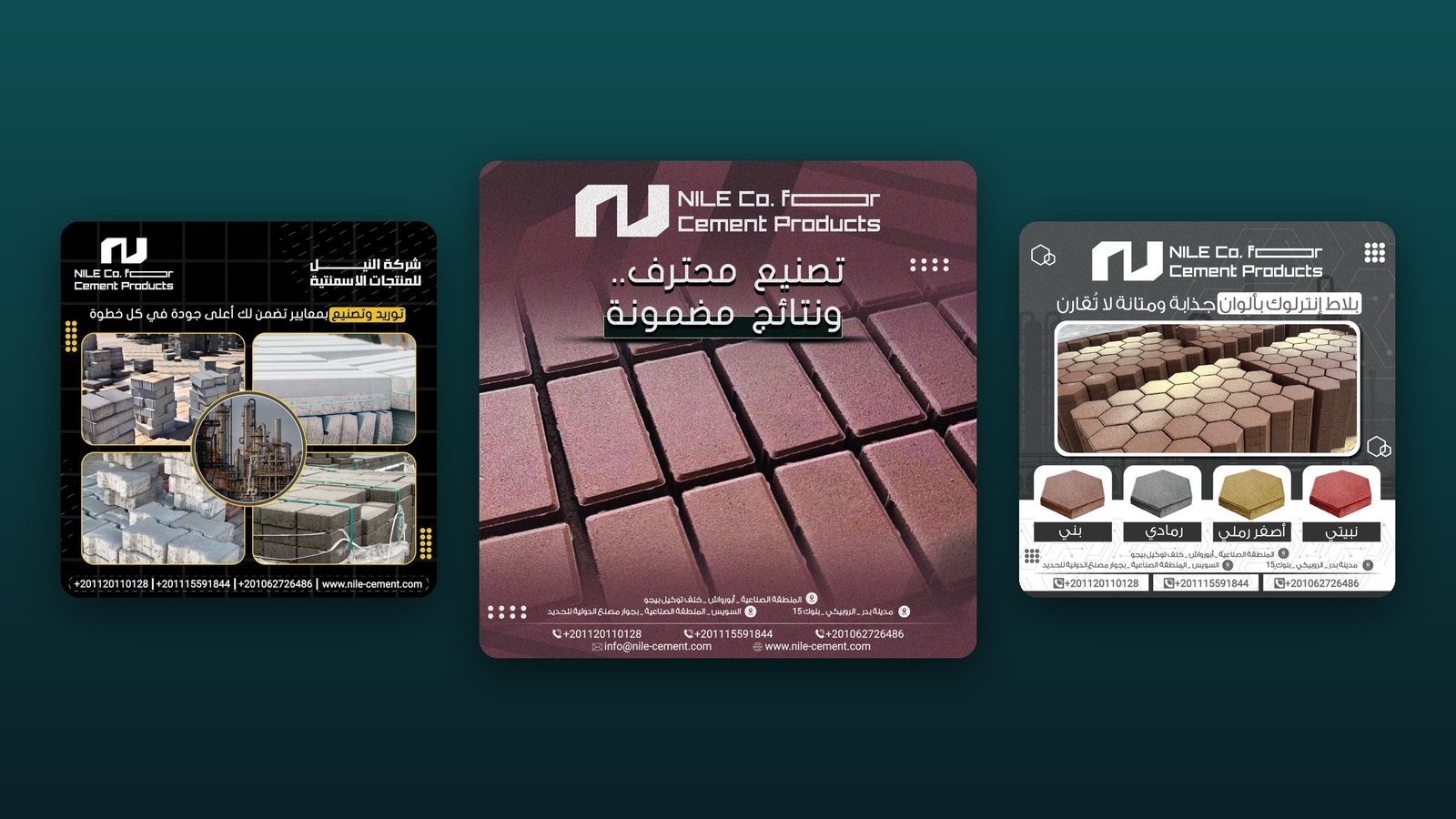
RX’s identity work for Nile Co. for Precast Cement Products (Nile Cement), an Egyptian manufacturer producing across three sites, shows the principle in practice. Precast products such as interlock pavers, curbstones and blocks look alike to buyers, so the identity had to signal quality and consistency rather than novelty. The work covered an Arabic and English logo system with a teal colour palette and a technical type style, business cards and letterhead for sales and tenders, site and PPE branding, and a high volume of social content built around the product line, factory and delivery, written for contractors, developers and engineers. The identity put forward the products buyers order rather than replacing them with brand language. To keep a high-volume feed fresh without weakening recognition, the Nile system rotates visual seasons (black and amber, deep blue, green and cobalt) while the logo, footer and contact system never change.
The lesson for other industrial companies: the identity should make the existing business easier to recognise across every surface a buyer sees, not reinvent what the business is.
How to tell whether the channel accepted the change
A manufacturer does not need a brand-tracking study to know whether a rebrand landed. Watch what the channel does in the first three months:
- Dealer questions. Log every call or message asking whether new stock is genuine, whether prices changed or which pack to order. The number should fall quickly; if it does not, the announcement did not reach the counter.
- Order and delivery issues. Count orders placed under old product codes that could not be matched, and deliveries queried at site because the paperwork looked different.
- Procurement friction. Track invoices rejected or vendor records reopened because of the name or document change.
- Old identity still in use. Ask the sales team to photograph dealer signs, trucks and forms still carrying the old identity and give each one an owner and a date.
- Specifier feedback. Ask the consultants who specify you whether submittals with the new documents went through without questions.
If these signals are quiet by the end of the first quarter, the channel has absorbed the change. If they are not, the problem is almost always communication, not design, and the fix is another round of direct contact with the dealers and accounts concerned.
For a factory whose products have moved ahead of its image, the goal of an industrial brand identity project is not to look different. It is to look like the company buyers already trust, finally presented at the level of its products.
Frequently asked questions
When should a manufacturing company rebrand?
When its identity no longer matches the quality, scale or range of what it makes and that gap is costing it credibility with buyers, specifiers or tender committees. A dated logo alone is a reason to refresh, not to rename.
Should we change our company name during a rebrand?
Usually not, if buyers order by name. Change it only if the current name is legally weak, misleading about what you now make, or shared with others in your market, and clear the new name as a trademark in every country you sell in before design starts.
What do we do with old packaging and stock already at dealers?
Set a cut-over batch or date with production, let existing stock sell through, and tell dealers in writing that both old and new packs are genuine. A short line on new packs and a before-and-after sheet help dealers answer customers at the counter.
Do product names and codes need to change with the new identity?
No, and they generally should not. Specifications, approved lists and price lists refer to them. If a range must be renamed, publish a table mapping each old code to the new one and keep it available while old specifications are in use.
How do we check trademark availability for a new name in Saudi Arabia or Egypt?
In Saudi Arabia, search SAIP's IP search engine and consider using an IP agent. In Egypt, confirm the current procedure with the national IP authority or a licensed agent: an EU IP Helpdesk fiche and a 2025 INPI fiche name different offices and opposition periods (two months versus 30 days). This is general information, not legal advice.
- RX Designer, Nile Cement case study.
- World Intellectual Property Organization (WIPO), Trademarks.
- Saudi Authority for Intellectual Property (SAIP), IP Search Engine.
- Saudi Authority for Intellectual Property (SAIP), Trademarks.
- European Commission, Intellectual Property Helpdesk, IP Country Fiche: Egypt.
- INPI (France), Fiche PI Égypte 2025 (2025-06).