- Give each discipline you deliver yourselves its own page with scope, systems, projects and a named contact.
- Turn projects into fact-based pages; keep filter combinations out of search unless they deserve a written page.
- Publish classification grades and certificates exactly as on the documents, and check them every quarter.
- Build city pages and Business Profiles only where you have a real presence, using your real business name.
A consultant shortlisting MEP subcontractors opens your website to confirm three things: what you deliver yourselves, at what scale, and under which classification. If the site cannot show that in a few minutes, the next name on the list gets the call. The same check is made by a developer’s procurement team or a main contractor looking for a subcontractor.
This guide sets out a structure that answers those checks and the searches behind them. It also explains how the same structure helps you appear when someone searches for an “MEP contractor in Riyadh” or a “fire fighting contractor in Jeddah”. The two goals point the same way: pages specific enough to convince an engineer are the pages search engines can match to specific queries. The pages every B2B company site needs (home, about, contact, downloads) are covered in our B2B website checklist for the Gulf; this guide deals with what is specific to contractors.
What the person vetting you is checking
A consultant or developer reviewing contractors is not reading your homepage copy. They are trying to answer a short list of questions, usually in roughly this order:
- Scope: which disciplines do you deliver yourselves, and which do you subcontract?
- Scale: what is the largest comparable project you have completed, and for whom?
- Eligibility: what is your classification or registration, in which fields, and is it current?
- Capability: who are your engineers, what equipment and approvals do you hold, and what is your safety record and system?
- Coverage: which cities or regions can you mobilise to?
- Contact: who do they speak to about a tender or a site visit?
Every section below exists to answer one of these questions without forcing the reader to email you first. Vague language (“integrated solutions”, “highest quality standards”) suggests to the reader that you have nothing specific to show.
Organise services by discipline, then by what you actually do in each
A structural mistake we see often is a single “Services” page listing everything in one paragraph. For a contractor, each discipline deserves its own page, because each one is evaluated by a different engineer and searched for with different words.
A practical top level for an MEP or electromechanical contractor looks like this: HVAC, fire fighting and fire alarm, plumbing and drainage, electrical (low and high current, as relevant), and, if you offer it, operation and maintenance. A general contractor would add civil and structural works, finishing and fit-out. Do not create a page for a discipline you only subcontract occasionally; it is likely to be the page that lets you down in a technical interview.
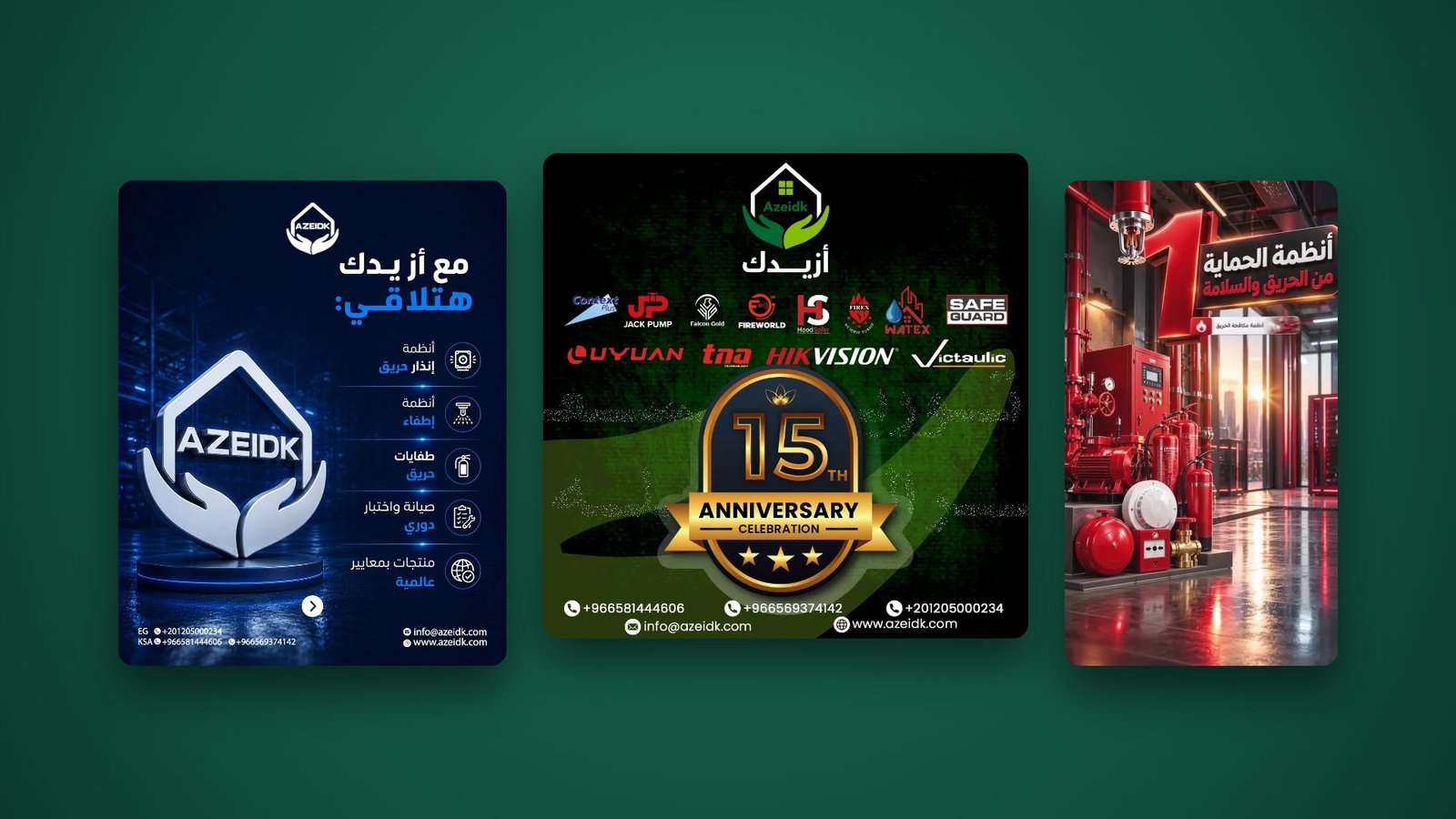
For Azeidk, a contracting and electromechanical company in Saudi Arabia and Egypt, RX organised fire fighting, fire alarm, MEP, CCTV, maintenance contracts and technical supply into clear service categories used on the website, the company profile and every campaign.
Each discipline page should carry the same blocks, so a consultant comparing you across disciplines finds information in the same place:
| Block | What it should contain | Why it matters to the reader |
|---|---|---|
| Scope statement | Design-and-build or build-only; supply, installation, testing and commissioning; maintenance | Tells the reviewer where your responsibility starts and ends |
| Systems covered | Named systems (for example chilled water, VRF, sprinkler, foam, clean-agent suppression, BMS integration) in plain terms | Lets an engineer match you to the specification |
| Project types | Hospitals, warehouses, towers, factories, residential compounds, government buildings | Shows whether you have done their kind of building |
| Selected projects | Three to six linked project pages for this discipline | Proof, not claims |
| Approvals and standards | Only those you hold or routinely work to, stated accurately | Answers the eligibility question early |
| Named contact | The person or department that handles tenders for this discipline | Removes friction at the moment of interest |
Write these pages in the language your buyers use in tender documents and in search. Engineers search for the system and the place, not for your tagline. In our view, a page titled “Fire Fighting and Fire Alarm Contracting in Saudi Arabia” will do more for both readers and search than one titled “Safety Solutions”.
Project pages a consultant can actually use
Projects are the strongest evidence a contractor has, and many sites waste them in an image gallery with no text. A consultant cannot shortlist a photograph. Give every significant project its own page with a consistent fact block:
- Project name and type (as far as your client allows you to name it)
- City and country
- Client, consultant and main contractor, where you have permission to state them
- Your scope by discipline
- Status and completion year
- Scale indicators you can stand behind (for example floor area, number of floors, or system capacity), only if accurate
- A short paragraph on what was difficult and how you handled it
- Site photographs with descriptive captions (see our guide to project photography and video that work as references)
Get written permission before naming clients or showing their buildings. If a client will not allow it, describe the project generically (for example, “a 12-storey private hospital in Riyadh”); it is still more useful than a logo wall.
Hypothetical example of a filled fact block. The project below is invented to show the format; replace every field with your own documented facts.
| Field | Entry |
|---|---|
| Project | 12-storey private hospital, Riyadh (client not named at its request) |
| Consultant and main contractor | [Named only with written permission] |
| Our scope | HVAC (chilled water, air-handling units); fire fighting (wet riser, sprinklers, clean-agent suppression for server rooms); low current (fire alarm, CCTV). Supply, installation, testing and commissioning |
| Status | Completed [year] |
| Scale | [Floor area or number of beds, only if you can document it] |
| What was difficult | Phased handover floor by floor while occupied wards stayed open, with shutdowns scheduled at night |
| Photographs | Plant room, riser and ceiling services before close-up, each captioned with system and location |
Note what the block avoids: no adjectives, no claim that cannot be checked, and a scope line an engineer can compare with the specification.
Filtering without creating thousands of junk URLs
A filterable project list (by discipline, sector, city and status) is genuinely useful to a reviewer. It can also create a near-endless set of filter combinations that search engines crawl instead of your real pages. Google’s guidance on faceted navigation (last updated December 2025) says that if you do not need filtered URLs in search, you should prevent them from being crawled, keeping the individual item pages and the unfiltered listing crawlable. It also notes that filters held in the URL fragment (after the “#”) are generally not used for crawling at all.
The practical approach for most contractors: let the filters work for people, keep each project page and the main “All projects” page indexable, and, where a combination has real search value (such as “hospital projects”), build it as a proper, written page rather than relying on a filter URL.
For the photographs themselves, Google’s image SEO best practices recommend descriptive alt text, short descriptive file names instead of camera defaults, images placed near relevant text, and standard image elements rather than CSS backgrounds, which Google does not index.
Credentials, HSE and the downloadable profile
This is the section consultants look for and contractors most often bury. Make it a top-level page, often called “Qualifications” or “Credentials”, that contains:
- Classification and registration. In Saudi Arabia, according to Muqawil’s Certificate of Compliance with Technical Standards page, the classification (technical grade) of contractors and other urban service providers is requested through the Balady platform and completed on Muqawil, where the Saudi Contractors Authority reviews and approves it; the approved grade then appears in Balady. Balady also provides an inquiry service to search for and verify classified establishments by classification type, field and city, with optional filters such as certificate grade and expiry date. These procedures change, so check the current process on both platforms, but assume a careful reviewer will look you up. State your fields and grades exactly as they appear on your certificate, with the expiry date, and update the page when they change. The same Muqawil page asks applicants to make sure their engineers and technicians are registered with the Saudi Council of Engineers, which is one more reason to present your engineering team accurately. In Egypt, the UAE and Qatar, list the registrations and approvals you hold with the relevant authority, in that authority’s own wording.
- Quality, environmental and safety management systems. List only certificates you hold, with the certifying body and validity. Do not show a certificate logo for a standard you are “working towards”.
- HSE. A short statement of your safety system, how inductions and permits to work are handled on site, and any safety metrics you formally track and are willing to publish. A photograph of a toolbox talk says more than a paragraph about “safety culture”.
- Manufacturer and brand approvals. If you are an approved installer for specific equipment brands, say so with their permission and under their guidelines.
The company profile download
Offer the company profile as a downloadable PDF, linked from the credentials page, every discipline page and the footer. Google lists PDF among the file types it can index, so the file itself can be found, but do not let it replace web pages: the key facts must also exist as HTML on the site. Keep a version date on the cover, use a stable file name that does not change with each update, and keep the file small enough to open on a site engineer’s phone. If you are preparing a profile for formal pre-qualification, the structure differs from a marketing download; we cover that in the company profile that wins pre-qualification.
Ranking for “MEP contractor in Riyadh” without doorway pages
Searches such as “mep contractor in riyadh” combine a discipline and a place. Matching them takes three things working together.
First, specific discipline pages, as described above. A single generic services page cannot rank for five different disciplines.
Second, location pages only where you are genuinely present. If you have an office, a yard or an active project base in Riyadh, Jeddah and Dammam, a page for each city with its address, team contact, the projects delivered in that region and the disciplines you cover there is useful. Ten near-identical pages with only the city name swapped are not. Google’s spam policies list “multiple domain names or pages targeted at specific regions or cities that funnel users to one page” as an example of doorway abuse, and consultants notice the pattern too.
Third, a correct Google Business Profile for each real location. Google’s Business Profile guidelines say your business name should reflect the real-world name and that unnecessary additions, such as marketing taglines, are not permitted; a profile named “Company X Best MEP Contractor Riyadh” breaks this rule. If you serve customers only at their sites, with no office they can visit, the guidelines allow one service-area profile and say the address should be hidden. We cover branch profiles in more depth in Google Business Profile for multiple locations.
On the technical side, Google’s LocalBusiness structured data documentation (updated September 2026) requires a name and address, recommends the most specific business type available, and supports nested departments. Schema.org includes specific types for this sector, such as GeneralContractor, HVACBusiness, Electrician and Plumber. Mark up each real location with the type that fits; Google’s structured data guidelines require markup to be a true representation of the page content and not to describe content readers cannot see.
Finally, write the pages in both Arabic and English if your buyers search and read in both, which is common when local clients and international consultants sit on the same project. We recommend giving each language version its own URL and properly written content rather than an unedited machine translation; the set-up of separate Arabic and English URLs, including hreflang and right-to-left layout, is covered separately.
A careers section that recruits and reassures
Contractors hire constantly, and a careers section does two jobs: it brings in engineers, technicians and supervisors, and it signals to clients that you have the workforce to deliver. Include current openings, the disciplines you hire for, the cities you work in, and a short, honest description of what working on your sites is like. What to say to candidates is covered in our guide to employer branding for engineers and site teams.
Google supports JobPosting structured data, which can make your openings eligible for Google’s job search experience. According to that documentation (updated September 2026), the experience is available in Saudi Arabia, the UAE, Egypt and Qatar, among other countries. It requires the job title, full description, date posted, hiring organisation and job location. The documentation also states that expired postings are not allowed: remove them, or keep the validThrough date set in the past, because failing to act in time may lead to a manual action. If no one will maintain the listings, a simple “send us your CV” page is safer than a job board full of stale vacancies.
What a working example looks like, and a pre-launch checklist
The structural point to take from any good example is the one above: separate the markets where the buyer, the approvals and the language differ, and give documents and projects their own place. The live websites RX has built, including sites for companies in fire safety, food trading and freight, show how that structure carries across sectors. The Azeidk Group website RX built applies the first half of that point at group level: it sends every visitor to the right country and language, Saudi Arabia or Egypt, Arabic or English, before they reach a company’s pages.
Before you launch or relaunch a contractor website, check:
- Each discipline you deliver yourselves has its own page with scope, systems, project types, linked projects and a named contact.
- Every significant project has a page with a fact block, and you have permission for every client name and photo.
- Project filters do not generate crawlable junk URLs; the main project list and every project page are indexable.
- Classification fields and grades, certificates and approvals match the current documents, with expiry dates.
- The company profile PDF is current, dated, quick to open on a phone and linked from the credentials and discipline pages.
- City pages exist only where you have a real presence, and each has its own content.
- Google Business Profiles use your real business name, with no added keywords.
- Structured data matches the visible page content.
- Arabic and English versions are both written for the reader, on separate URLs.
- The careers section has an owner, and expired vacancies are removed.
- A consultant can reach a named person for tenders in two clicks from any page.
If your website was built before your company reached its current scale, it is usually the structure, not the design, that needs rebuilding first. Start by drafting one discipline page and one project fact block from the templates above; if the facts are hard to assemble, that is the gap to close before any redesign. Discipline pages, project fact blocks and the credentials page are where our website design work starts, with SEO for the discipline-and-city searches your buyers actually make.
Frequently asked questions
What pages should a construction or MEP company website have?
At minimum: a page per discipline you deliver yourselves, individual project pages, a credentials page covering classification, certificates and HSE, a downloadable company profile, location pages for real offices, a careers section and a clear tender contact.
Should we publish our classification grade on the website?
Yes, if it helps you qualify. State the fields and grades exactly as they appear on your certificate, with the expiry date. In Saudi Arabia, Balady provides an inquiry service for checking classified establishments, so the figures on your site must match.
How do we rank for searches like 'MEP contractor in Riyadh'?
Combine a specific discipline page, a genuine Riyadh location page (if you have a presence there), a correct Google Business Profile under your real business name, and LocalBusiness structured data that matches the visible page. Near-identical city pages risk being treated as doorway content.
Is a PDF company profile enough on its own?
No. Google can index PDFs, but key facts such as disciplines, projects and approvals should also exist as web pages. Use the PDF as a dated, downloadable summary linked from the credentials and discipline pages.
Can our job openings appear in Google's job search?
Google's JobPosting structured data documentation lists Saudi Arabia, the UAE, Egypt and Qatar among the countries where its job search experience is available. You need the required properties, and expired jobs must be removed or have a validThrough date in the past; failing to act in time may lead to a manual action.
- Google Search Central, Managing crawling of faceted navigation URLs (2025-12-18).
- Google Search Central, Image SEO best practices (2026-03-02).
- Google Search Central, File types indexable by Google (2026-02-03).
- Google Search Central, Local business (LocalBusiness) structured data (2026-09-08).
- Google Search Central, Job posting (JobPosting) structured data (2026-09-08).
- Google Search Central, Spam policies for Google web search (2026-08-28).
- Google Business Profile Help, Guidelines for representing your business on Google.
- Google Search Central, General structured data guidelines.
- Schema.org, HomeAndConstructionBusiness.
- Balady platform, Saudi Arabia, Inquiry about service providers classification.
- Muqawil (Saudi Contractors Authority), Certificate of Compliance with Technical Standards.
- RX Designer, Websites — RX Designer work.