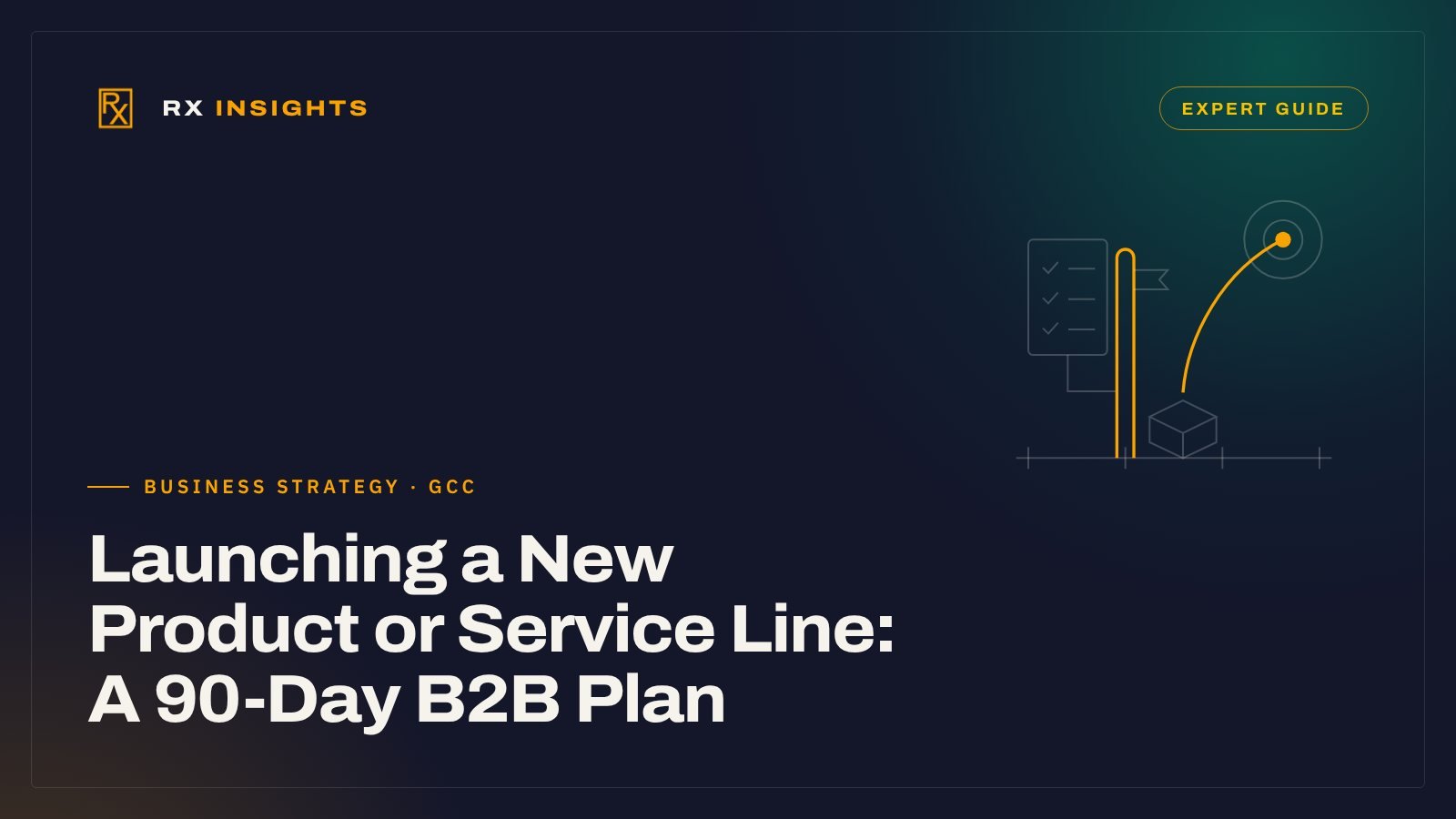
- Name the growth move first: a new offer for existing customers needs a different plan from a new market or new buyers.
- Days 1-30 produce decisions and documents, including checking that the new activity is on your commercial register or licence.
- Hold the launch until the price list, quotation template, WhatsApp replies and sales briefing are approved.
- Tell existing customers before the public, and judge day 90 on enquiries, quotations and orders, not reach.
Most established companies do not fail at launching a new product or service line because the idea was wrong. They fail in the first few weeks, when the announcement is out, enquiries arrive, and the sales team has no price list, no quotation template and no agreed answer to “how is this different from what you already sell us?”. The marketing looked finished; the business was not ready to sell.
This guide sets out a 90-day launch plan for a company that already has customers, a sales team and a brand, and is adding something new: a product line, a service line, or a new branch or city. It is written for CEOs, sales directors and marketing directors in Saudi Arabia, the UAE and Egypt, and it puts the sales-readiness work in the place it belongs: before the launch date, not after.
It is not a guide to launching an international brand you have just become the agent for; that has its own sequence, covered in our piece on launching a represented brand as exclusive distributor.
1. Name the move you are making before you plan it
A useful starting point is the product-market grid Igor Ansoff set out in “Strategies for Diversification” (Harvard Business Review, 1957), usually called the Ansoff Matrix. It sorts growth into four moves: selling existing products to existing markets (market penetration), taking existing products to new markets (market development), offering new products to existing markets (product development), and new products in new markets (diversification). Summaries of the model, such as Shopify’s overview, describe risk rising from penetration to diversification.
For a launch plan, the quadrant tells you where the work sits:
| Your launch | Ansoff move | Where most of the effort goes |
|---|---|---|
| New product or service sold to your current customers | Product development | Explaining the new offer and pricing it against what customers already buy from you; existing accounts are your first audience |
| Existing service in a new city, branch or country | Market development | Local visibility, local registration and licences, local references, and a team that can answer quickly in the new location |
| New offer for buyers you do not serve yet | Diversification | Almost everything: positioning, audience research, credibility and a sales process built from scratch |
Be honest about the quadrant. A contractor adding a maintenance service for its own past clients is in a very different position from the same contractor selling maintenance to facilities managers it has never met, even though both get described internally as “the new service”.
2. Days 1–30: decide, register and build the launch brief
The first month produces decisions and documents, not posts. By day 30 you should have a one-page launch brief signed off by the CEO and the sales director. It answers seven questions:
- What exactly are we launching? Scope, what is included and excluded, and the name customers will see in Arabic and English.
- Who buys it, and who decides? The job titles that sign, approve and use it. In B2B these are often three different people.
- Why would they switch or add it? One sentence on the problem it solves, plus the proof you can show today.
- How is it priced? List price, discount authority (who can approve what), payment terms and validity period.
- Which channels carry it? Existing account managers, WhatsApp, LinkedIn, search, an exhibition, a partner network.
- Who owns it? One named owner for the launch, with marketing and sales leads beneath.
- What does success look like at day 90? Targets agreed now, not invented later (see section 5).
Check the paperwork for the new activity
A new line can mean a new licensed activity. In Saudi Arabia, the Ministry of Commerce service to modify a company’s main commercial register data covers adding activities through the Saudi Business Center platform; its listed conditions include an active registration, the activity falling within the company’s objectives, and a valid licence where the activity needs one before it can be issued. Sole proprietorships have their own services, such as updating operating licence data. Commercial register rules and service conditions change, so check the current requirements on the ministry’s page before you apply. In the UAE and Egypt, confirm the activity appears on your trade licence or commercial register with the relevant authority before you advertise it. This is a question for your legal or PRO team, but marketing should not set a public date until it is answered.
Also decide early what the launch is not allowed to say. If the service needs a certification, an approval or a supplier agreement that is still pending, the copy has to wait for it.
3. The sales-readiness kit most launch plans skip
Every item below should exist, be approved and be in the sales team’s hands before day 31.
| Item | What it must contain | Owner |
|---|---|---|
| Price list | Codes or service names matching the quotation, list prices, what is included, validity date, VAT treatment, version number | Sales director, finance |
| Quotation template | Scope, exclusions, payment terms, delivery or mobilisation time, validity, terms and conditions, bilingual where your buyers need it | Sales, finance |
| WhatsApp replies | Saved replies for the five questions you will get most (price, availability, location, lead time, “send me details”), plus greeting and away messages | Sales, marketing |
| Sales briefing | A short deck: what it is, who buys it, how to open the conversation, price and discount rules, how to hand over to delivery | Launch owner |
| Objection sheet | The likely objections with an approved answer for each, including “why should we buy this from you?” | Sales director |
| Existing-customer announcement | An email and a personal message from the account manager, sent before the public post | Account managers, marketing |
| Web page and listings | A dedicated page for the new line, linked from the main navigation, and the service added to your Google Business Profile | Marketing |
Price and tax details that cause friction
Quotations get questioned when tax is unclear. Saudi Arabia’s standard VAT rate has been 15% since 1 July 2020, according to ZATCA’s guideline on the rate increase; the UAE Federal Tax Authority’s VAT page shows a 5% standard rate. In Egypt, confirm the applicable rate for your product or service with your tax adviser. State on every quotation whether prices include or exclude VAT. In Saudi Arabia, for VAT-registered businesses the invoice that follows the quotation must be issued through a compliant electronic solution under ZATCA’s e-invoicing (FATOORAH) rules, so check that the new codes or service lines exist in your invoicing system before the first order arrives, not after.
WhatsApp and Google set-up
The WhatsApp Business app lets you greet people when they start a conversation, reply while you are away, show your products and share items with prices; its feature list also includes quick replies for messages you send often and labels for sorting conversations. Load the new line before launch so the first enquiry gets a complete answer. On Google, service businesses can add and edit services on their Business Profile, which then appear under Services in Google Maps; note that custom service names containing prices or phone numbers are rejected.
This is the work we build under sales enablement: sales messaging and scripts, WhatsApp and email flows, and proposal and quotation content, written so the team can use them on day one.
4. Days 31–60: launch in the right order
Sequence matters more than volume. The people who already trust you should hear first, your own team should be able to answer before the public asks, and paid media should come last, once you know the replies work.
- Week 5: internal launch. Run the sales briefing live, role-play three typical enquiries, and confirm who answers WhatsApp, calls and website forms, and how quickly.
- Week 5–6: existing customers. Account managers send the personal message and the announcement email. For a new branch, tell customers in that city first. Ask for two or three early orders or pilot projects that can later become references, with the client’s approval.
- Week 6: public announcement. The web page goes live, followed by the LinkedIn and social announcement in Arabic and English. Every post points to one place: the page, a WhatsApp link or a quotation request.
- Weeks 7–8: content that explains. Short posts or reels on what the new line solves, how it works, and a frequently asked question each week. Technical buyers need explanation more than slogans.
- Weeks 7–9: paid support, if justified. Search ads for the terms buyers use, LinkedIn for named job titles, or click-to-WhatsApp ads when your team can answer fast. Keep the ad accounts in your company’s name.
Check your launch window against the calendar: Ramadan, Eid holidays, summer slowdowns and the exhibitions your buyers attend all change how quickly decisions are made. Your annual marketing plan should already mark those dates; place the launch around them.
5. Days 61–90: judge it by the numbers you agreed
A launch judged on followers and impressions will always look successful. Judge it on the commercial chain instead, working backwards from the sales target in the launch brief.
| Measure | Why it matters | Where it comes from |
|---|---|---|
| Qualified enquiries for the new line | Shows whether the market noticed and understood the offer | WhatsApp labels, CRM or a shared sheet, form submissions |
| First-response time | The first test of sales readiness | WhatsApp and CRM timestamps |
| Quotations issued | Shows whether enquiries are serious and the team is following up | Quotation register |
| Quotation-to-order rate | Tests price, terms and the objection answers | Quotation register and orders |
| Orders from existing customers vs new | Tells you whether the line is growing the customer base or only the share of wallet | Sales records |
To set the targets, work from your own history. As a hypothetical illustration, a company that wants ten orders of the new line in the first quarter, and whose quotations usually convert at around one in four, needs roughly forty quotations, and enough qualified enquiries to produce them. If your conversion history for comparable lines is different, use your own figure; the point is that the enquiry target is derived from the sales target, not chosen because it sounds achievable.
At day 90, hold one review with sales and marketing together. Decide three things: what to keep, what to fix (usually price presentation, response speed or the main message), and whether the line now moves into the normal monthly plan or needs a second, more focused push.
6. Where launches usually break
- The announcement goes out before the price list exists. The first enquiries get “we will send details”, and the momentum goes.
- Existing customers learn about it from social media. Your best buyers should never hear second-hand.
- The new line is a paragraph on an old page. Without its own page, it cannot rank, cannot receive ad traffic properly and cannot be shared by sales.
- Nobody owns it after week six. Launch energy fades; a named owner with a day-90 review keeps it alive.
- Claims run ahead of approvals. If a certification, licence or supplier agreement is pending, the copy waits.
Before day one, put the launch brief, the price list and the quotation template on one table with the sales director. If any of the three is missing, the launch date moves, not the announcement. For an example of identity, launch and sales tools prepared together for a market entry in Saudi Arabia, see the GCS case study; our launch and go-to-market planning work prepares the plan and the tools together, and the wider strategic choices behind a launch are covered in our guide to go-to-market strategy in Saudi Arabia.
Frequently asked questions
How long should a B2B product launch plan cover?
Ninety days is a practical structure for an established company: about 30 days of decisions and sales readiness, 30 days of launch activity in sequence, and 30 days of measurement and correction before the line joins the normal monthly plan.
What is the difference between a go-to-market plan and a launch plan?
The go-to-market plan sets the strategic choices: who buys, the offer, pricing and channels. The launch plan is the dated sequence that puts those choices into action, including the sales tools and the order in which audiences hear about the new line.
Should existing customers hear about a new service before the public announcement?
Yes. A personal message from the account manager and an announcement email before the public post respect the relationship, and existing customers are often the quickest source of first orders and later references.
Do I need to update my commercial registration before launching a new service in Saudi Arabia?
If the new line is an activity not already on your commercial register, the Ministry of Commerce service for modifying a company's main commercial register data covers adding activities, subject to its conditions, which can change. Check the current requirements and confirm with your legal or government-relations team before announcing.
- Shopify, Strategies for Diversification (Igor Ansoff, Harvard Business Review, 1957) — summarised in: Ansoff Matrix.
- Ministry of Commerce, Saudi Arabia, Modify the Company's Main Commercial Register Data.
- Ministry of Commerce, Saudi Arabia, Updating the operating license data for a sole proprietorship.
- Zakat, Tax and Customs Authority (ZATCA), Guideline on the VAT rate increase to 15% (2020).
- Zakat, Tax and Customs Authority (ZATCA), What is e-invoicing.
- UAE Federal Tax Authority, VAT.
- WhatsApp (Meta), WhatsApp Business App.
- WhatsApp (Meta), WhatsApp Business App features.
- Google Business Profile Help, Add or edit services on your Business Profile.