- State the standard, edition, issuing body and certificate number for every product, and never imply a Saudi approval you do not hold.
- An EOS Conformity Certificate covers a specific supply; the Conformity Mark and quality marks are standing schemes. Explain which you have.
- Every test value needs a unit, a test method, a lab, a date and a minimum-or-typical label, identical in Arabic and English.
- Expect distributors to weigh the packing, minimum-order, lead-time and Incoterms table as heavily as the specification.
Your catalogue gets read twice in the Gulf. A distributor’s sales manager looks at it first and asks one question: can I sell this? Then it goes to a procurement engineer, a consultant or the distributor’s own technical team, and they ask something harder: can I approve this, and can it get through Saudi conformity checks? It is easy to design for the first reader and lose the deal with the second.
This guide follows that second reader. It sets out what they check in an Egyptian manufacturer’s technical catalogue and datasheets, in roughly the order they check it, and what to fix before the file goes out. It does not cover catalogue structure or price lists in general (we cover those in our guide to B2B product catalogues for distributors). This one is about export credibility.
Why the catalogue is getting more scrutiny now
More Egyptian product is reaching Gulf buyers. More of those buyers are seeing an Egyptian supplier for the first time, too. Chemicals are a clear example. According to the Export Council for Chemical Industries and Fertilisers, as reported by Daily News Egypt on 11 October 2026, the sector’s exports to Saudi Arabia rose 98% to about $356m in January to August 2026, up from $180m a year earlier. That made the Kingdom the sector’s sixth-largest market. Petrochemicals (about $102m), fertilisers and pesticides ($51m), plastics ($44m), detergents (about $41m) and inks and paints ($31m) led the categories. The same report says the council plans to take part in four Saudi exhibitions in 2026 and five in 2027.
The state is also paying for exports, and it rewards more than volume. Egypt’s export support programme for fiscal year 2025/26 had a budget of EGP 45bn, up from EGP 23bn, with EGP 38bn for targeted sectors and EGP 7bn as a flexible reserve (Business Today Egypt, 3 June 2025). Enterprise reported engineering industries at about EGP 7bn and chemicals at EGP 6.1bn. Business Today did not give per-sector amounts, but it did list trade-show participation, strategic market entry and branding among the additional criteria. For fiscal year 2026/27, which began on 1 July 2026, the budget allocates EGP 48bn to export subsidy programmes for goods and services (Business Today Egypt, 1 June 2026); we did not find the new programme’s sector split or criteria. Check the current programme rules with your export council.
The likely result is more Egyptian suppliers chasing the same Gulf buyers. When two offers look alike on price, our view is that the technical file is often what decides which supplier gets approved.
Check one: which standard, and whose certificate
The first thing a Gulf engineer looks for is the standard each product is made and tested to, with the edition year. The second is proof that an independent body has confirmed it. Two habits tend to cause trouble here. One is a row of logos with no explanation. The other is the word “certified” with no indication of who certified what.
Explain your Egyptian marks properly
The Egyptian Organization for Standardization and Quality (EOS) issues several different things, and a Saudi reader may not know the difference unless you tell them:
- Egyptian Conformity Mark. EOS describes it as a mark confirming that a product conforms to the relevant mandatory Egyptian standard, backed by periodic testing and inspection of the product (EOS).
- Quality marks. EOS says it is the competent body for granting quality marks to local industrial products that conform to Egyptian standards, with periodic inspection of licensed products (EOS).
- Conformity Certificate. This one is narrower. EOS issues it for a specific quantity of a product after sampling and testing, and it “is exclusive for the detailed supply indicated in the certificate” (EOS). It is not a standing approval of the product line. If your catalogue presents it as one, an experienced reviewer is likely to notice.
For each mark, state which products it covers, the standard number, the issuing body and the certificate or licence number, and keep the current copies ready to send. Do the same for ISO management-system certificates: name the certification body and the scope written on the certificate.
Show you understand the Saudi side
An Egyptian mark does not replace Saudi conformity. Regulated products entering the Kingdom go through SASO’s SABER platform. We could not open SABER’s own pages for this guide, so the outline below is taken from secondary summaries. A product certificate is issued by a SASO-approved certification body, and every consignment needs a shipment certificate. Products not covered by a technical regulation use a self-declaration (see the summaries by the US International Trade Administration and SGS). Both describe the importer as the party that registers the product, so expect your distributor to ask you for the technical documents. Check the current process on SABER or with SASO, as the ITA page itself warns that some of its operational detail may be dated.
The technical regulation is what tells you which documents. Take building materials. SASO’s Technical Regulation for Building Materials, Part 3 (Version 1, Amendment II, published in the Official Gazette on 14 January 2022, the latest version we found on SASO’s site in October 2026) covers cement products, ready-mix concrete, mortars, aggregates, concrete admixtures and precast concrete products. Its annex lists the metric version of the ASTM interlocking paver standard as SASO-ASTM-C936M. Under it, cement and ready-mix concrete need the Saudi Quality Mark or an equivalent. Other covered products need a certificate of conformity from a SASO-approved notified body. The product must come with a supplier declaration of conformity, a risk assessment and its country of origin. Ceramic tiles, marble and stone, and sanitary ware fall under Part 4 (Version 2, published March 2019), which has its own rules. Other GCC states run their own schemes. The UAE, for example, issues conformity certificates for regulated products under its Emirates Conformity Assessment Programme (ECAS) through the Ministry of Industry and Advanced Technology.
Check two: test data an engineer can actually use
A specifier compares your datasheet against the project specification line by line. Marketing language does not survive that comparison. Numbers that cannot be traced do not survive it either. What they look for:
- Value, unit, test method. Every figure should show the test standard it was measured to. “Compressive strength 50” means nothing. “Compressive strength, average, MPa, tested to [standard and year]” does. SASO’s Part 3 regulation requires SI units in design, manufacturing and trading.
- Minimum or typical. Say which one. A typical value read as a guaranteed minimum can end in a rejected batch and a lost distributor.
- Who tested it and when. Name the lab, say whether it is accredited, and give the report date. Expect distributors to ask for the reports. Have them ready as PDFs named by product code.
- Tolerances and options. Give dimensional tolerances, colour ranges, finishes and any purchaser-specified options the standard allows. The current edition of ASTM C936/C936M (C936/C936M-26), for example, notes that features such as higher compressive strength, surface texture, finish and colour should be specified by the purchaser (ASTM). Quote the edition you actually test to.
- Safety and handling information. For chemical products, keep safety data sheets, storage conditions, shelf life and batch coding on file in the formats your buyers request.
Check three: a bilingual specification that matches itself
For building materials, SASO’s Part 3 regulation says label data “shall be written in Arabic or in both Arabic and English”, along with the supplier’s name, country of origin, storage requirements and, where relevant, validity period and batch number. Your catalogue is not the label. But a reviewer is likely to notice if the catalogue, the label and the datasheet describe the product differently.
Points worth checking before an export file goes out:
- Two languages, two sets of numbers. The English table was updated after the last test. The Arabic table was not. Build both from one data source.
- Local terms. Trade names used on Egyptian sites may not match what a Saudi consultant writes in a specification. Agree a glossary with your distributor and use the standard’s own terminology in both languages.
- Numerals and decimals. Pick one digit style and one decimal convention for the Arabic pages and apply it to every table (our catalogue guide, linked above, covers the bilingual layout side).
- Product codes. One code per product, the same in both languages, on the datasheet, the test report file name and the packing list.
Check four: packing, minimum orders and how the goods arrive
For a distributor, this page can carry as much weight as the specification. They are working out whether your product fits their warehouse, their cash flow and their customers’ order sizes. Put it in one table per product family:
| Item | What the buyer needs to see |
|---|---|
| Unit and pack | Unit size and weight, units per pack, pack dimensions |
| Pallet | Units per pallet, pallet size and gross weight, wrapping, whether pallets are returnable |
| Container | Indicative quantity per 20ft and 40ft container, and whether you allow mixed loads |
| Minimum order | Per product, per colour or variant, and for the first order compared with repeat orders |
| Lead time | From confirmed order to ready for dispatch, stated as a range you can keep |
| Delivery terms | The Incoterms 2020 rules you quote under, with the named place |
| Marking | What is on each pack: product code, batch, production date, origin, storage |
Prices are better kept in a separate dated quotation that uses the same product codes and pack sizes.
Check five: proof of the company behind the product
The last question is whether you can deliver. Your datasheets cannot answer that. The company section of the catalogue has to show:
- Production sites and what each one makes, with real factory photography rather than stock images.
- Management-system certificates and their scope.
- Export experience, with references only where the client has agreed to be named.
- Who handles the Gulf: an export contact by name, plus the agent or distributor if you have one.
- A legal name that matches your commercial register, certificates and invoices. A mismatch here is likely to make a document reviewer look more closely at everything else. (The brand side of this alignment is covered in our pre-expansion diagnosis for Egyptian brands.)
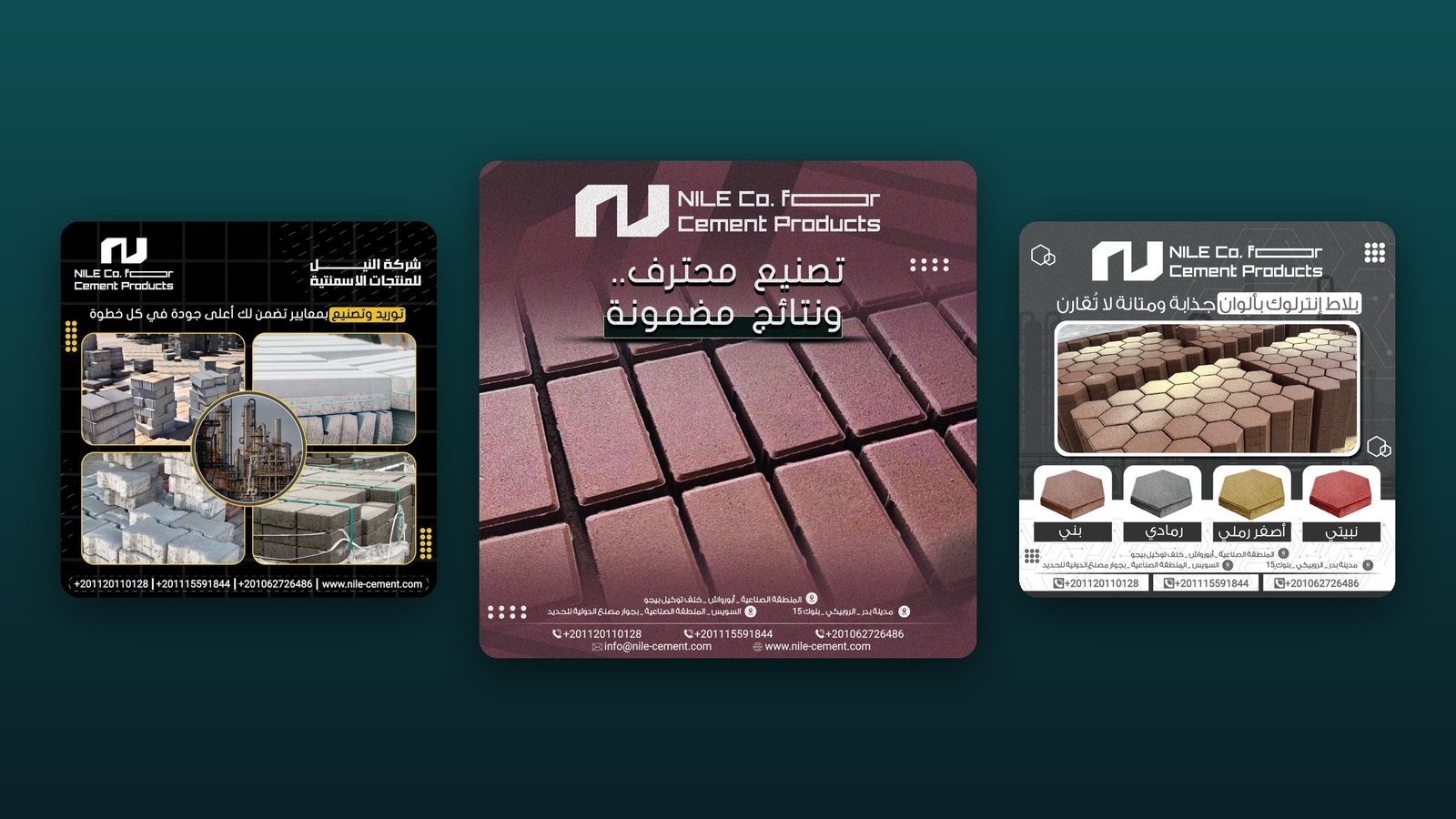
This is a branding job as much as a technical one. The Nile Cement case study describes an Egyptian precast manufacturer of pavers, kerbstones and blocks, with three production sites. For that client RX built a bilingual identity, business stationery and a monthly content programme for contractors, developers and engineers, built around the product line, quality and delivery. An export catalogue calls for the same discipline, applied to a reader who has never heard of you.
What to fix first
For example, take a hypothetical Egyptian paint manufacturer whose first Saudi distributor has asked for “the full technical file”. A sensible order of repair would be:
- Build a certification matrix. List products as rows and markets as columns, with the standard, the certificate, the issuing body and the expiry date. This one sheet drives every claim in the catalogue.
- Rebuild the datasheets from a single data source with test methods, units and minimum or typical labels, in Arabic and English.
- Add the packing and order table for each product family.
- Then redesign. Layout, photography and the company story come last. They matter, but they cannot rescue numbers that do not add up.
RX designs technical catalogues, datasheet layouts and sales kits for manufacturers and distributors through its distributor and product marketing work, and builds the industrial brand identity those documents sit on. The client keeps approval of every technical claim and receives the final source files at handover.
Frequently asked questions
Does an EOS certificate let my product enter Saudi Arabia?
No. Egyptian marks show conformity with Egyptian standards. Regulated products entering Saudi Arabia need conformity under the relevant SASO technical regulation, processed through the SABER platform, with a shipment certificate for each consignment. Check the current regulation and process for your product category with SASO.
What is the difference between the EOS Conformity Certificate and the Egyptian Conformity Mark?
EOS issues the Conformity Certificate for a specific quantity of product after sampling and testing, and it applies only to that supply. The Conformity Mark is a standing mark for products under mandatory Egyptian standards, backed by periodic testing and inspection.
Does the technical catalogue have to be in Arabic for Saudi buyers?
The catalogue itself is a sales document, but SASO's building-materials regulation (Part 3) requires label data in Arabic or in Arabic and English. Bilingual datasheets are the safer choice for Gulf distributors, and the two languages must carry identical figures.
Should prices and minimum orders go in the export catalogue?
Put minimum orders, pack and pallet data, lead times and Incoterms in the catalogue, because buyers screen on them. Keep prices in a separate dated quotation that uses the same product codes.
- Daily News Egypt, Egypt's chemical exports to Saudi Arabia surge 98% to $356m in 8M 2026 (2026-10-11).
- Business Today Egypt, Egypt launches EGP45B new export subsidy program for FY2025/2026 (2025-06-03).
- Enterprise, Egypt doubles upcoming export support program budget, lays out its main components (2025-06-04).
- Business Today Egypt, Egypt allocates EGP 90B in FY2026/2027 budget to boost production and exports (2026-06-01).
- Egyptian Organization for Standardization and Quality (EOS), Egyptian Conformity Mark.
- Egyptian Organization for Standardization and Quality (EOS), Egyptian Quality.
- Egyptian Organization for Standardization and Quality (EOS), Quality – Conformity Certificate.
- International Trade Administration (US Department of Commerce), Saudi Arabia – Testing, Inspection and Certification (2024-10-01).
- SGS, Saudi Arabia SASO Certificate of Conformity.
- Saudi Standards, Metrology and Quality Organization (SASO), Technical Regulation for Building Materials – Part 3: Hydraulic Connections and Related Products (Version 1, Amendment II) (2022-01-14).
- Saudi Standards, Metrology and Quality Organization (SASO), Technical Regulation for Building Materials – Part 4: Bricks, Tiles, Ceramics, Sanitary Ware and Related Products (Version 2) (2019-03-22).
- UAE Ministry of Industry and Advanced Technology, Issue Conformity Certificates for Regulated Products (Emirates Conformity Assessment Programme).
- ASTM International, ASTM C936/C936M-26 Standard Specification for Solid Concrete Interlocking Paving Units (2026-07-17).
- International Chamber of Commerce, Incoterms rules.
- RX Designer, Nile Cement case study.