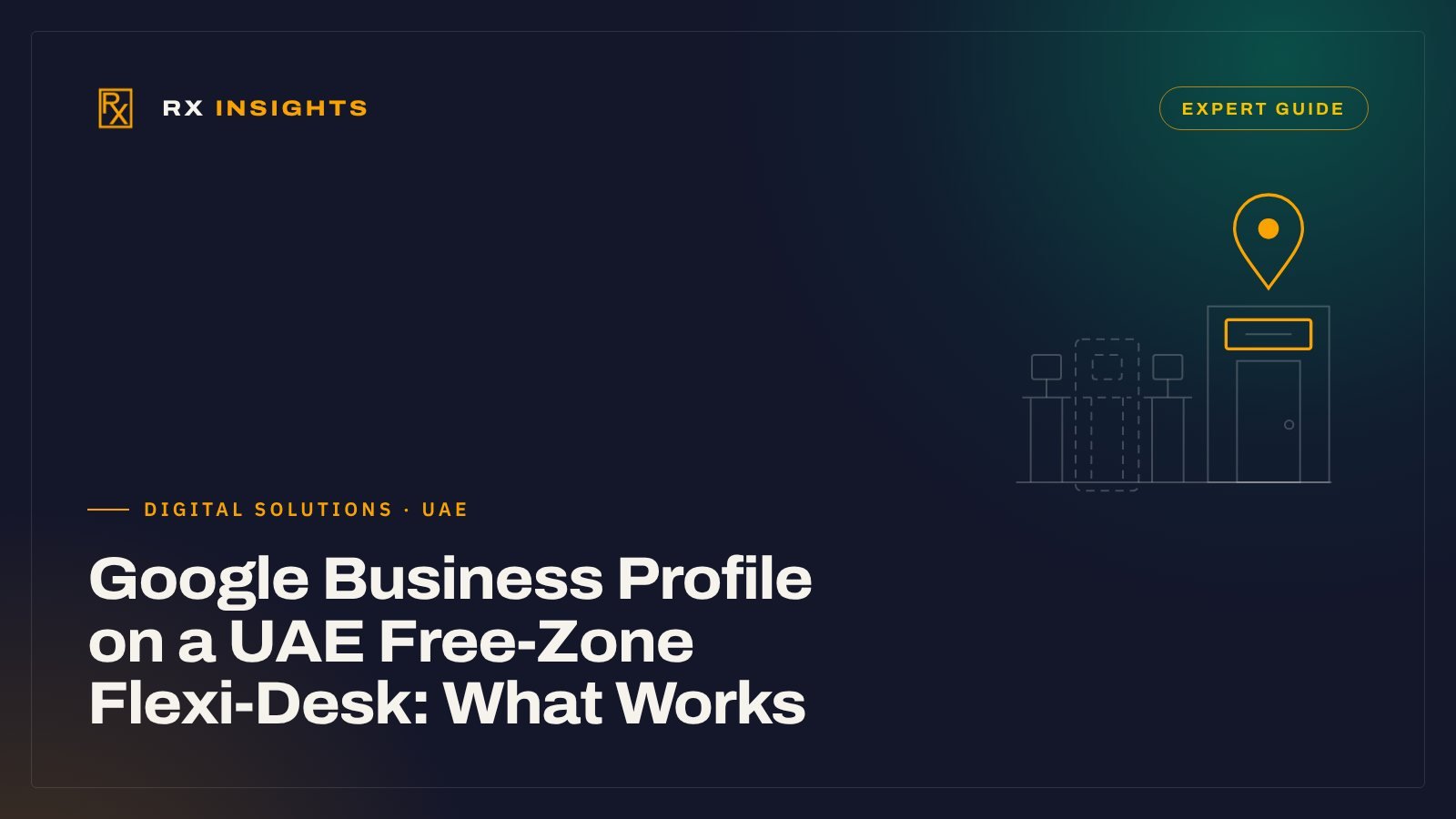
- Google treats virtual offices as ineligible; co-working offices need clear signage, your own staff and customers received during business hours.
- Hiding the address does not help: service-area profiles still need a base staffed during business hours.
- Companies that visit clients get one service-area profile with up to 20 named areas within about two hours' drive.
- If suspended, fix the underlying set-up first, then appeal once with matching documents; never create a new profile.
A free-zone licence gives a company a legal address. It does not give it a Google Business Profile. A familiar sequence: the profile is created at the business-centre address shown on the licence, and it either never verifies or runs for a while and is then suspended. The free zone accepted the address for licensing purposes; Google applies a different test, and a flexi-desk rarely passes it.
This guide explains what Google’s rules say, how a typical flexi-desk package compares against them, and which of four routes fits your company. It also covers how to build local visibility in Dubai and the wider UAE when a Maps listing is not available to you yet. If you are still setting up, it fits inside the wider go-to-market plan for a new UAE company.
Two different tests: the licence address and the Google address
Free-zone authorities describe the flexi-desk as a shared, low-cost base that comes with a registered address. Meydan Free Zone’s guide, for example, contrasts a flexi-desk, described as “shared desks on demand in business lounge”, with a physical office described as a “dedicated private office full-time“, and lists the registered address as included with the licence (Meydan Free Zone, updated May 2026). Masdar City Free Zone says a typical flexi-desk may include access to shared workspaces, a registered business address, meeting-room access and reception support, and that the number of visa allocations depends on the desk or office package chosen (Masdar City Free Zone). Packages differ between free zones and change over time, so read your own contract.
Google’s question is narrower: can a customer meet your staff at this address during your stated hours? Its guidelines for representing your business set out three rules that matter here:
- Virtual offices are out. If a business rents a physical mailing address but does not operate from it, Google says “that location isn’t eligible for a Business Profile.”
- Co-working offices need three things. “Businesses can’t list an office at a co-working space unless that office maintains clear signage”, and the office must also receive customers there during business hours and be staffed by the business’s own employees during those hours.
- Hiding the address does not fix it. “Service-area businesses can’t list a ‘virtual’ office unless that office is staffed during business hours.”
In our experience, an on-demand desk in a shared lounge, used by different licensees on different days, has no fixed sign carrying your name, no staff of yours there every day and no customers coming to see you. Measured against those three rules, we would expect most flexi-desk set-ups not to qualify as a storefront. That is not a criticism of the free zone; the two systems were built for different purposes.
Which of the four routes fits your company?
Start with how customers actually meet you, not with the address on the licence.
| How you serve customers | Route | What must be true |
|---|---|---|
| Fully online or by phone and video: software, remote consulting, e-commerce shipped from a third-party warehouse | No Business Profile. Build visibility through your website and other channels | Google’s guidelines describe businesses with a physical location customers can visit, or that travel to customers. In our reading, remote-only firms fit neither |
| You go to the client: installers, maintenance teams, on-site trainers, field consultants | One service-area profile, address hidden | A real base where your staff work during business hours; service areas defined by city or area |
| Clients come to you, or you want them to | Storefront profile at a staffed office | A dedicated or co-working office with permanent signage, your own staff and customers received during stated hours |
| You also run a mainland branch, showroom or warehouse that customers visit | Profile for that location, not for the flexi-desk | Each qualifying location gets its own profile; the free-zone desk gets none |
If you have more than one qualifying location, the rules for naming, ownership and bulk verification are covered in our guide to Google Business Profiles for multiple branches.
Route 1: the service-area profile, done properly
Many free-zone companies are service businesses that visit clients across Dubai, Sharjah or Abu Dhabi. For them, Google offers a service-area profile: the address is hidden from customers, and the profile shows the areas served instead. Google’s rules are specific:
- A service-area business “should have one profile for the central office or location with a designated service area” (Google guidelines). One company, one profile, not one per emirate.
- “You can set up to 20 service areas based on the cities, postal codes, or other areas you serve”, and the overall area “shouldn’t be more than about 2 hours of driving time from where your business is based” (Google Business Profile Help: service areas).
- Service areas are chosen as named cities, postal codes or other areas; Google says you can’t set your service area as a radius around your business.
- If you do not serve customers at your address, Google says to remove the address from the profile.
The catch for flexi-desk companies is the base itself. A hidden address is still the address Google verifies, and the rule quoted above says a virtual office does not become acceptable just because it is hidden. If your team genuinely works from somewhere staffed during business hours, such as a rented office, a warehouse or a workshop, that is the address to use. If the only address you have is an unstaffed desk you rarely visit, a service-area profile built on it carries the same risk as a storefront profile.
Hypothetical example: an HVAC maintenance company licensed in a free zone, whose technicians start each day from a small rented workshop in Al Quoz, could set up one service-area profile based on that workshop, list the areas it covers within reasonable driving time, and keep the free-zone address on its licence and invoices only.
Route 2: upgrade to a location Google will accept
If clients need to visit you, for consultations, product demonstrations or document handovers, the cleaner route is a space that meets the co-working test or a dedicated office. Free zones typically offer upgrade paths from flexi-desk to a fixed desk or private office; Meydan’s guide mentions upgrading to a “hot table or personal office”, and Masdar City describes moving into larger workspace as a business grows. Before you sign, check four things:
- Signage. Google expects businesses that show their address to “maintain permanent fixed signage of their business name at the address.” Ask the operator whether a fixed name plate or sign is allowed and who approves it; signage rules in free zones are set by the zone or landlord, so confirm the current requirements with them.
- Staffing. Someone from your company must be present during the hours you publish. If you only attend two days a week, publish only those hours.
- Customer access. Visitors must be able to reach you during those hours, whether through reception or building security.
- Verification readiness. Google may ask for a live video call, which it says is only available within your business hours. Google suggests showing outside signs, nearby businesses or a street sign that confirm the location; your products, branded equipment, marketing materials or tools; and proof of management, such as access to employee-only areas or storage rooms, or opening the premises with your keys (Google Business Profile Help: verification). It also notes that live video verification may not be offered to every business. A shared lounge with no sign of yours makes the location and management points hard to show.
Once the office qualifies, the visible sign, the profile name and the name on your website should all match. Google’s guidelines say unnecessary information in the business name isn’t permitted, listing marketing taglines, location information and service or product information among the exclusions. Legal terms such as LLC are also listed, allowed only where there is real-world proof, so add a suffix like FZ-LLC only if it genuinely appears on your sign. For a hypothetical firm, that means “Northline Advisory” rather than “Northline Advisory Free Zone Dubai Best Consultants”. Getting the physical sign right is as much a brand job as a compliance one; our brand applications and signage work covers name plates and office branding that match your identity.
Pin, address and Makani: getting the location right
Large business centres often house many licensees at a single address, so precision matters. Google asks for an address that is precise and accurate, and says suite or unit numbers belong in Address Line 2, with the street address in Line 1. Use your own office or unit number, not just the building name.
In Dubai, the Makani number is a useful cross-check. Makani is Dubai Municipality’s geographic addressing system: a 10-digit number that pinpoints a building’s entrance, shown in the official Makani app, which covers Dubai, Ajman, Umm Al Quwain, Fujairah and Ras Al Khaimah (Makani app, Dubai Municipality; Gulf News, updated Nov 2020). It is not a field in Google Business Profile, but you can use it to confirm that your Maps pin sits on the right building entrance, and add it to your website’s contact page and visitor instructions so drivers and couriers arrive at the right door. Abu Dhabi has its own system, Onwani, developed by the Department of Municipalities and Transport; the Abu Dhabi Media Office reported that its building address data is available on Google Maps and other navigation apps (Abu Dhabi Media Office, Oct 2021). Sharjah is not covered by Makani, so check the addressing arrangements there with your landlord or free zone.
Two more checks: use a phone number that rings your team, not the business-centre switchboard, and never create a second profile at the same address to “test” one.
If your profile is already suspended
Google’s help page on suspended profiles is direct: submit an appeal through the appeals tool, and “Do not create a new Business Profile for the same business.” Appeals can only be submitted once, so prepare before you click.
- Be honest with yourself first. If the profile sat on an unstaffed flexi-desk, we would not expect an appeal arguing that the address is on your licence to succeed, because the licence was never the test. Fix the underlying situation (a staffed base, or a switch to a service-area profile from a genuine base) before appealing.
- Gather matching evidence. Google lists business registration, a business licence, tax certificates and utility bills as helpful. The name and address on each document must match the profile you are appealing.
- Separate account problems from profile problems. Google distinguishes a restriction on the whole account, which must be lifted first from the “My accounts” page, from a suspension of a single profile.
- Keep ownership in the company. The profile should sit under a company-controlled Google account, with agencies or staff added as managers, so a departing employee or supplier does not take it with them.
Local visibility while you have no eligible location
A Maps listing is one channel, not the only one. A remote-only or early-stage free-zone company can still be found by buyers searching in Dubai and across the UAE:
- Service pages written for the market. Pages that explain what you do, for whom, in which emirates, and in Arabic and English where your buyers search in both. Avoid near-identical pages with only the city name swapped; they add little for readers and dilute the pages that matter.
- Organization structured data. Google says some Organization properties “can influence visual elements in Search results”, such as your logo and knowledge panel, and the sameAs property lets you point to your official profiles elsewhere (Google Search Central, updated Sep 2026).
- Consistent company details everywhere. The same trade name, phone and website on your licence-linked listings, LinkedIn company page and industry directories, and in the disclosures on your own site (see what a UAE company website should show).
- Paid search for the areas you serve. Search campaigns targeted to the emirates where you work, sending visitors to a page built for that service.
Build these first. When your search visibility already rests on the website, a Maps listing becomes an addition once you qualify, not the one channel you lose if a profile is suspended.
A short decision checklist
- Write down how customers meet you: online only, at their premises, or at yours.
- Read your flexi-desk contract: is the desk fixed or on demand, and is signage allowed?
- If online only, skip the profile and invest in the website and structured data.
- If you visit clients, identify a genuinely staffed base and create one service-area profile from it, with up to 20 named areas.
- If clients visit you, move to an office with your name on a permanent sign, your own staff present and published hours you actually keep.
- Match the trade name across sign, profile, website and licence; keep keywords out of the name.
- Prepare verification: signage, equipment or materials, and access to staff-only areas, all visible during business hours.
- Re-read Google’s guidelines before each change; they change over time, and the version on Google’s help centre is the one that applies.
Frequently asked questions
How many service areas can a UAE service business add?
Google allows up to 20 service areas, chosen by city, postal code or other area, and says the overall area shouldn't be more than about two hours of driving time from where the business is based.
My profile at a business-centre address was suspended. Should I make a new one?
No. Google says not to create a new profile for the same business. Fix the eligibility issue, then submit one appeal with documents, such as your licence and utility bills, whose name and address match the profile.
Can I put my Makani number on Google Business Profile?
There is no Makani field in the profile. Makani is Dubai Municipality's 10-digit number for a building entrance, covering Dubai, Ajman, Umm Al Quwain, Fujairah and Ras Al Khaimah, so use it to check the Maps pin and add it to your website's contact page.
- Google Business Profile Help, Guidelines for representing your business on Google.
- Google Business Profile Help, Manage your service area.
- Google Business Profile Help, Verify your business on Google.
- Google Business Profile Help, Fix suspended or disabled profiles.
- Google Search Central, Organization structured data (2026-09-08).
- Meydan Free Zone, What is a Flexi-Desk in the UAE with Your Free Zone License? (2026-05-22).
- Masdar City Free Zone, Flexi Desk in Abu Dhabi: Maximizing Business Flexibility in Masdar City Free Zone.
- Dubai Municipality / Apple App Store, Makani (app listing).
- Gulf News, Makani number: What is it and why do you need it? (2020-11-25).
- Abu Dhabi Media Office, DMT's Onwani addressing and spatial guidance system (2021-10-11).