- Brand architecture runs from one master brand to fully independent brands; most groups need a deliberate mix, not one model for everything.
- Decide per company using buyer overlap, the group name's value in that market, shared risk, exit plans, principal-brand rules and budget.
- Write down where the group name appears on profiles, tenders, signage, vehicles and uniforms, and keep each company's own contact details on customer-facing items.
- In Saudi Arabia the new Trade Names Law (in force since April 2025) affects family names, similarity and transfer; law firms report its dates and decree references differently, so check the current text with the Ministry of Commerce and a legal adviser.
Many family groups in the Gulf and Egypt never planned their brand structure. A trading company came first, then a contracting arm to install what it sold, then a maintenance company, a logistics unit, perhaps a property business. Each one got a logo when it was registered, usually from whoever was available that month. Twenty years later the group can have six or seven names, four colour palettes, a holding company that nobody outside the family has heard of, and a recurring argument in board meetings: should everything carry the group name, or should each company stand on its own?
There is no single right answer, but there is a right way to decide. This article sets out the established models, the questions that choose between them, and how the decision plays out on profiles, tender files, signage, vehicles and websites.
The symptoms of a structure nobody designed
Brand architecture problems rarely show up as a branding complaint. They show up as business friction:
- A consultant reviewing your contracting company’s pre-qualification file finds a group profile that spends half its pages on food trading and car accessories, and wonders how focused the firm really is.
- A client of the maintenance company calls the trading company’s number from a van, because the vehicle livery shows the group logo larger than the company name.
- A strong subsidiary wins a large client, but the win does nothing for the group’s other companies, because nobody can tell they are related.
- One business has a public dispute or a quality problem, and customers of the others start asking questions.
- A potential buyer or partner for one company discovers that its name, logo and website all belong to the holding entity, and the deal stalls while lawyers work out what is being sold.
If two or more of these sound familiar, the issue is not the logo. It is the relationship between the names.
Four models, from one brand to many
The most widely used framework is the brand relationship spectrum developed by David Aaker and Erich Joachimsthaler, published in California Management Review, Vol. 42, No. 4 (2000). It treats brand architecture as the way a portfolio sets the role of each brand and how the brands relate to one another. WARC’s summary of the model groups the options into four broad positions, from tightly linked to fully independent:
| Model | How it looks in a family group | Works best when | Main risk |
|---|---|---|---|
| Branded house | One group brand; companies are described, not named: “[Group] Trading”, “[Group] Contracting” | The businesses serve similar buyers and the group name already carries trust | A problem in one business affects all of them |
| Sub-brands | The group name plus a distinct second name that adds meaning: “[Group] [Name] Solutions” | A unit needs its own personality but still sells on the group’s credibility | Names get long; rules for which name leads get ignored |
| Endorsed brands | Each company has its own name and identity, with a visible line such as “a member of [Group]” | Companies serve different markets but benefit from the group’s scale and stability | The endorsement is applied inconsistently or so small it does nothing |
| House of brands | Stand-alone companies with little or no visible link to the group | Markets conflict, risks must be kept apart, or a business may be sold | Every brand must be built and funded separately |
Large regional groups publicly mix these models. Abdul Latif Jameel, which traces its origins to 1945, presents its businesses by sector on its group website, and several units carry the family name, such as Abdul Latif Jameel Motors and Jameel Finance Egypt, while other names featured on the site, such as Almar Water Solutions and FRV, do not carry the family name at all. The site also notes that the Abdul Latif Jameel name and logotype are trademarks of a dedicated IPR company. Al-Futtaim’s website lists divisions under the group name (Al-Futtaim Automotive, Al-Futtaim Real Estate, Al-Futtaim Retail, Al-Futtaim Health) and, separately, presents itself as a partner to international brands it brings into its markets, such as Toyota, IKEA and ZARA.
For a mid-sized group, the lesson is not to copy either structure. In our view, a hybrid is normal, as long as each company’s position on the spectrum is a decision rather than an accident.
Six questions that choose the model for each company
Decide company by company, not for the whole group at once. For each business, answer these questions with the people who run it and the people who sell for it.
- Do its buyers overlap with the other companies’ buyers? If the same procurement manager buys from your trading arm and hires your contracting arm, a shared name helps cross-selling. If one sells to homeowners and another to government entities, a shared name may confuse both.
- Does the group name win or lose business in this market? A group name with decades of history can open doors in tenders and with banks, and groups trading in several countries also need to decide how to run one brand across several Gulf markets. A group name that is known for something unrelated can make a specialist look like a side project. Ask a few real customers, not the family.
- How much risk can the group share? Contracting, healthcare and anything safety-related carry reputational risk. Linking a high-risk business tightly to the group name means a site incident or a complaint travels across the portfolio.
- Could this company be sold, merged or partnered? If there is any chance of an exit, a joint venture or bringing in an investor, the company needs a name and identity that can leave the group cleanly.
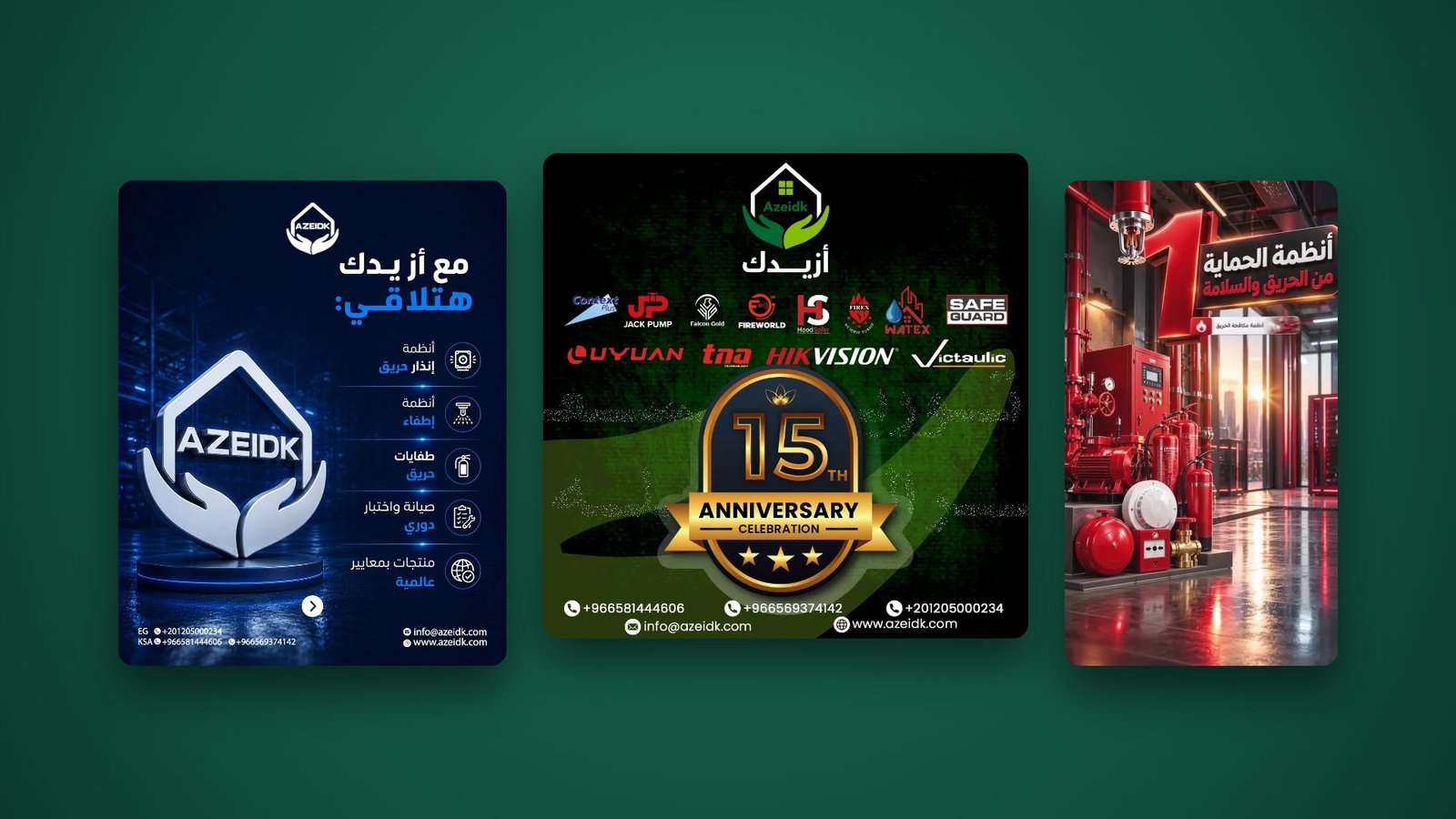
- Does it represent other brands? Agents and distributors often have to follow the principal’s brand guidelines. In that case the company brand is usually secondary to the products, and the group name sits further back still; see our guide to working within a manufacturer’s brand guidelines. Our Azeidk case study shows the agent side of this question: launch and product campaigns for each international brand Azeidk represents, designed to the Azeidk system while respecting every partner brand.
- Can the group fund separate brands properly? A house of brands needs a separate website, content, campaigns and sales materials for every company. If the budget cannot support that, an endorsed structure usually gives more for less.
Hypothetical example: one group, three models
The group below is invented to show how the six questions produce a mixed structure rather than one answer for everyone.
| Company | Buyers overlap with group? | Group name helps? | Risk to share | Exit or partner plan | Principal’s rules | Resulting model |
|---|---|---|---|---|---|---|
| Trading (building materials) | High: contractors also hire the contracting arm | Yes, decades of supply history | Moderate | None | Some product lines | Branded house: “[Group] Trading” |
| Contracting (MEP) | High | Yes in tenders, where financial standing counts | High: site incidents | None | None | Endorsed: own name, “a member of [Group]” |
| Maintenance | Medium: facility managers | Somewhat | Moderate | Possible partner for a regional contract | None | Endorsed, with its own phone numbers on every vehicle |
| Logistics | Low: importers outside the group’s sectors | Little | Moderate | Open to an investor | None | House of brands: stand-alone name and trademark |
| Agency for an international brand | Medium | Secondary to the principal’s brand | Low | Depends on the agency agreement | Strict | Endorsed lightly, inside the principal’s guidelines |
One company carries the group name as a descriptor, three are endorsed to different degrees, and one stands alone because it may leave. Written down like this, the board can approve the structure company by company, and the designer receives a brief instead of an argument.
Where the group name should appear
Once the model is set, the arguments move to specific touchpoints. Writing the rule down once saves the same debate every time a sign or a uniform is ordered. A typical rule set for an endorsed structure looks like this:
| Touchpoint | Company name | Group name |
|---|---|---|
| Company profile and pre-qualification file | Leads the cover and every page | One “about the group” page near the end; group references only where they strengthen the bid (financial standing, shared certifications, related projects) |
| Tender and technical proposals | The legal entity that signs the contract, exactly as registered | Mentioned only where the tender asks about the parent or ownership |
| Website | Own domain or a clearly separate section with its own contacts | Endorsement line in the header or footer, and a link to the group site |
| Shopfront and building signage | Dominant | Smaller endorsement line, or on the directory panel only |
| Vehicles | Company name and its own phone number, large | Small, never larger than the company name |
| Uniforms | Company logo on the chest | Optional on the sleeve or back for multi-company sites |
| Letterhead, invoices, email signatures | Company identity | Endorsement line plus the legal details the law requires |
| Social media and LinkedIn | Separate pages for companies with separate buyers | Group page for corporate news, recruitment and investor audiences |
Two details often cause confusion in practice. The first is contact details: every customer-facing item should show the phone number, WhatsApp and email of the company that delivers the service, never a group switchboard. The second is size: an endorsement line is a signature, not a second logo. If it competes with the company name, customers read the group name and call the wrong company.
For groups that bid on tenders, the profile deserves special care. A pre-qualification reviewer is assessing one legal entity, so a file built around that entity, with the group shown as backing rather than as the subject, reads as more focused. We cover the structure of those files in our guide to the company profile for pre-qualification.
Legal names, brand names and the Saudi Trade Names Law
A brand architecture decision sits on top of legal names, and in Saudi Arabia those rules changed recently. According to Al Tamimi & Company and Gibson Dunn, the new Trade Names Law and Commercial Registration Law were published in the Official Gazette on 4 October 2024 and took effect in April 2025 (Gibson Dunn gives 3 April 2025), and Gibson Dunn reports implementing regulations published on 30 March 2025. Several points from law-firm summaries of the law and its regulations matter to groups:
- One registration can cover branches. Al Tamimi describes a unified national commercial registration covering all of a merchant’s activities, including branch activities. A branch is not a separate company, so if a business needs its own legal identity, its own contracts or a future sale, it needs to be a separate entity, not just a separate logo.
- Names must be distinct across activities. Gibson Dunn reports that names resembling an already registered trade name are not allowed “regardless of activity type”. Before you plan names like “[Group] Trading” and “[Group] Contracting” for separate entities, check with the Ministry of Commerce how names sharing a root are treated for related companies.
- Family names have conditions. Clyde & Co’s September 2025 summary of the regulations says a family name may be registered only if it combines two or more surnames, and that its use and ownership are restricted to individuals who share that surname. Groups built on a family name should check how this applies before naming a new company.
- Trade names can be transferred. Clyde & Co says only distinctive or family trade names may be sold or transferred, using Ministry-approved forms; Gibson Dunn describes trade names more generally as capable of being owned, sold or assigned. That makes the choice between a distinctive name and a descriptive one a commercial decision, not just a creative one.
The sources do not set out specific rules for group or subsidiary names, so we have not stated any. Law-firm summaries also give different enactment dates and decree references (see DWF alongside the summaries above), so treat the points above as a checklist for your adviser, not as the text of the law. Confirm the current requirements with the Ministry of Commerce before you register or rename any group company. This section is not legal advice.
A trade name is also not a trademark. The registered name lets a company trade; trademark registration protects the mark you sell under. Decide which entity in the group owns each mark, since a subsidiary that may be sold should not depend on a logo the holding company owns. Record who owns each logo and its files at the same time. Rules in other markets differ: for the UAE, see our guide to trade name rules in Dubai and the UAE.
From decision to rollout
A workable sequence for a family group looks like this:
- Audit what exists. List every legal entity, trade name, logo, domain, social account, trademark and physical asset (signs, vehicles, uniforms) and who owns each one. Many groups find names and accounts nobody remembers registering.
- Map customers and risk. For each company, record its main buyers, how much they overlap with the others, its risk profile and its likely future (keep, grow, partner, sell).
- Place each company on the spectrum. Use the six questions above. Agree it at board level, because this is a decision about ownership and risk as much as design.
- Design the system, not just logos. That means the group mark, the company marks, the endorsement lock-up in Arabic and English, colour rules that say whether companies share a palette, and the touchpoint table above written as rules. Our brand identity and positioning work starts here, because the architecture sets the brief for every logo that follows.
- Clear the names. Check trade names and trademarks in every market where each company trades before anything is produced.
- Roll out by priority. Start with documents that win business (profiles, tender templates, websites), then high-visibility physical assets, then the long tail. Replace vehicles and uniforms in planned cycles rather than all at once. Our rebrand rollout guide sets out the touchpoint inventory and launch sequence in detail.
Rollout is where structures most often slip. A sign contractor adds the group logo “for balance”, a new branch manager orders uniforms from an old file, and within a year the rules are gone. Keep one owner for the brand rules, and check every physical application against the approved file before it is produced. For an example of extending one company’s identity across collateral, signage, campaigns, presentations and film, see our SafeCo Group case study.
RX Designer is itself a member of IYDEX Group, a group that works across trading, contracting and business services, so we know these questions from the inside. Before your group adds or rebrands a company, fill in a table like the hypothetical one above for every company, with the people who run and sell for each. If nobody can answer the exit column, or two rows reach the same model for different reasons, settle that before any logo is drawn; you can bring the table to a business diagnosis session for an outside reading.
Frequently asked questions
What is the difference between a branded house and a house of brands?
A branded house uses one master brand across all businesses, with descriptive names such as '[Group] Trading' and '[Group] Contracting'. A house of brands runs separate brands with little or no visible link to the owner. Endorsed brands sit between them: each company has its own name and identity plus a visible line such as 'a member of [Group]'.
Should every subsidiary carry the family or group name?
Not necessarily. A shared name helps where buyers overlap and the group name carries trust. It hurts where markets conflict, where one business carries high reputational risk, or where a company may be sold or partnered. Decide company by company.
How should a group company present the parent group in a tender or pre-qualification file?
Lead with the legal entity that will sign the contract, exactly as registered, and keep the group to a short 'about the group' section. Refer to the group only where it strengthens the bid, such as financial standing or shared certifications, or where the tender asks about ownership.
Can a Saudi company use a family name as its trade name?
According to Clyde & Co's September 2025 summary of the new regulations, a family name may be registered only if it combines two or more surnames, and its use and ownership are restricted to people who share that surname. Check the current rules with the Ministry of Commerce and a legal adviser before naming a company.
- California Management Review (Berkeley Haas), The Brand Relationship Spectrum: The Key to the Brand Architecture Challenge (California Management Review, Vol. 42, No. 4) (2000-08).
- WARC, Brand architecture spectrum (SWOCC Book of Brand Management Models) (2006-01-01).
- Abdul Latif Jameel, Abdul Latif Jameel group website.
- Al-Futtaim, Al-Futtaim Group website.
- Al Tamimi & Company, New Commercial Registration and Trade Name Laws Take Effect in 2025 (2024-12-11).
- Gibson Dunn, Saudi Arabia's New Trade Name Law: Legal Update (2025-05-07).
- Clyde & Co, Saudi Arabia's recently issued Regulations of the Commercial Registration Law and Trade Name Law (2025-09-17).
- DWF, Saudi Commercial Register Law and Law of Trade Names (2025-04).