- Compare the full annual cost of each hire (insurance, visas, end-of-service, tools, vacancy), not the salary against a retainer.
- Since 19 April 2026, Saudi private establishments with three or more workers in the covered marketing roles must meet a 60% Saudisation rate; sales roles fall under a separate decision.
- Separate agencies leave the integration job with you; an outsourced department takes it on and is held to one plan and one report.
- Control comes from the set-up: your approvals, accounts in your name, source files at handover and a clean exit clause.
Many growing companies in the Gulf reach the same point. Marketing has grown beyond one coordinator and a freelancer, sales wants better material, and the CEO has to choose: hire a proper team, appoint an agency, or hand the whole function to an outside partner that runs it as a department. Each answer is right for some companies. The mistake is choosing on the monthly number alone.
This guide compares the three models on what decides the outcome in practice: control, total cost, time to start and continuity. It also covers the GCC employment rules that change the cost of hiring, including Saudi Arabia’s 2026 localisation of marketing jobs.
Three models, defined properly
The labels get used loosely, so it is worth being precise about what you are comparing.
- In-house team. Your own employees: typically a marketing manager plus some mix of content, design, digital and events people. You carry salaries, benefits, visas and management time. You own the know-how, and you lose it when people leave.
- Agency (or several agencies). An outside firm hired for defined work: a campaign, a website, paid media, social management. It is common to end up with three or four specialists, each with its own contract, reports and point of view.
- Outsourced marketing department. One external partner takes responsibility for the function as a whole: planning, brand consistency, content, campaigns, websites, events and sales material, under one direction and one accountable lead. A fractional CMO is a narrower version of this: senior direction a few days a month, with execution still sitting with your team or your agencies. If that is the option you lean towards, see what a marketing strategy consultant should deliver in 90 days.
The difference between the second and third models is not size. It is who owns the overall picture. With separate agencies, your company does the joining up. With an outsourced department, the partner does, and you hold it to account for the result.
What an in-house team actually costs in the GCC
A salary figure is not the cost of an employee. Before comparing any hire with a retainer, build the full annual cost per role. No reliable public salary benchmark covers every marketing role in every Gulf city, so use your own offers or a recent recruiter quote for the salary line, and add the components below.
| Cost component | What to include |
|---|---|
| Salary and allowances | Basic, housing, transport and any other fixed allowances; annual increments |
| Social insurance | Employer contributions (see the country notes below) |
| Expatriate costs | Work permit and residence fees, government levies, medical insurance, annual tickets if in the contract |
| End-of-service liability | The gratuity or award that builds up every year of service |
| Recruitment | Recruiter fees or advertising, plus the weeks the seat stays empty |
| Tools | Design and video software licences, scheduling, analytics, stock assets, hardware |
| Management and training | Senior time spent directing and reviewing work; courses to keep skills current |
Saudi Arabia
For a Saudi employee, the employer pays social insurance on the contributory wage: basic salary plus housing, capped at SAR 45,000 a month. For a Saudi first registered with GOSI before 3 July 2024, the employer’s share is 11.75% (9% annuities, 2% occupational hazards, 0.75% SANED unemployment insurance). For Saudis first registered from 3 July 2024 under the new Social Insurance Law, the annuity rate rises in annual steps, which puts the employer’s share at 12.75% from 1 July 2026, with further steps scheduled for 2027 and 2028. For non-Saudi employees, the employer pays 2% for occupational hazards only (PwC Worldwide Tax Summaries; PaySpace; Qoyod). These figures come from tax and payroll references; confirm the current rates with GOSI before budgeting.
The larger change for marketing hiring is localisation. The Ministry of Human Resources and Social Development has applied a 60% Saudisation rate to marketing professions (with a separate decision covering sales professions) in private establishments with three or more workers in the covered marketing roles, in force since 19 April 2026 (Arab News). A Saudi employee in a marketing role counts towards the rate only at a monthly wage of at least SAR 5,500. According to the ministry, the covered marketing titles are marketing manager, marketing specialist, advertising manager, advertising specialist, advertising agent, graphic designer, advertising designer, public relations specialist and manager, and photographer; a separate list covers sales titles such as sales manager, sales representative and sales specialist.
In practice, a Saudi company planning an in-house team of three or more in these roles needs at least 60% of them to be Saudi nationals at or above that wage. Whatever your view of the local talent market, the rule shapes who you can hire, at what salary and how fast. Localisation rules are revised from time to time, so check the current ministry text and ask your HR or legal adviser how your own establishment’s roles are classified before you design the team.
United Arab Emirates
For expatriate staff, the main long-term liability is the end-of-service gratuity: 21 days of basic salary for each of the first five years and 30 days for each year after, capped at two years’ wages, payable once a worker completes one year (UAE government portal; Gulf News on Article 51 of Federal Decree-Law 33 of 2021). The portal also describes an optional end-of-service savings scheme employers can use instead. On Emiratisation, companies with 50 or more employees have been required to raise the share of Emiratis in skilled roles by 2% a year, towards a 10% increase by 2026. Companies with 20 to 49 employees in 14 targeted sectors (including professional, scientific and technical activities, construction, manufacturing, and wholesale and retail trade) had to employ at least one Emirati in 2024 and at least two from 2025. Financial contributions apply to companies that miss their targets (UAE government portal; Gulf News, November 2025). Targets beyond 2026 may change, so check the current MOHRE requirements for your company size and sector. Marketing hires count towards your headcount like any other role.
Egypt
Salary levels differ from the Gulf, so the cost case looks different, but the same framework applies: employer social insurance contributions, annual increments, tools and management time all belong in the calculation. For many Egyptian companies the harder questions are seniority and retention: whether you can attract and keep someone senior enough to direct the whole function, not just produce for it.
Hypothetical example: the annual cost of one marketing specialist in Riyadh
Use this worksheet for each seat you are thinking of filling. It contains no salary figures on purpose: enter your own offer or a recent recruiter quote, then let the other lines show what the salary leaves out. The insurance rates are the ones cited above; check them with GOSI before you budget.
| Line | How to calculate it | Your figure (SAR a year) |
|---|---|---|
| Basic salary | Monthly basic × 12. For a Saudi in a covered marketing title to count towards the 60% rate, the monthly wage must be at least SAR 5,500 | |
| Housing and transport allowances | Monthly allowances × 12, or the cash value of housing you provide | |
| GOSI employer share | Saudi: 11.75% (first registered before 3 July 2024) or 12.75% (first registered from 3 July 2024, rate from 1 July 2026) of basic plus housing, capped at SAR 45,000 a month. Non-Saudi: 2% | |
| Residence, work permit and expatriate levy | Non-Saudi only: the annual iqama, work permit and levy amounts that apply to your establishment, from your government-relations officer | |
| Medical insurance | The annual premium quoted for this employee (and dependants, if the contract covers them) | |
| Tickets and other contract benefits | Annual air tickets, phone, training allowance: whatever the contract promises | |
| End-of-service accrual | The amount that builds up this year under the employment contract and the Labour Law; ask your accountant for the monthly accrual | |
| Tools and hardware | Software licences, stock assets and the laptop, spread over its useful life | |
| Recruitment | Recruiter fee or advertising, divided by the years you expect the person to stay | |
| Vacancy months | Months a seat is likely to stay empty in a year × the monthly output you lose (or the freelancer cost to cover it) | |
| Management time | Hours a month a senior person spends briefing and reviewing × that person’s hourly cost | |
| Total per seat | Sum of the lines above |
Repeat the sheet for every role on your list. The total of all seats, not the salary of the first hire, is the number to set against an outside team’s scope.
Side-by-side comparison
The table below is our assessment of how the models usually compare, not measured data. Your own contracts and people can move any row.
| Factor | In-house team | Separate agencies | Outsourced department |
|---|---|---|---|
| Day-to-day control | Highest; people sit with you | Per contract; you coordinate between them | High if approvals and reporting are set up properly |
| Cost structure | Fixed; grows with headcount and tenure liabilities | Several retainers or project fees; overlap is common | One fee for a defined scope; easier to scale up or down |
| Time to start | Slowest; recruitment, visas, onboarding | Weeks per agency | Usually fastest for the full function, after onboarding |
| Breadth of skills | Limited to who you hire | Deep in each specialism | Broad team: strategy, design, content, video, web, ads |
| Consistency across channels | Good if one strong lead | Weakest; each agency optimises its own channel | Strongest when one direction covers every touchpoint |
| Continuity | At risk with each resignation | At risk at each contract change | Partner absorbs staff changes; your risk is the partner relationship |
| Business knowledge | Deepest over time | Shallow; each sees one slice | Builds over time if the partner stays long term |
Where each model breaks down
In-house: the team of generalists
A company hires a marketing manager and a designer, then expects them to run social media, video, the website, paid ads, exhibitions and sales presentations. Nobody is senior in all of these. The work gets done, but the standard drifts, and the manager spends the week producing rather than planning. In-house works best when your volume justifies specialists, or when the knowledge involved is so specific to your products that an outsider would struggle.
Separate agencies: nobody owns the whole
The social agency reports engagement, the ads agency reports cost per lead, the web developer reports uptime. Each report looks fine, but sales still complain about lead quality, and the exhibition stand does not match the website. The CEO or a junior coordinator ends up as the integrator, which is the job none of them was hired for. If this sounds familiar, the issue is structural, not a matter of finding better agencies; it is also the usual reason companies end up changing agencies every year. Our guide to what drives agency fees in Saudi Arabia covers how to compare proposals like for like.
Outsourced department: losing the inside view
The risk here is distance. An external team that only receives briefs by email will produce competent work that misses what matters to your buyers. The model works when the partner is close to the business: present in sales conversations, briefed on product and pricing changes, and measured against business results rather than activity.
How to choose: five questions
- How many disciplines do you need every month? If it is two (say, content and design), a small in-house team or one specialist may be enough. If it is five or more across strategy, social, video, web, ads, events and sales material, a single partner is often more efficient than hiring or contracting each one.
- Is your workload steady or seasonal? Exhibition seasons, Ramadan campaigns and product launches create peaks. A fixed team is sized for either the peak (idle the rest of the year) or the average (overloaded at the worst moment).
- Who will direct the work? Every model needs someone senior who knows the business and can say no. If you do not have that person internally, hiring juniors will not create it.
- What does localisation mean for your plan? In Saudi Arabia, three or more workers in the covered marketing roles bring the 60% rate into play (sales roles fall under a separate decision); see our Saudisation guide. In the UAE, headcount affects your Emiratisation targets. Factor this in at the planning stage, not after the offers go out.
- How quickly do you need results? A launch eight weeks away leaves little room for a recruitment cycle.
A hybrid is often the most practical answer: one internal marketing manager who owns priorities, approvals and the link with sales, working with an outsourced department that provides the planning, production and channel management. The internal lead keeps the inside view; the partner provides breadth and continuity.
Keeping control when the department is outside
The reasonable objection to outsourcing is control. In our view it is settled by the set-up more than by the model. Before signing with any partner, agree these points in writing:
- Approvals. Nothing is published or sent without your sign-off, with a named approver and a turnaround time on both sides.
- Ownership of accounts. Ad accounts, analytics, domains and social pages are registered in your company’s name, with the partner given access, not the other way round.
- Files and rights. You receive final and source files, and the rights to use them, at handover.
- One plan, one report. A quarterly plan tied to your sales targets, and a monthly report that connects activity to inquiries and pipeline.
- A clean exit. A notice period and a handover list, so changing partner never means starting again.
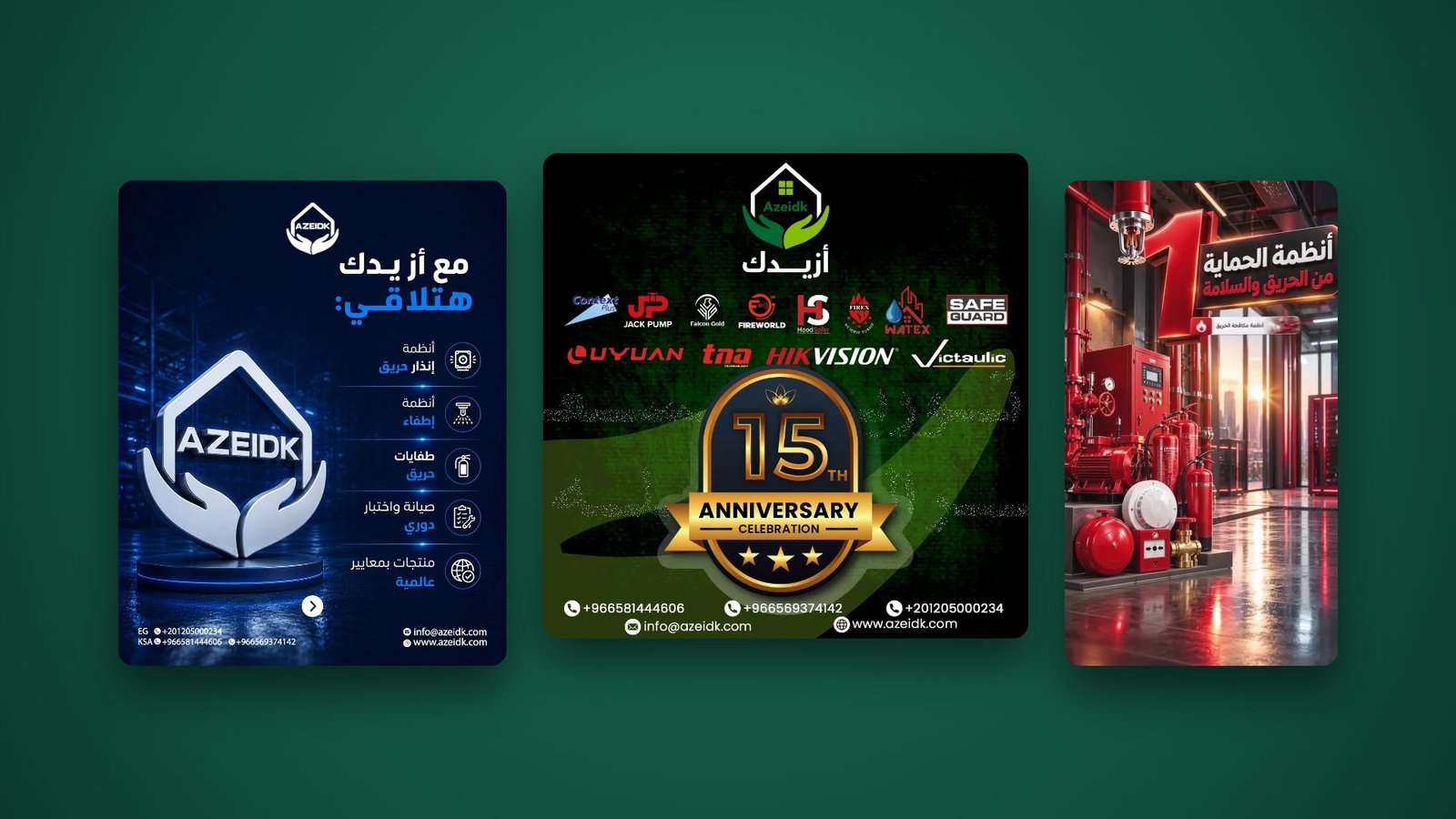
This is the way RX Designer works as a client’s marketing control centre: one direction across brand, content, campaigns and sales communication, with clients approving content before it goes out, ad accounts kept in the client’s name and source files handed over. Azeidk, a contracting, MEP and fire-protection company working across Saudi Arabia and Egypt, is the clearest example of the model: RX became its marketing department, organising fire fighting, fire alarm, MEP, CCTV, maintenance and technical supply into one service architecture used on the website, the company profile and every campaign, alongside bilingual awareness content and sales-ready WhatsApp, email, LinkedIn and proposal material. For a long-running example in Egypt, see how RX acted as the marketing team of a Cairo fire-fighting company for four years, until October 2023.
Before you post a job ad or sign a retainer, list the disciplines you need each month and who will direct them. Bring that list and your draft job descriptions to a business diagnosis session; we will compare an in-house, agency and outsourced set-up for your scope and Saudisation position.
Frequently asked questions
What is an outsourced marketing department?
It is an external partner that runs your marketing function as a whole, covering planning, brand consistency, content, campaigns, websites, events and sales material under one direction and one accountable lead, rather than a single agency doing one channel.
Is it cheaper to hire a marketing team or outsource marketing in Saudi Arabia?
It depends on how many disciplines you need. Build the full annual cost of each role, including GOSI contributions, expatriate costs, end-of-service liability, tools and vacancy time, then compare that with a retainer for the same scope. Also factor in the 60% Saudisation rate that applies to marketing roles in establishments with three or more workers in those roles; sales roles are covered by a separate decision.
Which marketing jobs are covered by Saudisation?
According to the Ministry of Human Resources and Social Development, covered marketing titles include marketing manager, marketing specialist, advertising manager and specialist, advertising agent, graphic designer, advertising designer, public relations manager and specialist, and photographer. A Saudi employee counts towards the marketing rate at a monthly wage of at least SAR 5,500.
How is a fractional CMO different from an outsourced marketing department?
A fractional CMO provides senior direction for part of the month, while execution stays with your team or agencies. An outsourced department provides both direction and the team that delivers the work.
How do I keep control if marketing is outsourced?
Agree in writing that nothing goes out without your approval, that ad accounts, analytics and pages are in your company's name, that you receive final and source files at handover, and that there is a notice period with a handover list.
- Ministry of Human Resources and Social Development (Saudi Arabia), Localization in Marketing and Sales Professions (2026-05-03).
- Arab News, New Saudization targets for marketing and sales roles come into effect (2026-04-19).
- PwC Worldwide Tax Summaries, Saudi Arabia: Other taxes impacting individuals (social security contributions).
- PaySpace, Saudi Arabia: GOSI contribution rate increase, Saudi nationals hired from 3 July 2024.
- Qoyod, GOSI contribution rates.
- UAE Government portal, End of service benefits for workers in the private sector.
- Gulf News, New UAE Labour Law: How is gratuity calculated?.
- Gulf News, Private sector warned to meet Emiratisation goals or face penalties (2025-11-25).
- UAE Government portal, Emiratis' employment in the private sector.