- Confirmed: Qassim Cement signed for 100% of A-Mix on 8 Sep 2026 for SAR 65m, received GAC no-objection on 6 Oct and completed on 19 Oct 2026.
- Not disclosed: A-Mix's plants, fleet, profit, instalment schedule or whether the A-Mix name stays.
- RX view: the main commercial question is brand architecture: keep, endorse or merge the acquired name.
- Contractors, traders and independent ready-mix producers in Saudi Arabia and Egypt should check supplier records and sharpen their own offer now.
On 19 October 2026, Qassim Cement Company (QCC, Tadawul: 3040) told the Saudi Exchange that it had completed the purchase of 100% of A-Mix, a ready-mix concrete producer, and that A-Mix is now a wholly owned subsidiary. Unlike the company’s 2024 acquisition of Hail Cement, which combined two cement producers, this deal moves downstream: a Saudi cement maker has moved one step closer to the construction site. This piece sets out what has been disclosed. It then explains, as clearly labelled opinion, what the move means for the contractors, distributors and suppliers who buy from or sell alongside companies like this in Saudi Arabia and Egypt.
What happened
The agreement: 8 September 2026
- Signing. On 8 September 2026, Qassim Cement signed a share sale and purchase agreement with the shareholders of A-Mix Company. The company announced this on its website on 9 September (Qassim Cement, 9 Sep 2026).
- Target. A-Mix is a Saudi closed joint-stock company that produces, manufactures, markets and sells ready-mix concrete. Argaam names it “Amix for Ready Mix Concrete Co.” (Argaam, 9 Sep 2026). Arabic coverage of the completion filing names it «إي مكس للخرسانة الجاهزة» (Al Eqtisadiah, 19 Oct 2026); other Arabic outlets spell it «اي مكس». We could not open the Arabic Saudi Exchange filing itself, so the exact registered Arabic name is not confirmed here.
- Stake and price. 100% of A-Mix’s share capital for a total of SAR 65 million. TradeArabia gives this as about US$17.3 million (TradeArabia, 9 Sep 2026).
- Payment and funding. The price is paid in three instalments under the agreement’s terms and is funded from existing Shariah-compliant facilities with commercial banks. The schedule and amount of each instalment have not been published.
- Sellers. The sellers are individuals who together owned all of A-Mix’s shares. They are not named. The company states that no related parties are involved.
- A-Mix revenue. SAR 34 million in 2023, SAR 54.8 million in 2024 and SAR 54.4 million in 2025, as disclosed by the company. Profit, assets, plant locations, capacity and fleet size were not disclosed.
- Stated rationale. Qassim Cement says the deal supports its strategy of strengthening the building-materials value chain through vertical integration, and that it expects it to diversify revenue. No quantified financial impact was given.
- Conditions. Signing did not transfer ownership. Completion was subject to regulatory approvals and permits, including a no-objection from the General Authority for Competition (GAC), and to contractual procedures agreed between the parties.
Addendum, approval and completion
- 14 September 2026: the company published an addendum to the signing announcement, according to its news page. We have not been able to read the addendum’s text, so its contents are not reported here.
- 6 October 2026: GAC issued its no-objection to the economic concentration. The company announced this on 7 October and said the consideration was unchanged (Argaam, 7 Oct 2026; Mubasher via Decypha, 7 Oct 2026).
- 19 October 2026: the company announced completion. Ownership of 100% of A-Mix has transferred, A-Mix is a wholly owned subsidiary, and the value is unchanged at SAR 65 million (Argaam, 19 Oct 2026; Mubasher via Decypha, 19 Oct 2026).
Background. Qassim Cement is a Saudi joint-stock company based in Buraydah, established by Royal Decree in 1976. On 10 June 2024 it completed the acquisition of Hail Cement Company by issuing new shares to Hail’s shareholders (Qassim Cement). That deal combined two cement producers. This one adds a ready-mix business downstream.
Not disclosed: where A-Mix’s plants are, how many trucks and pumps it runs, its customer list, whether the A-Mix name will be kept, and any change to sales teams or prices. Anything said about these points elsewhere is speculation. No Egyptian or other non-Saudi party is named in any of the disclosures.
Why it matters
Cement is usually sold by the tonne to ready-mix plants, block and precast factories, traders and large contractors. Ready-mix concrete is sold by the cubic metre and delivered straight to a pour on site. A cement company that owns a ready-mix producer therefore deals with the site engineer, the contractor’s procurement team and the consultant who approves the mix design, not only with the plant buyer.
Three points follow from the disclosed facts.
- The deal is about position, not size. On the published figures, SAR 65 million is about 1.2 times A-Mix’s 2025 revenue. This is simple arithmetic on public numbers, not a valuation. A-Mix’s revenue rose by about 61% between 2023 and 2024 and was broadly flat in 2025. The move matters because it changes where Qassim Cement meets the customer, not because of the money involved.
- Regulators looked at it. GAC reviewed the deal as an economic concentration before it closed. Any building-materials company planning a similar move in Saudi Arabia should expect the same step, and should plan its customer communication around the approval date rather than the signing date.
- The relationships around the plant change. Independent ready-mix producers that bought cement from Qassim Cement now buy from a company that also competes with them. Contractors that bought from A-Mix now buy from a subsidiary of a listed cement group. Neither group has been told anything new in public yet.
For Egypt. Egyptian contractors, precast makers and suppliers working on Saudi projects will meet the combined group as a customer, a supplier or both. Egyptian cement and building-materials groups that are thinking about their own downstream steps can treat this deal as a public, well-documented example of the sequence: signing, conditions, competition clearance, completion.
RX analysis: what integration means on the buying side
1. The real question is brand architecture
After a downstream acquisition, the parent has three options. It can keep the acquired name as a separate brand, endorse it (“A-Mix, a Qassim Cement company”), or merge it into the parent’s identity. Each option sends a different message to a different buyer. A contractor reads a merged name as “the cement maker now guarantees the concrete”. An independent ready-mix plant that buys cement may read the same change as “my supplier is now my competitor”. In our view, an endorsed structure is often the safest first step in a Saudi B2B market. It keeps the trust the acquired name has built with site teams and adds the parent’s credibility with consultants and procurement. Our guide to brand architecture for Gulf holding companies covers the trade-offs in more depth.
2. Procurement teams will want one story and two sets of documents
Contractors in Saudi Arabia and Egypt buy concrete through approved-supplier lists, mix-design approvals by the consultant and project-specific test records. An integrated group can now tell one story: our cement, our concrete, one quality chain. But each company still needs its own registration, certificates and datasheets. The group’s sales materials have to make the link obvious without blurring which legal entity supplies what. In our view, this is where combined offers are most likely to look improvised.
3. Sales materials must be rebuilt around the site, not the factory
A cement company’s materials usually lead with plant capacity and product standards. A ready-mix offer is bought on dispatch reliability, the mix range, pumping and the response time to a site request. A combined catalogue that simply puts the two side by side misses the point. The better structure starts from the project stage (foundations, structure, finishing) and shows which product and service serves each one.
4. The fleet becomes the most visible brand asset
Ready-mix trucks and pumps appear on job sites and roads every day. Whatever the group decides about the name, the fleet, the plant gates, delivery notes and driver PPE will show that decision more often than any advert. Rebranding them is an operational project with procurement and safety teams, not a design afterthought.
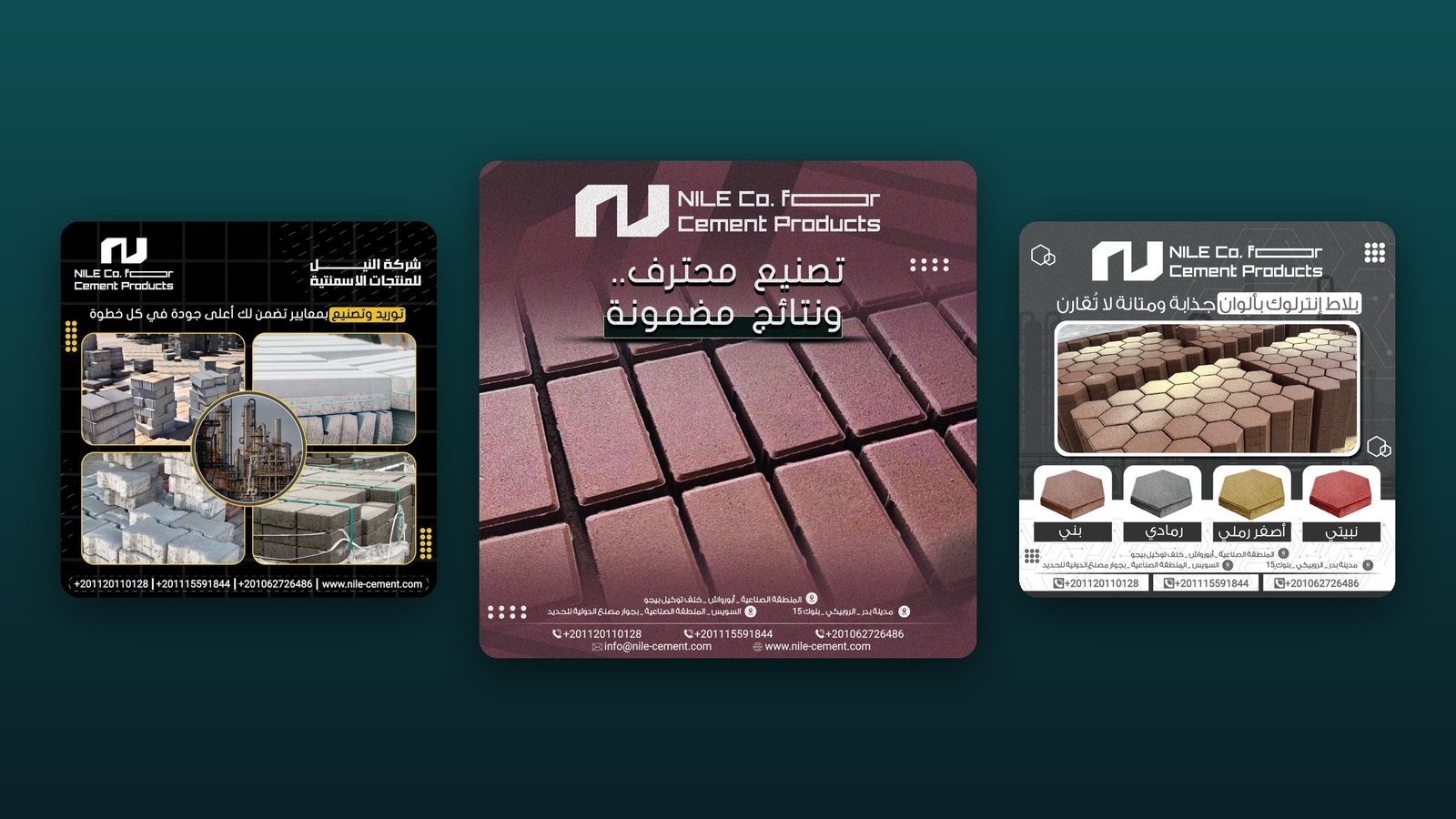
A related RX case, for context only. RX’s Nile Cement case is not an integration project. Nile Co. for Precast Cement Products is an Egyptian precast manufacturer with three production sites. The case page shows what a product-led industrial system involves: Arabic and English logo lock-ups, a monthly content calendar built around each product line, business cards and letterhead for sales and tenders, and on-site brand applications. Those same building blocks are what a combined cement and concrete offer would have to bring into one system.
Practical implications: what to do this week
The checklists below are for companies in the Saudi and Egyptian building-materials chain. Use the one that matches your position.
If you are a contractor or a procurement manager
- Check whether any approved-supplier records, mix-design approvals or framework agreements list the acquired entity, and ask in writing whether the legal entity, bank details or quality documents will change.
- Ask for one point of contact for combined cement and concrete inquiries, and confirm who handles complaints and test failures.
- Review whether single-sourcing cement and concrete from one group increases your supply risk on critical pours, and keep a qualified alternative.
If you are a distributor, trader or independent ready-mix producer
- Map which of your cement suppliers now own, or could own, downstream businesses that compete with you.
- Review your own brand promise: if a large group can now offer “cement plus concrete”, what can you offer that it cannot (local response, flexible volumes, a specialist mix range)? Write it down in one sentence and put it in your sales materials.
- Prepare a short customer message in Arabic and English in case clients ask how the change affects you.
If you are a building-materials company planning your own move
| Decision | Keep the acquired name | Endorse it | Merge into the parent |
|---|---|---|---|
| Best when | Its customers differ from yours, or it sells to your competitors | Its name carries site-level trust and you want to add group credibility | Both businesses sell to the same buyer and you want one offer |
| Main risk | The integration story stays invisible to contractors | Two logos compete on trucks and documents | Losing customers who were loyal to the old name |
| First materials to update | Company profile “part of” line | Logo lock-up, fleet, delivery notes, datasheets | Every touchpoint, starting with tender documents |
| Gulf and Egypt check | Time public announcements to the regulatory step (GAC in Saudi Arabia, your local competition authority elsewhere), and update supplier registrations before you change any customer-facing name. | ||
For the dealer side of a name change, see rebranding an established manufacturer without losing its buyers.
Sources
All dates are the publication dates of the announcements or reports. Qassim Cement’s own announcements and Argaam’s reports of its Saudi Exchange filings are the primary sources. TradeArabia and Mubasher were used to cross-check them. The original announcements were filed on the Saudi Exchange under Qassim Cement (symbol 3040); Al Eqtisadiah confirms the completion was announced there on 19 October. We could not open the Saudi Exchange disclosure pages themselves or the text of the 14 September addendum, so we cite the company’s own news pages and Argaam’s reports of the filings. Egyptian readers should note that every source here concerns a Saudi transaction; none describes Egyptian market conditions. The full list is in the references below.
Related RX services
If your company is adding a business, a product line or a new brand to the group, the decisions above sit inside brand identity and positioning: architecture, lock-ups and guidelines. For catalogues, datasheets and sales kits that present a combined offer to contractors and dealers in Saudi Arabia and Egypt, see distributor and product marketing.
Frequently asked questions
Has Qassim Cement completed the A-Mix acquisition?
Yes. Qassim Cement announced on 19 October 2026 that it had completed the purchase of 100% of A-Mix and that A-Mix is now a wholly owned subsidiary, with the SAR 65 million value unchanged.
How much did Qassim Cement pay for A-Mix?
SAR 65 million for 100% of the shares, paid in three instalments from existing Shariah-compliant bank facilities. The size and timing of each instalment have not been published.
Did the deal need regulatory approval?
Yes. Completion required a no-objection from Saudi Arabia's General Authority for Competition, which was issued on 6 October 2026, as well as other regulatory approvals and agreed contractual procedures.
Will the A-Mix brand name change?
Nothing has been announced. Qassim Cement's disclosures do not say whether A-Mix will keep its name, be endorsed by the parent or be merged into the Qassim Cement brand.
What does vertical integration in building materials mean for contractors?
It means one group may supply both cement and ready-mix concrete. Contractors should confirm supplier registrations and quality documents, ask for a single contact for combined inquiries, and keep a qualified alternative supplier for critical pours.
- Qassim Cement Company, Qassim Cement Company Announces the Signing of a Share Sale and Purchase Agreement to Acquire 100% of A-Mix Company's shares (2026-09-09).
- Qassim Cement Company, Qassim Cement news listing (dates of the 9 Sep, 14 Sep, 7 Oct and 19 Oct 2026 announcements) (2026-10-28).
- Argaam, Qassim Cement signs deal to acquire 100% of Amix Ready Mix for SAR 65M (2026-09-09).
- Argaam, Qassim Cement gets GAC approval for Amix acquisition (2026-10-07).
- Argaam, Qassim Cement completes Amix acquisition (2026-10-19).
- Al Eqtisadiah (Arabic), أسمنت القصيم تستكمل الاستحواذ على إي مكس للخرسانة الجاهزة (2026-10-19).
- Mubasher via Decypha, Qassim Cement secures GAC approval for A-Mix acquisition (2026-10-07).
- Mubasher via Decypha, Qassim Cement concludes acquisition of A-Mix Company (2026-10-19).
- TradeArabia, Qassim Cement to acquire 100% of A-Mix for $17.3m (2026-09-09).
- Qassim Cement Company, Qassim Cement Company Announces the Listing of the Consideration Shares and the Completion of the Procedures of the Acquisition of Hail Cement Company (2024-06-13).