- Build the launch calendar backwards from the date the building permit and phase plan approvals are on file, not from when the creative is ready.
- Brief brokers before the market and give them approved assets, one dated price sheet and a do and don't list.
- As a cautious approach, keep prices, availability and reservations out of the teaser until the developer's legal adviser confirms what can be advertised.
- Judge the launch by contracts: plan follow-up for reservers, non-reservers and no-shows before the event.
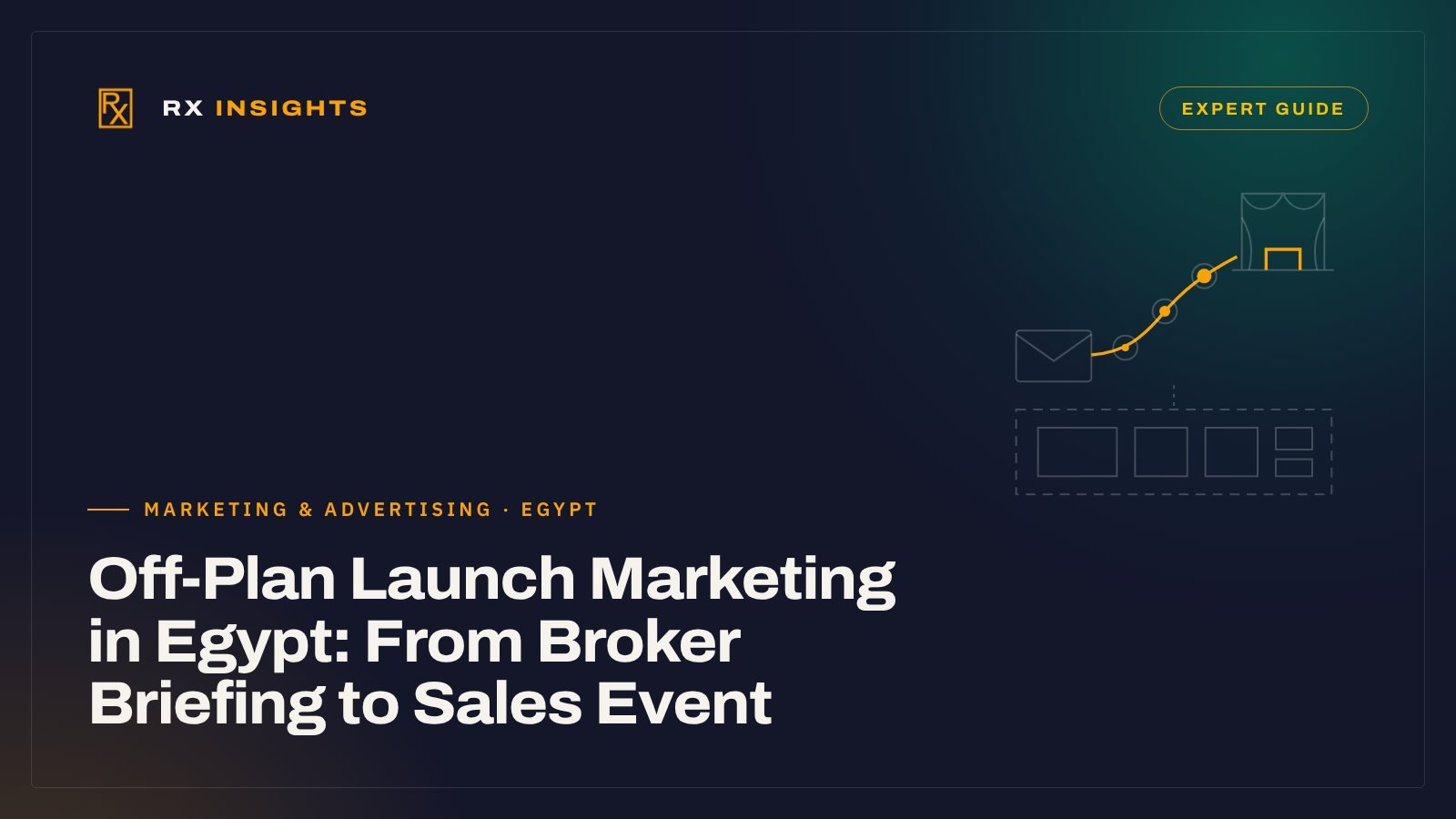
An off-plan launch in Egypt is rarely a single campaign. It is a sequence: the broker network hears about the project first, the market sees a teaser, a countdown builds a list of interested buyers, the launch event turns interest into reservations, and the weeks after the event decide how many of those reservations become contracts. Each stage depends on something being ready before it starts: an approval, a price sheet, a landing page, a trained sales team.
This guide maps that sequence stage by stage and shows what branding, campaigns and sales tools need to be finished at each point.
The launch on one page
In our view, many launch problems are timing problems. The teaser goes out before the brochure is approved, or the event happens before the CRM can tell the sales team who registered. Lay the launch out as five stages and agree what has to be ready at the start of each one.
| Stage | What happens | Must be ready before it starts |
|---|---|---|
| 0. Clearance | Legal and technical approvals are confirmed; claims are agreed | Permit and plan approvals on file; an approved claims sheet |
| 1. Broker briefing | Brokerage partners and the in-house team learn the project | Project identity, sales kit, approved price and payment-plan sheet, broker asset pack |
| 2. Teaser | The market learns a project is coming | Key visual, teaser films and posts, a holding landing page |
| 3. Countdown | Interested buyers register; the event is promoted | Registration form, lead routing, invitation and reminder messages |
| 4. Launch event | Units are presented and reserved | Venue branding, availability board, reservation documents, photo and video crew |
| 5. Follow-up | Reservations are converted; non-reservers are worked | Follow-up rules, post-event content, a report the board can read |
Hypothetical example. The timeline below is invented to show the lead times between stages for one phase; the weeks are relative to the day approvals and the claims sheet are signed off, and your own gaps will depend on the project, the approvals and the broker network.
| Week | Stage | Owner | Must be ready that week |
|---|---|---|---|
| 0 | Clearance | Legal team and project director | Permit and phase plan approvals on file; claims sheet signed |
| 2 | Broker briefing | Sales director | Sales kit, dated price sheet, broker asset pack, do and don’t list |
| 3 | Teaser | Marketing | Key visual, teaser films, holding landing page with registration form |
| 5 to 8 | Countdown | Marketing, with sales on lead routing | Routing rules live, message sequence scheduled, event invitations out |
| 8 | Launch event | Sales director and events lead | Availability board, reservation receipts reviewed by legal, coverage shot list |
| 9 to 14 | Follow-up | Sales director | Owner for every lead group, event highlights film, written update to brokers, launch report |
The useful part is not the week numbers but the gaps between them: if the broker pack cannot be finished two weeks after clearance, the teaser and everything after it move too.
Stage 0 is not marketing work, but marketing cannot start without it. That is where the Egyptian rules come in.
Stage 0: what has to be cleared before anything is public
Egyptian law ties property advertising to approvals, so the launch calendar should be built backwards from the date those approvals are in hand, not from the date the creative is ready. Three points are worth confirming with the developer’s legal team before the first public post.
- Building permit first. Article 15 of the Consumer Protection Law, Law No. 181 of 2018, prohibits advertising or contracting for the sale of real estate units, or of land designated for construction, without first obtaining a building permit under the Building Law, Law No. 119 of 2008. This is set out in the English translation of the law published by Andersen in Egypt, and in a commentary by Al Tamimi & Company, which notes that the same article bars sale contracts from including terms that entitle the seller to collect percentages, fees or commissions when the buyer resells, and treats such terms as void. Translations differ slightly: Al Tamimi renders the first rule as a ban on announcing the reservation of units, which matters if a campaign invites early reservations.
- Plan approvals for the phase being marketed. An Andersen article published on Legal 500 on 21 October 2026 says that, under Decision No. 2184 of 2022, a developer may not advertise units before obtaining the ministerial decisions approving the project’s master plan and the detailed plan for the phase being marketed. The same article describes requirements for phase funding in a designated bank account and a 5% reserve or bank guarantee from collections. Sources describe the issuer differently: Andersen calls it a ministerial decision, while Invest-Gate reported on 21 June 2022 that the rules were issued by the Prime Minister. Ask your legal adviser to confirm the instrument and its current text.
- No misleading claims. Article 9 of Law 181 requires suppliers and advertisers to avoid deceptive practices on, among other things, price and payment methods, the identity of the provider, false discounts and available quantities. Under Article 57 the Consumer Protection Agency can ask for a misleading advertisement to be corrected and, if it is not corrected within the set period, suspend it for a limited time, subject to referral to the prosecution and a court decision. For a launch, “only 20 units left” or “prices rise after the event” must be true on the day it is said.
The rules may tighten further. Daily News Egypt reported on 4 October 2026 that the Ministry of Housing is discussing a draft real estate developers’ law with developers. As reported, it would require prior approval from the Egyptian Federation of Real Estate Developers before advertising units, marketing projects or taking part in property exhibitions, along with per-project bank accounts and buyer protection funds. It is a draft, not law, but a launch planned for 2027 should leave room for an extra approval step. An earlier report by Enterprise on 4 February 2026, citing unnamed sources, said a version of the draft would require 30% of construction to be complete before units could be marketed or sold; developers opposed it, and the October report does not mention that threshold. Treat it as unconfirmed until a final text is published.
The practical output of Stage 0 is a one-page claims sheet: delivery date, finishing level, payment-plan terms, unit areas, amenities, the developer’s legal name and what each claim is based on. Every brochure page, ad and script line is checked against it.
Stage 1: brief the broker network before the market
Where a developer sells through brokerage companies as well as its own sales team, expect brokers to start talking about the project the day they hear of it. The briefing is then effectively the first public moment, so treat it as one.
What the broker pack should contain:
- The sales kit: master plan, unit types with areas, specifications and finishing level, delivery timeline, developer background and an FAQ written from real buyer questions. Keep a light PDF that is easy to send on WhatsApp and a fuller presentation edition.
- One price and payment-plan sheet with a version number and a date in the footer. When prices change, the old sheet is withdrawn in writing.
- Approved creative assets: key visual, renders, logo files, short films in feed and story formats, and the approved project name in Arabic and English. Brokers often produce their own ads; giving them good material is a practical way to keep those ads accurate.
- A short do and don’t list: which claims are approved, which are not (for example, a guaranteed return or a delivery date earlier than the contract), and who to ask when a buyer raises something new.
Article 9 of Law 181 names advertisers as well as suppliers, so ask the legal team how a broker’s exaggerated post could affect the developer. In our view, the do and don’t list protects the developer as much as the buyer.
The project name and identity should be final before this stage, not designed alongside the broker pack; otherwise brokers start circulating whichever draft they were sent first. Naming and identity are a separate piece of brand identity work, finished before the launch sequence starts. What the identity and hoardings need to carry is covered in our guide to project branding and site hoardings.
Stages 2 and 3: teaser, then countdown
Teaser
The teaser’s job is to create curiosity about the destination and the developer, not to sell units. Which content counts as advertising units for sale under Article 15 and the 2022 decision is a legal question, so confirm it with the developer’s counsel. Our cautious suggestion, not a legal reading, is to keep any mention of prices, unit availability or reservations out of the teaser until the approvals are on file and counsel has signed off.
Useful teaser material:
- A key visual and two or three short films built around the location, the view or the lifestyle, sized for feed, story and reel placements.
- Developer credibility content: delivered projects, construction progress on earlier phases, the team.
- A holding landing page with the project name, a short description and a registration form, so the teaser has somewhere to send people.
Countdown
The countdown turns attention into a list. Its success measure is the number of qualified registrations, not reach. Before it starts:
- Decide what the form asks. Name, phone, preferred unit type and budget range, and whether the buyer is in Egypt or abroad. Every extra field lowers volume and raises quality; agree the trade-off with the sales director.
- Decide where each registration goes. Developer team, a named broker, or a shared pool. Unclear routing means two calls to the same buyer, or none.
- Write the message sequence: confirmation, event invitation, reminders, the day-before message and the location pin. Approve them once and schedule them, and check the consent position under Egypt’s rules on direct electronic marketing before sending to any list you did not collect yourself.
- Agree the campaign split between paid social, search for the project and area names, broker reposts and the developer’s existing customer base.
If the countdown is also inviting buyers abroad, the landing page and sales kit need more proof than a local campaign. We cover that in selling Egyptian property to Gulf buyers.
Stage 4: the launch event
The launch event is where branding, sales tools and operations meet in one room. Small gaps, such as an out-of-date price sheet on one table, become visible quickly.
| Area | What to have ready |
|---|---|
| Venue branding | Entrance, stage backdrop, model or master-plan display, sales-desk panels and directional signs, all from the same approved files |
| Availability | One live availability board or screen, updated by one person, so two sales staff never offer the same unit |
| Sales desks | Current price sheet, payment-plan calculator, unit floor plans and reservation forms at every desk |
| Reservations | A reservation receipt that carries what the law requires (see below), checked by the legal team in advance |
| Coverage | Photo and video crew with a shot list: arrivals, the presentation, sales desks, the developer’s leadership, short testimonials from consenting guests |
| Live content | Stories and short posts during the event; a same-day highlights post for those who could not attend |
On reservations: Article 12 of Law 181 requires a supplier to issue a reservation receipt when a product is reserved, and the Executive Regulations (Prime Ministerial Decree No. 822 of 2019) list what it should include (confirm the article number against the official Arabic text, as translations number it differently): the supplier’s name, trade name, commercial registration and tax numbers, the reservation date, the total price including all charges, the product’s type, features and specifications, the delivery date and place, and the signature or stamp of the supplier or its representative, according to the Andersen translation. Design the receipt as part of the sales tools, not as an afterthought on the day.
Invitations, on-site branding, coverage and post-event content for a launch event sit under our events and exhibitions service.
Stage 5: the weeks after the event
A launch is judged by contracts, not attendance. The follow-up stage needs as much planning as the event itself, and it is the easiest one to leave to chance.
- Reservers: a clear path from reservation to contract, with the documents, payment steps and deadlines explained in writing. Silence after a reservation is when doubts grow.
- Attendees who did not reserve: a named owner for each one, a follow-up message within an agreed time, and a reason to come back, such as a site visit or a second-phase briefing.
- Registrants who did not attend: the event highlights film, the sales kit and an invitation to the sales centre.
- Brokers: a written update on what is sold and what is available, the current price sheet and new content to share.
- Content: event photography and film edited into material that keeps the project visible until construction updates can take over.
The common failure, leads sitting in a spreadsheet while the team moves on, is the same one exhibitors face. Our diagnosis of trade show leads with no follow-up sets out the ownership and timing rules that apply here too.
Close the launch with a short report: registrations by source, attendance, reservations, contracts to date, cost per reservation and what the next phase should change.
A readiness check before you set the launch date
Run through this list with marketing, sales and legal in the same meeting. Any “no” moves the date, or moves the item.
- Are the building permit and the plan approvals for this phase on file, and has the legal team confirmed what can be advertised?
- Is there one approved claims sheet, and has every piece of material been checked against it?
- Is the project identity final in Arabic and English, with files ready for brokers, the venue and digital?
- Does the price sheet carry a version and date, and who has the authority to change it?
- Do brokers have the asset pack and the do and don’t list before the teaser goes out?
- Is it decided where each registration goes and who calls it?
- Is the reservation receipt designed and reviewed?
- Is there a written follow-up plan with an owner for every group of leads?
If several of these are unclear, the launch needs a plan before it needs creative. Write each “no” into the timeline above as the item that has to be finished before its stage, with its owner, and count back from the event: the date that comes out is the earliest honest launch date. Launch and go-to-market planning sits under our marketing strategy service; to test the sequence with us before you announce a date, bring the timeline and the claims sheet to a business diagnosis session.
Frequently asked questions
Can a developer in Egypt advertise units before getting a building permit?
Article 15 of Consumer Protection Law No. 181 of 2018 prohibits advertising or contracting for the sale of real estate units without first obtaining a building permit under Law No. 119 of 2008. A 2026 Andersen article also cites Decision No. 2184 of 2022, under which units may not be advertised before the master plan and phase plan approvals are obtained. Confirm the current position with a legal adviser.
What should a broker pack for an off-plan launch include?
The sales kit (master plan, unit types, specifications, delivery timeline, developer background, FAQ), one versioned and dated price and payment-plan sheet, approved creative assets in Arabic and English, and a short list of approved and unapproved claims with a named contact for new questions.
What should a real estate teaser campaign say?
Focus on the destination, the lifestyle and the developer's credibility, and send people to a registration page. As a cautious approach, keep prices, availability and reservation offers out until the developer's legal adviser confirms the required approvals are in place and what may be advertised.
What does a reservation receipt need to include in Egypt?
Article 12 of Law 181 requires a reservation receipt, and the Executive Regulations (Decree No. 822 of 2019; translations number the article differently) list contents including the supplier's name, trade name, commercial registration and tax numbers, the reservation date, the total price, the product specifications, the delivery date and place, and the supplier's signature or stamp, according to Andersen's English translation. Have the legal team review the template before the event.
How do you measure an off-plan launch?
Report registrations by source, event attendance, reservations, contracts to date and cost per reservation, and record what the next phase should change. Reach and attendance alone do not show whether the launch worked.
- Andersen in Egypt, Law No. 181 of 2018 (Consumer Protection Law) and Executive Regulations, English translation.
- Al Tamimi & Company, The real estate market in Egypt: impact of consumer protection regulations.
- Andersen – Maher Milad Iskander & Co. (Legal 500), Real Estate Purchases And Buyers' Rights In Egypt (2026-10-21).
- Daily News Egypt, Egypt drafts new real estate developers' law with escrow accounts, buyer protection funds (2026-10-04).
- Invest-Gate, Prime Minister sets regulations for sale of real estate development units (2022-06-21).
- Enterprise, In the works: Real estate developers law eyes 30% completion rate before developers can market or launch sales (2026-02-04).