- Use a brochure for one audience and one purpose; use a company profile or catalogue for the full story or the full range.
- Choose the format from where the brochure will be used: meetings, exhibitions, mail or digital sharing.
- Arabic and English need their own reading direction; decide between two editions and one flip format early.
- Prepare a searchable, accessible PDF version, and receive editable files at handover.
Brochure design looks simple: a few pages, some photos, the logo and contact details. In practice, most company brochures fail for the same reasons. They try to say everything, they are written for the company rather than for the reader, and the Arabic version is squeezed into a layout drawn for English. A good brochure does one job for one audience, and does it in a few minutes of reading.
This guide covers when to use a brochure rather than a profile or catalogue, which formats to choose, what to include, how to handle Arabic and English, and how to brief the work. It does not cover prices. Brochure and sales material design is part of our Brand Identity and Positioning service.
Brochure, company profile or catalogue?
| Document | Job | Typical length | Main reader |
|---|---|---|---|
| Brochure | Introduce one service, product line, offer or event, and lead to contact | 2 to 12 pages or panels | Prospects met at a meeting, exhibition or by email |
| Company profile | Prove who the company is: history, capabilities, projects, certificates | 12 to 40 pages | Procurement, consultants, partners |
| Product catalogue | Show the full range with specifications | As long as the range | Buyers, dealers, engineers |
If you need the full company story, our guide to company profile design in Saudi Arabia is the better starting point. For product ranges, see our guide to product catalogue design for distributors.
Choose the format from where it will be used
- A4 or A5 booklet: the A series sizes are defined by ISO 216 for administrative, commercial and technical documents (ISO). A4 fits a folder and a meeting table; A5 is easier to carry at exhibitions.
- Bi-fold: one sheet folded once, giving four panels. Good for a single service or an event.
- Tri-fold: one sheet folded twice into six panels. Common for product lines and handouts on a stand.
- Digital brochure (PDF): designed for screens, shared by email or WhatsApp and downloaded from the website. It can be the main version, not only a copy of the physical one.
Ask where the brochure will actually be handed out or sent, and how many people will receive it. A brochure that mostly travels by WhatsApp should be designed for a phone screen first.
What a B2B brochure should include
- A cover that names the reader’s problem or the offer, not just the logo.
- A short introduction: who you are in two or three sentences.
- The service or products: what you provide, for whom, and what is included.
- Proof: selected projects, clients you are allowed to name, certificates, approvals or brand authorisations.
- How it works: the steps from inquiry to delivery, in a simple sequence.
- Next step and contact: one clear action, phone, email, website and a QR code to a relevant page, not the homepage.
Keep text short. Use headings that make sense on their own, because many readers will only scan them. Replace generic stock photos with real photos of your work, team, products or sites wherever possible.
Arabic and English brochures
Arabic reads and opens from the right, English from the left. That gives you two main options:
- Two separate editions: one Arabic, one English, each laid out in its own direction. Clean and easy to read; you choose which edition to hand over.
- One flip (back-to-back) brochure: English from one cover, Arabic from the other, meeting in the middle. Practical at exhibitions with mixed visitors.
Avoid placing Arabic and English side by side on every page in long documents; it halves the space for each language and makes both harder to read. Write the Arabic for the Arabic reader rather than translating the English line by line, keep figures and product names identical in both, and check that Arabic typefaces are given enough size and line spacing. Our guide to bilingual company profile formats discusses the same layout choices for longer documents.
How to brief a brochure
- Objective: what the reader should do after reading.
- Audience: who receives it, and what they already know about you.
- Use: meetings, exhibitions, mail, email or website download, and the expected quantities.
- Content owner: who supplies the text, photos and technical data, and who approves them.
- Languages and format: Arabic, English or both, and the format chosen above.
- Deadline: including time for proofs and production, especially before an exhibition.
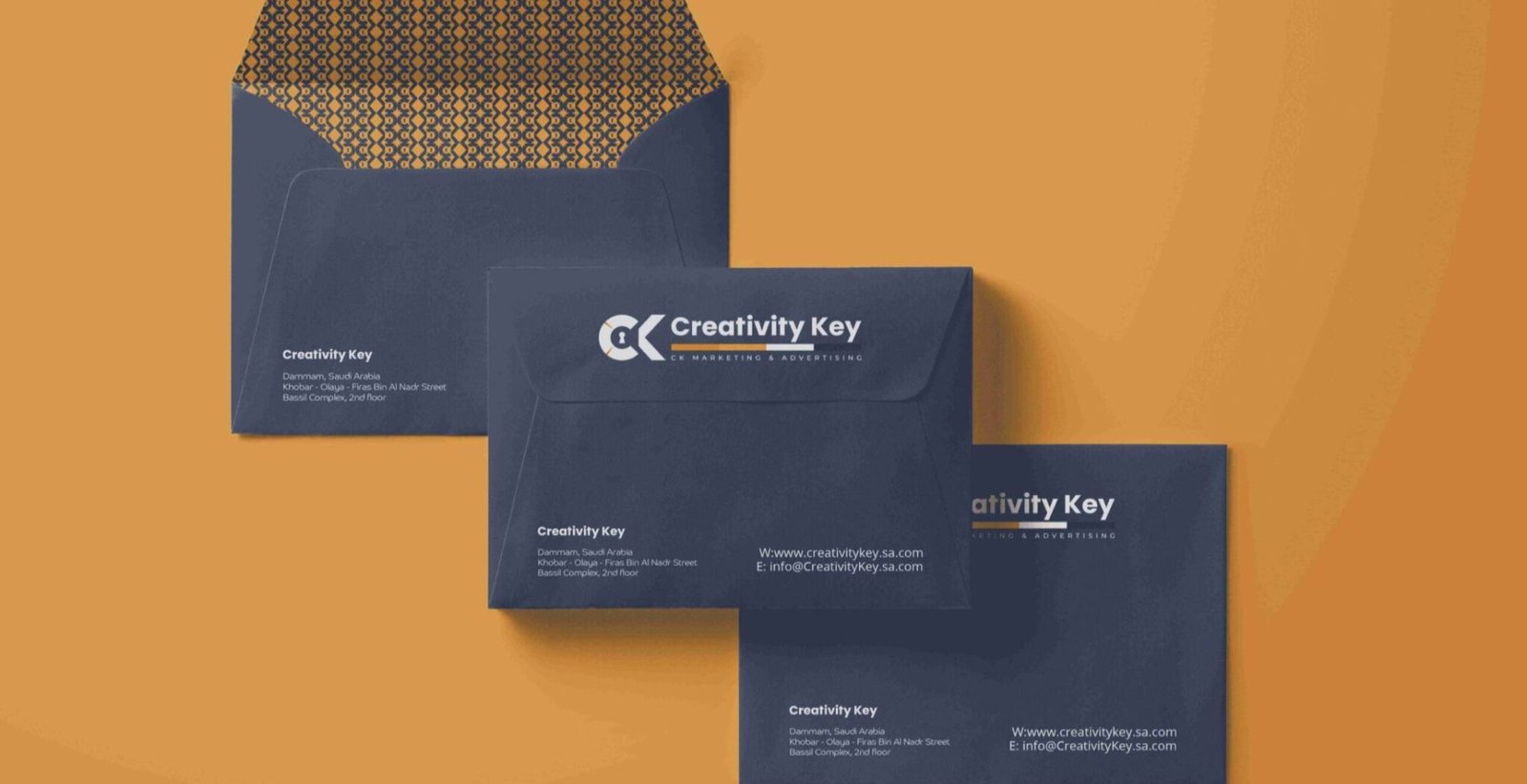
For example, in our Creativity Key work, brochures were designed as part of the company’s business cards and stationery, so every item followed the same identity.
The digital version
A PDF brochure can do more than a physical one, if it is prepared properly. Google can index PDF files (Google Search Central), so use real text rather than images of text, give the file a clear name and title, and also publish the key content on a web page. Adobe’s guidance on accessible PDFs covers tags, reading order, alternative text for images and setting the document language (Adobe Acrobat Help). Keep the file small enough to send by WhatsApp and email.
Files to receive and the final check
- Editable source files and the fonts’ licence details.
- A production-ready PDF for the fabrication partner, and a lighter digital PDF.
- Each language edition, clearly named.
- Photos and graphics used, with the rights to use them.
Before production, check a physical proof against the approved file: colours, folds, the QR code, phone numbers and spelling in both languages.
What to do next
- Write the brochure’s single purpose and reader in one sentence.
- Choose the format from where the brochure will really be used.
- Gather proof: projects, certificates and photos you are allowed to show.
- Decide between two language editions and a flip brochure.
If you are not sure whether you need a brochure, a profile or a catalogue, a paid Business Diagnosis session helps you choose. Design is covered by our Brand Identity and Positioning service, and product brochures by our Distributor and Product Marketing service.
Frequently asked questions
What should a company brochure include?
A cover that names the offer or problem, a short introduction, the service or products, proof such as projects and certificates, how the service works, and one clear next step with contact details and a QR code.
What is the difference between a brochure and a company profile?
A brochure introduces one service, product line or offer in a few pages and leads to contact. A company profile is longer and proves who the company is, with capabilities, projects and certificates.
Should a brochure be in Arabic and English together?
For short handouts, a flip brochure with Arabic from one side and English from the other works well. For longer documents, two separate editions are easier to read than both languages on every page.
What size should a brochure be?
A4 suits meetings and folders, A5 is easier to carry at exhibitions, and bi-fold or tri-fold sheets suit single services or product lines. Choose by where the brochure will be used.
- International Organization for Standardization, ISO 216:2007 Writing paper and certain classes of printed matter — Trimmed sizes — A and B series (2007-09).
- Google Search Central, File types indexable by Google.
- Adobe Acrobat Help, Create and verify PDF accessibility.