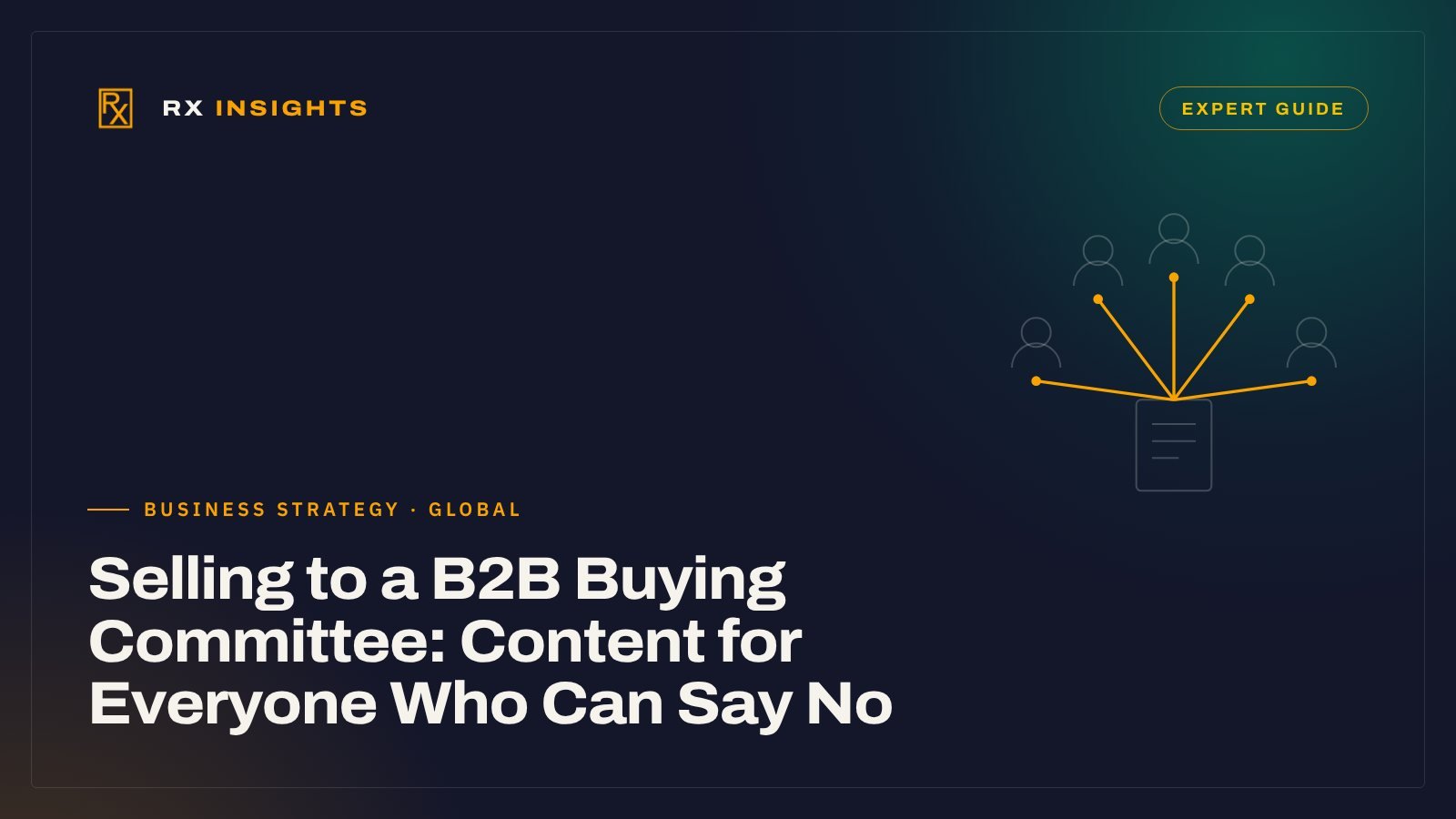
- Gartner puts the typical buying group for a complex B2B solution at six to 10 decision makers; the popular '13 stakeholders' figure is hard to trace to a primary source.
- Gartner says buyers spend only about 17% of their buying time meeting potential suppliers, so your documents carry much of the selling.
- Map roles, not titles: user, technical evaluator, finance, procurement and final approver each need a different asset.
- Gartner found buyers 2.8 times more likely to complete a high-quality deal when website and sales-rep information is consistent.
Picture a sales director in Riyadh who closes a strong meeting with an operations manager who loves the product. Three weeks later the deal is “on hold”. Nobody objected in the room. The objection came later, from people the supplier never met: the finance manager who could not see the payback, the consultant who wanted a test certificate, the procurement officer whose vendor file was incomplete, and the general manager who was never given a one-page reason to say yes.
That is a common shape for a B2B purchase, not an exception. This guide shows how to map everyone in a B2B buying committee to the specific content that answers their question, using Gartner’s primary research rather than the recycled statistics that dominate this topic.
What the research actually says about buying groups
Much of what is written about buying committees repeats figures that are hard to trace to a primary source. The most common one, “13 stakeholders in a typical enterprise deal”, circulates widely in blogs and social posts, usually without a report title, a date or a description of who was counted. We could not find a primary study behind it as a general average. An automated fact-check by Lenz (August 2026) reached a similar view, rating the claim mostly false and noting that the repeated citations summarise each other rather than confirm it; treat that as a pointer, not as proof. The safer habit is to treat any round number without a report title and date with caution, including in your own sales decks.
Here is what Gartner publishes on its own pages and reports:
- Group size. Gartner’s B2B buying journey page says the typical buying group for a complex B2B solution involves six to 10 decision makers. Its B2B Buying Report, based on the 2022 Gartner B2B Buyer Survey, puts the average enterprise buying group at five to 11 stakeholders representing an average of five business functions.
- Time with suppliers. The same page says that buyers considering a purchase spend only about 17% of their buying time meeting potential suppliers and, when several suppliers are compared, perhaps only 5% or 6% of their time with any one sales rep.
- Decisions get reopened. On its buyer enablement page, Gartner reports that 95% of buying groups go back and revisit decisions at least once as new information emerges, and that in a survey of more than 250 B2B customers, 77% rated their purchase experience as extremely complex or difficult.
- Helpful information pays. The same page says customers who receive information they find helpful for advancing the purchase are three times more likely to buy a bigger deal with less regret.
Our reading of these figures: many of the people who decide will never sit in your meeting, and much of the deciding happens while you are not there. Your content has to do the selling in the rooms you are not in.
The six buying jobs, and why they matter more than “stages”
Gartner describes six buying jobs that a group must complete. They are not a straight funnel; groups move back and forth between them, which is why decisions get revisited.
| Buying job | The group’s question (Gartner’s wording) | Where it often stalls (our view) |
|---|---|---|
| Problem identification | “We need to do something.” | The cost of doing nothing is not quantified |
| Solution exploration | “What’s out there to solve our problem?” | Supplier websites describe products, not problems |
| Requirements building | “What exactly do we need the purchase to do?” | Each function writes its own list |
| Supplier selection | “Does this do what we want it to do?” | Specifications are hard to compare like for like |
| Validation | “We think we know the right answer, but we need to be sure.” | No references, certificates or proof at hand |
| Consensus creation | “We need to get everyone on board.” | The champion cannot explain the choice to others |
In our view, the last two jobs are where many “on hold” deals stall. The champion who likes you has to resell your offer internally, in your absence, to people with different priorities. If you have given them nothing they can forward, they will forward your price and little else.
Who can say no: five roles and the question each one asks
Job titles vary by company, and one person may play two roles in a smaller business. Map roles, not titles.
1. The user or operations lead
Asks: Will this work in our daily reality, and will it make my job harder? This is often your first contact and your likely champion. They need practical proof: how installation, training, delivery or service works, what changes for their team, and who they call when something goes wrong.
2. The technical evaluator
Asks: Does it meet the specification and the standards we are accountable for? In engineering, contracting and safety purchases this may be an in-house engineer or an external consultant who must approve materials before an order is placed. They want data sheets, certificates, compliance statements and comparison against the specification, in a format they can file. Marketing language tends to make them suspicious.
3. Finance
Asks: What does it really cost over its life, and when do we get the money back? They are unlikely to read a 30-page proposal closely; what they usually look for is the commercial summary: total cost, payment terms, what is included and excluded, running and maintenance costs, and the cost of the current problem.
4. Procurement
Asks: Is this supplier registered, compliant and comparable with the alternatives? Procurement protects the process. They need a complete vendor file, a quotation structured like the others they received, clear validity and delivery terms, and no surprises in the fine print. A missing document can remove you from a shortlist no matter how strong the solution; for Saudi buyers, the vendor registration document pack lists what large buyers usually request.
5. The final approver
Asks: Is this the right decision, and will I regret it? The general manager, CEO or board member wants the business case in one page: the problem, the recommended option, the main risk and how it is controlled, and why this supplier. They also judge credibility quickly, from how the company looks and how consistent its documents are.
The stakeholder-to-asset matrix
Use this as a working sheet. For each live deal, mark which assets the buying group has actually received, and from whom.
| Role | Primary asset | Supporting asset | Buying job it serves |
|---|---|---|---|
| User / operations | Solution overview with “how it works here” steps | Short demo or installation video; service and support summary | Solution exploration, requirements |
| Technical evaluator | Technical data sheet and compliance statement against the specification | Certificates, test reports, approved-materials submittal pack | Supplier selection, validation |
| Finance | One-page commercial summary and cost-of-ownership view | Payment-terms options; cost of the current problem | Requirements, consensus |
| Procurement | Structured quotation with inclusions, exclusions, validity | Vendor registration file; company profile | Supplier selection |
| Final approver | One-page business case the champion can forward | Comparable project references; company profile | Validation, consensus |
| The whole group | A shared “decision summary” document | Consistent website pages for each service or product | Consensus creation |
Two rows deserve extra attention. The proposal is not one document for everyone; it is a pack with sections each role can find quickly. If the line between proposal and quotation is blurred in your company, our guide to proposals and quotations sets out what each one should contain. The references should match the approver’s situation: same industry, similar scale, a named contact who agreed to be referenced. Generic logo walls rarely answer “will I regret it?”
Consistency is part of the content
Gartner’s buying report found that buyers are 2.8 times more likely to complete a high-quality deal when they perceive high information consistency between a supplier’s website and its sales representatives. In committee sales it is likely to matter even more, because each stakeholder sees a different fragment of you: the engineer downloads a data sheet, finance receives a PDF on WhatsApp, the approver glances at the website before a meeting.
Common inconsistencies that quietly cost deals:
- The website lists a product range or capability that the proposal does not mention, or the reverse.
- Specifications differ between the catalogue, the data sheet and the quotation.
- The company profile looks years older than the proposal, or uses a different logo version.
- Arabic and English versions of the same document say different things.
- Sales reps build their own slides, so two reps describe the same offer differently.
The same report notes that 75% of B2B buyers surveyed said they prefer a rep-free sales experience, yet buyers who made a digital self-service purchase were more likely to regret it than rep-led buyers, and buyers who used supplier digital tools together with a rep were 1.8 times more likely to complete a high-quality deal than those who used the tools on their own. Our reading is not that you should remove salespeople; it is to make sure the material buyers consume on their own says exactly what your people say. If your reps already build their own slides, start with why sales teams ignore the marketing materials.
How to build the pack: a six-step working method
- List your last ten won and lost deals. For each, write down who was involved on the buyer side, by role, and where the deal slowed. Patterns tend to appear quickly; often one role accounts for most of the stalls.
- Write each role’s top three questions. Ask your sales team, your technical staff and, where possible, friendly clients. Keep the questions in the buyer’s words, in Arabic and English if you sell in both; they become the core of your sales messaging playbook.
- Audit what you already have. Map existing documents to the matrix above. Many companies find they have plenty for the technical evaluator and almost nothing for finance or the approver.
- Fill the gaps with short, forwardable assets. One page beats ten for finance and the approver. Each asset should make sense without a salesperson explaining it, because it will be read when no salesperson is present.
- Put the pack in one controlled place. One current version of every document, one design system, one set of numbers. The website should hold the public version of the same story.
- Teach the champion to sell internally. Ask your contact directly: “Who else needs to agree, and what will they ask?” Then send the right asset for each person, not the whole folder.
For example, a distributor of building materials might find that its lost deals rarely stalled with engineers, who were satisfied by the data sheets, but often stalled after the price reached finance with no explanation of lifetime cost. The fix there is not more technical content; it is a single commercial page that travels with every quotation.
This is the kind of work our sales enablement team does: building the proposal content, sales messaging and pre-qualification files a buying group needs, under one consistent identity. For a new brand entering a market, the same thinking applies from day one, as in the GCS market entry in Saudi Arabia, where a new fire-safety brand needed its identity, launch and sales tools to be credible from the start.
Signals that your content is failing the committee
- Deals go quiet after a positive first meeting, and the reason given is “internal discussion”.
- Buyers ask for the same document twice, or ask for a version “for my manager”.
- Your champion forwards your price but not your proposal.
- Procurement returns your quotation asking for it in a different format.
- Technical approval takes longer than the commercial negotiation.
- Your salespeople cannot name who signs the purchase order on their open deals.
Each of these points to a specific role in the matrix that has not been served. Fix the role, not the whole funnel.
Frequently asked questions
How many people are in a typical B2B buying committee?
Gartner says the typical buying group for a complex B2B solution involves six to 10 decision makers, and its B2B Buying Report, based on a 2022 buyer survey, puts the average enterprise group at five to 11 stakeholders from about five business functions. Smaller companies may have fewer people, with one person covering several roles.
Is it true that B2B deals involve 13 stakeholders on average?
The figure is widely repeated but we could not trace it to a primary study as a general average, and an automated fact-check by Lenz rated it mostly false. Gartner's published ranges of six to 10 decision makers, or five to 11 stakeholders for enterprise groups, are the stronger figures to cite.
What are Gartner's six B2B buying jobs?
Problem identification, solution exploration, requirements building, supplier selection, validation and consensus creation. Buying groups move back and forth between them rather than in a straight line.
Which stakeholder is most often under-served by supplier content?
In our view it is often finance and the final approver. Suppliers tend to produce plenty of technical material but rarely a one-page commercial summary or business case the champion can forward internally.
- Gartner, The B2B Buying Journey (undated).
- Gartner, Gartner B2B Buying Report: How to adapt your sales and marketing strategies to the current state of B2B buying (2023).
- Gartner, Buyer Enablement (undated).
- Lenz, Fact-check: a typical enterprise B2B purchase involves an average of 13 stakeholders (automated fact-check, secondary source) (2026-08-03).